

I have to admit: the older I get, the more ambivalent I become with the climate COPs.
There are the dizzying acronyms and word salads (the SSJW, anyone?) and the seeming-incoherence between what happens at COP and outside: the glacial pace of pledges, commitments, and actual actions, versus the terrifying speed with which we’re already witnessing impacts.
Still, it’s a good opportunity to remind ourselves of the intricate links between food, climate, and health systems. So I dug up some new - and not so new - reports that sound interesting, plus a brilliant new investigation by my colleague Beatriz and team.
Meanwhile, France is accusing Iran of being behind the supermarket cyberattacks (oh, dear) and Berkeley voters passed a higher soda tax by a large margin (yay, and see Marion Nestle’s write-up for more).
I’m on the road again so skipping Thin’s Pickings this week. Besides, this issue is a bit like a supersized Thin’s Pickings anyway.

⅓
The portion of Brazilian municipalities that found banned pesticides in their water after running tests between 2023 and 2026.
Of these, 28% found traces of paraquat, “an aggressive herbicide that is popular among farmers but also so toxic ingesting a capful can kill a person”, according to The Poison Pipeline, a months-long investigation by my colleagues at Lighthouse Reports together with Bloomberg and Repórter Brasil.
Paraquat is one of five chemicals banned by Brazil’s health regulator since 2011 for their impacts on human health, but that has not stopped the hazardous materials entering the agricultural superpower, which also happens to be the world’s largest pesticides market.
“Almost 60% of tests from the agricultural state of Sao Paulo detected at least one of the five outlawed chemicals,” reported Bloomberg (paywall). “None of the compounds are the type that accumulate in the environment and linger for decades,” it added.
In fact, paraquat disappears from surface water within months. This means the banned pesticide is still being used regularly. The article points its finger at smuggling from neighbouring countries, particularly Paraguay, but for me, the issue goes beyond just smuggled - or counterfeit - pesticides. See previous issue: Our Chemical Romances.
The impacts of our food systems’ addiction to these toxic products can be devastating: Brazilian medical professionals told the reporters “they’re seeing a troubling number of Parkinson’s cases among younger patients from rural areas”.
This includes people like Terezinha Junglos (meaning Little Teresa), a 58-year-old grandmother and tobacco farmer who has been working in the fields since she was seven.
“Every village in the valley had its own pesticide salesman, a man they called the instructor, who told them what to spray and when but never how to take the proper care. “It all came inside cardboard boxes,” said her husband Evaldo Junglos, 72. “Everything without labels.””
The products they used include a teal-colored herbicide made with paraquat by Syngenta to kill weeds, and an insecticide produced by FMC that came as thick-grained, deep purple granules.
Terezinha started developing Parkinson’s symptoms in her 30s: stiff joints, chest pains, trembling hands, lost appetite, and exhaustion. There are now three people who are diagnosed with the disease in her family, including Terezinha.
Common beliefs that Parkinson’s is an old person’s disease and that it is caused by genetics is not true, Ray Dorsey, neurologist, director of the Center for the Brain and the Environment at the Atria Health and Research Institute in New York, and author of Ending Parkinson’s Disease, told the reporters.
“Dorsey said study after study shows the trigger is often pesticides. “I get pissed off,” he said, “because I think it’s largely a man-made disease.””

$11 Trillion
The estimated cost of the super El Niño to the global economy, which could have long-lasting consequences on food security.
This includes direct impacts on agriculture, the impacts on infrastructure and wider economies, and their ripple effects through food and commodity prices, and cumulative impacts on demand and trade, said a new analysis by the International Fund for Agricultural Development (IFAD) and Türkiye Ministry of Agriculture and Forestry.
Launched at COP31, Food Systems Under Stress: Building Resilience from the First Mile identifies El Niño as one of many overlapping climate and economic shocks hitting small-scale food producers and rural economies, many of which are already suffering from rising global energy and fertiliser prices caused by the Strait of Hormuz crisis and bad policies.
According to the report, diesel supplies nearly three-quarters of the energy used for irrigation pumping, and to me, this is also why many are saying our food systems must decouple from fossil fuels and derivative products.
“When a drought coincides with an oil price increase, water demand rises just as pumping oil becomes more expensive. Indirect effects unfold at the same time: logistics and shipping costs increase, output markets shift, credit conditions may tighten and even remittance flows may decline…
“Climate resilience of small-scale producers and food systems is closely tied to input prices: where input and climate shocks compound, small-scale farmers face a high risk of crop failure, with strong implications for food and nutrition security.”
The 2026/2027 El Niño is expected to peak between October 2026 and January 2027, with impacts on producers likely to continue through 2027 and beyond, it said.
But the burden will disproportionately fall on those with fewer resources: women, who often have less secure land rights and less access to credit and farm-level support services, and young people, who are more likely to be landless or renting.
It suggested building resilience through solutions across inputs, markets and finance.
Solutions for inputs include preserving and making better use of the water already available, having access to weather forecasts, and the diversification of fertiliser and energy sources.
To keep markets open despite weather requires good infrastructure, both physical (like good roads) and institutional (like early warning systems), and diversified supply chains.
Meanwhile, savings tools, insurance, and credit availability could ensure farmers can rebound.
What is key is ensuring all three pillars are interlinked, the report said, and gave five case studies of how this bundling has helped countries.
“A household with all three is protected on more fronts at once. A small-scale producer with two pillars is better positioned than one with none, but remains more exposed to future shocks than a household supported by all three. Single-pillar or isolated interventions may raise incomes but often leave the underlying resilience gap unresolved.”
“Smallholders do not experience higher input costs, drought, constrained finance and disrupted markets as separate problems. These pressures interact, with one shock reducing their capacity to absorb the next. Development interventions designed around individual sectors or risks can therefore leave critical points of vulnerability exposed.”

3%
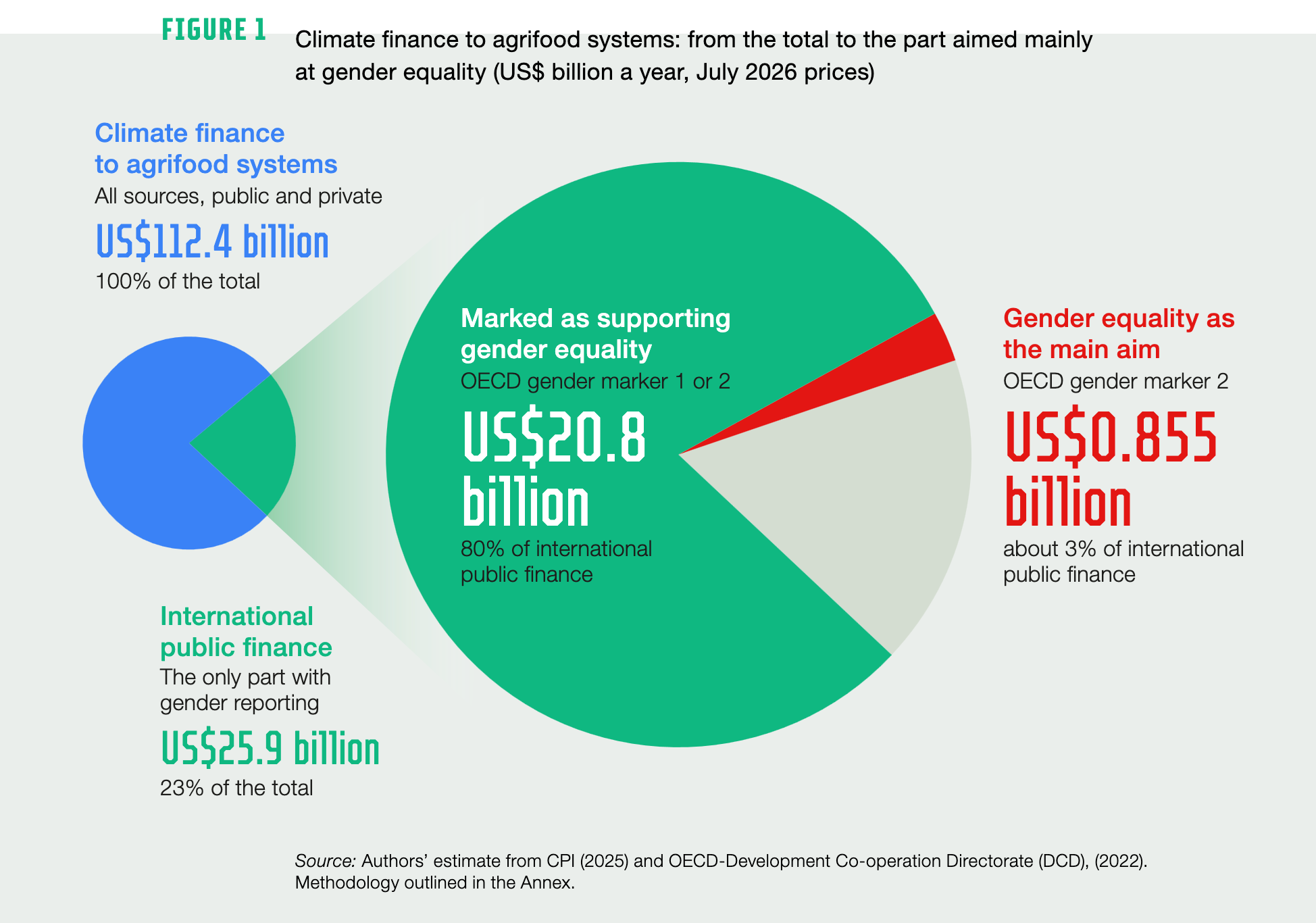
The share of all international public climate finance for agrifood systems that has gender equality as its main objective.
In absolute terms, that is $855 million out of $25.9 billion a year, as per The Unfunded Half - Financing Rural Women’s Resilience: From the Bond Market to the Farm, another COP31-focused report by IFAD, this time with Türkiye Ministry of Agriculture and Forestry.
The rest of the $112 billion, mostly domestic budgets and private investors, reports nothing on gender at all.
To be fair, the report said about 80% of the $25.9 billion pot takes gender into account in some way, but only 3% is designed around women.
Why does this matter?
“When gender equality is the main aim, the money is built around the barriers women face: credit that does not depend on a land title, insurance sold through women’s groups and paid into women’s own accounts, or grants that let women buy equipment they control. When gender is a secondary aim, women may benefit, but the project is often designed for the average farmer, who has the land title, the bank account and the collateral that many women lack.”
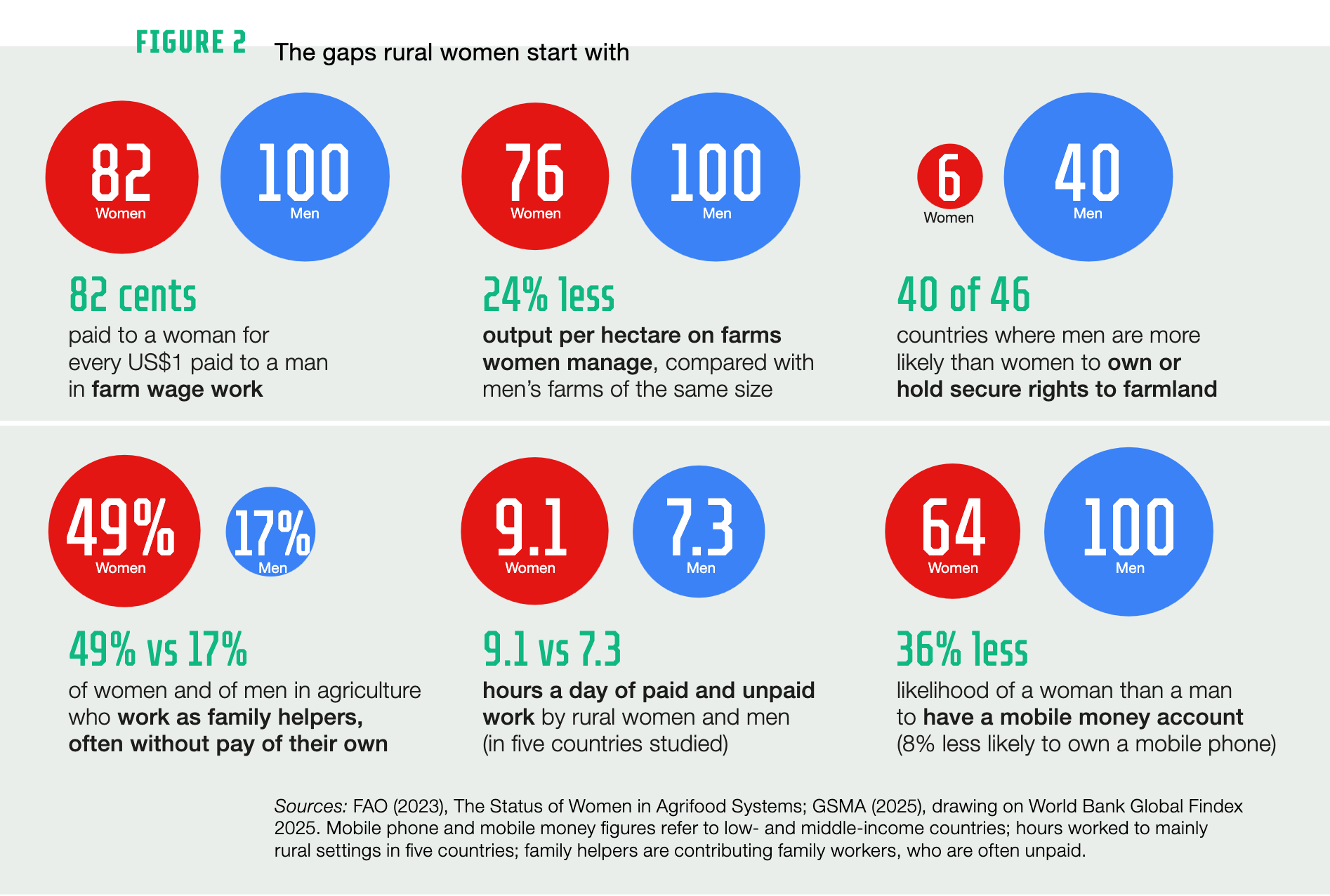
“Women are about four in ten farm workers… Globally, they hold less land, get fewer inputs and earn 82 cents for every dollar paid to men in farm wage work,”, the report said.
“Lenders tend to see women as costly to serve, yet the evidence suggests that they are reliable borrowers and that money lent to them also helps their farms and families adapt.”
In many countries, farming is also the only work on offer for many women, according to the report: in Southern Asia 71% of working women are employed in food systems, against 47% of men, and in sub-Saharan Africa the shares are 66% and 60%, respectively.
Yet, much of this work is often unpaid, many have no land title, and even the much-touted mobile money accounts that are bringing banking to rural areas reach fewer women, it added. They are also more affected by climate-related events such as heat stress, drought, and floods, an FAO report showed.
See my interview with Piedad Martín, Deputy Director of FAO’s Office of Climate Change, Biodiversity and Environment.
Evidence suggests that when women have more say over money and over what to invest in, they are more likely to take up and keep farming practices that withstand climate shocks.
However, current green bonds and similar financial instruments “mostly fund emission cuts” on energy, buildings, and transport.
So IFAD says it is launching the first global adaptation bond exclusively focused on rural communities. At $70 million, it is much less than what the world needs - the UN Environmental Programme estimates over $300 billion a year is needed - but it is a start.
1.47° Celsius
How much above the pre-industrial average we currently are, based on the global average surface temperature recorded between January to September this year.
This figure is likely to be higher by the end of the year because of the warming effect of El Niño, according to the World Meteorological Organization’s State of the Climate Update 2026 which also said “the past 12 years have individually been the warmest on record, with the past four years being the top four”.
Reminder: a key goal of the Paris Agreement was to try and limit warming to 1.5° C above pre-industrial levels. Also, full disclosure: I didn’t read the full report.
Sea level is the highest on record, sea-surface temperatures hit monthly records during 2026, and freshwater storage is dwindling, no thanks to glaciers’ continued retreat.
“The annual mass loss of ice in 2025 would have filled five Olympic pools every second of the year.”
This has implications for local and downstream geohazards, ecology, regional water resources and water quality.
“The current El Niño is expected to act as a risk multiplier for health. Increased heat, drought and heavy rainfall can contribute to heat-related illness and mortality, wildfire smoke and poor air quality, malnutrition and food insecurity, injuries, and changing risks of water- and vector-borne diseases such as cholera, malaria and dengue.”
And apparently, El Niño typically has the greatest impact on global average temperatures in the year after its development and the World Health Organization (WHO) has, for the first time, classified El Niño’s anticipated health impacts as a health emergency.
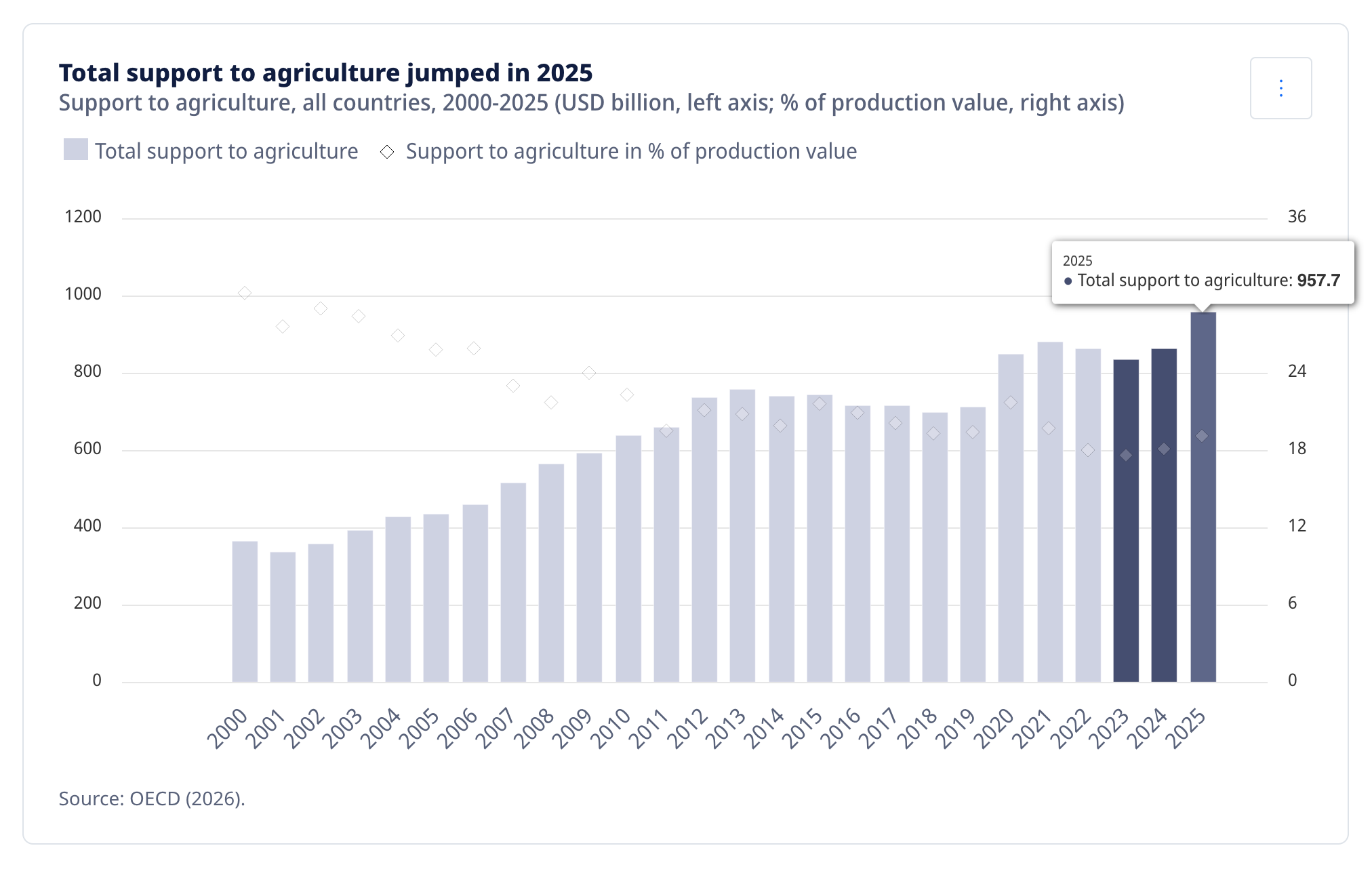
$957.7 billion
The amount governments spent in supporting agriculture in 2025
This is a record high, and an increase of nearly 15% (or $121 billion in absolute terms) since 2023, but much of it was “on short-term responses to successive crises rather than strengthening the sector’s resilience to future risks”, said the OECD Agricultural Policy Monitoring and Evaluation 2026. FYI: I focused on the Executive Summary.
While there are valid reasons for the rise in support - global shocks such as the U.S.-Israel war on Iran pushing up prices of inputs - the increase does not necessarily promote better outcomes.
“Public support to agriculture continues to be based largely on policies that alter market prices. Such price-altering policies reduce farmers’ responsiveness to changing production and market conditions.
“Despite longstanding recognition of their distorting effects, these and other policies that incentivise the production of certain commodities or the use of certain inputs continue to account for a large share of total support: in 2023-25, nearly half of all support provided to the sector has come in potentially most distorting forms.”
For example, in Norway and Switzerland, support represents around 50% of gross farm receipts, which means farmer incomes are reliant on such support. In Viet Nam and Argentina, policies depress domestic prices below world price levels, which means farmers lose more than 10% of what they could have earned.
While the type of support differs according to countries, it is often concentrated on a limited number of commodities, and we know this can be a barrier to diversified production and diets.
Despite the increase in dollar terms, public investment in knowledge and innovation systems has actually gone down, to an average of only 0.5% of sector value, roughly half the level observed in 2000‑02.
In addition, a large share of the support - nearly four-fifths - is not linked to specific environmental outcomes, even though food systems account for nearly a third of all man-made greenhouse gas emissions and farming is a major driver of freshwater use and ecosystem loss.
The report pointed to four key priorities for agricultural policy reform:
Target support more effectively by reducing reliance on measures that distort production, prices and trade, while expanding risk-management tools and outcome-oriented instruments.
Reinforce systemic risk management policies to help the agricultural sector anticipate, adapt to and manage future shocks within stable policy frameworks and open international markets, minimising the need for ad-hoc responses to crises.
Invest more in long-term resilience through research, innovation, knowledge, infrastructure and other public goods that support sustainable productivity growth and resilience.
Better align policies with sustainability objectives by strengthening incentives, regulations, and monitoring and evaluation
35 cents
How much farmers get out of every dollar of subsidy.
Practically everyone knows that not only are subsidies distorting prices, they also encourage practices that are harmful for human and planetary health (see The $470 billion problem) and widen the systemic inequalities and power imbalances within our food systems.
The challenge in progressing from just talking about reforming the subsidies to actually doing it is the political economy, said the High-Level Panel for a Just Rural Transition.
“Rather than hoping that evidence and technocratic processes will drive reform, a political economy approach recognises that policy change is inherently political and proposes strategies for change that address political realities. Political economy analysis examines how politics and economics interact to shape outcomes.”
So the group has delivered a report, Unlocking a Just Transition in Public Support to Agriculture, that provides practical steps to push on this issue and overcome vested interests, institutional inertia, unchecked corporate power, and political risk.
It outlined three main pathways to repurpose public support.
Making input subsidies smarter: such as switching from subsidising fertiliser to providing e-vouchers and e-wallets that farmers can use for a spectrum of inputs, making input subsidies greener, or substituting those with ‘smart subsidies’ that reward environmentally-friendly practices.
Pivoting from subsidies to services: such as redirecting funds from direct producer payments towards critical public goods, such as rural roads, electrification, irrigation, seed supply, market development, extension services, and research capacities.
Focusing on poverty reduction: such as moving away from untargeted agricultural production support and towards investment that raises smallholder incomes and resilience, making use of direct cash transfers and school feeding programmes for vulnerable populations.
It also suggested a menu of 10 strategies. Can you spot some in the sentence below?
“The political economy is difficult, but it is not immovable. Reform becomes possible when coalitions are broad, narratives are compelling, farmers are fully engaged, losers are compensated, ministries coordinate, private interests are incentivised and accountable, and transitions are predictable and fair.”
“The prize is not less support for agriculture but smarter support: spending that improves food security, strengthens rural economies, and delivers better value for taxpayers.”

As always, please feel free to share this post and send tips and thoughts on bluesky @thinink.bsky.social, mastodon @ThinInk@journa.host, my LinkedIn page, or via e-mail thin@thin-ink.net.