

I thought I’d become fairly inured to bad news, having been born and raised in Burma/Myanmar and having worked as a journalist covering bad news for nearly 20 years.
Then came the cyberattack on French supermarkets’ refrigeration systems.
I was shocked on many levels: that it hadn’t happened sooner, it is happening now (in the midst of a super El Niño), and it is probably going to result in copycats.
Of course, modern food systems’ heavy reliance on cold chains makes us so vulnerable, and if must require a particularly nihilistic mindset to intentionally attack sources of food.
Then I remembered how long food has been used as a weapon, how it is still being used in places like Gaza, Sudan, my own country, and even in the U.S., and how we have become numb to that news.
Maybe we will finally start treating what’s happening in these faraway places with the horror and urgency they deserve, once we start realising it can happen to us too? One can always hope.
On a not-unrelated note, I moderated a webinar for journalists on Thursday (Oct 15) that sought to answer the question of the day: Why is food so expensive? If you’re a reporter and missed it, but want to know what went down, drop me a line.

For this issue, which coincidentally falls on World Food Day, I’m doing a long-overdue roundup of some of the newest and/or most interesting reports that have come across my desk. If you squint hard enough, you’ll also see there’s a bit of a theme running through them.
It begins with a report that shows us how we can make our food systems fairer, greener, and healthier. Then we go on to look at the many reports that show why we really need to make those changes, and what the implications are if we don’t.
There are many more reports I want to cover than I have time and space for, but if you think I’ve missed some obvious contenders, again, do give me a shout.
Africa’s Case for Agroecology
We know our current food systems are doing little to combat some of the biggest challenges of our time, but these challenges are magnified in Africa.
They include growing levels of hunger and malnutrition (including overweight and obesity), rapidly deteriorating ecosystems and public health caused by the use of pesticides, and the unsustainable costs borne by African governments to support industrial agriculture.
ActionAid’s “Adapt to Thrive” report argues that investing in agroecology is the answer, and it has receipts from 10 countries: Ethiopia, the Gambia, Ghana, Kenya, Malawi, Nigeria, Tanzania, Uganda, Zambia and Zimbabwe.
There is an official description of agroecology and its principles, but I like to describe it as farming with three core elements: it cares for the soil, animals, and biodiversity; promotes food sovereignty; and aims to redress gender, social, and economic inequalities.
Core findings:
After a 1-3-year transition period, agroecology can increase farm profitability, with studies in Kenya indicating an average 37.8% rise in profits.
Yields drop initially - 10% to 35% depending on the state of soils - but bounce back within 3-5 years, and the initial reduction in productivity is somewhat offset by lower input costs.
When yields recover, they are significant: a 41% increase in cereals in Ghana, tripling of pigeon pea and sorghum production in Tanzania and a 100% increase in maize in Zambia.
Agroecological production is 2-4 times more energy efficient, leads to visible improvements in soil health and ecosystems, and provides more diversified incomes and diets.
So what’s the problem?
“Current policy, market and financing structures often favour industrial agriculture, creating barriers to adoption,” the report said.
Our continued - and narrow - focus on yield as a single determinant of food security instead of “multi-dimensional aspects such as nutrition, health and livelihoods” is one big barrier. So are ongoing programmes that subsidise conventional farming. And agroecological production often requires more time and labour, at least initially.
But all these can be addressed, the report says, by tweaking policy and regulatory frameworks, helping agroecological farmers to better access markets while educating consumers about such products, and supporting the development of biological inputs.
There is also a need to build institutional technical and research knowledge on agroecology and boost financing for farmers who want to switch.
“Agroecology is not a niche alternative. It is a practical, scalable and cost-effective pathway to deliver food security, climate resilience, ecological restoration and inclusive economic development across Africa.”
The report adds to a growing body of literature that seeks to debunk the usual argument against agroecology: that there is insufficient research and evidence on its benefits, or that it is not scalable.

Our Toxic Addictions
The need to transition is urgent, because our inability to wean ourselves off synthetic pesticides and fertilisers is costing us trillions of dollars every year in environmental, health, and social damages, said “Toxic Dependency: How Agrochemicals Lock In Food System Vulnerability”.
The report is from the Global Alliance for the Future of Food, which brings together philanthropic foundations working to transform food systems.
This is likely to be a conservative estimate, because while some costs are quantifiable (like an estimated $1.45 trillion in nitrogen pollution costs, another $1.26 trillion from greenhouse gas emissions across the entire food value chain, or $816 billion in toxic exposure, alongside links to cancer, neurological disease, and reproductive harm) many others are not, such as loss of sovereignty and deskilling of farmers.
At the same time, our food systems are also far less resilient to geopolitics and climate shocks, and far more polluting as a result of a system designed to encourage the continued use and abuse of these agrochemicals. This creates a vicious cycle, the report says.
“Degraded soils demand more inputs; health harms are managed downstream through healthcare rather than prevented; and economic pressures narrow farmers’ abilities to exit chemical-intensive pathways.”
Many of us are now fairly fluent in how fossil fuels drove the climate crisis we’re in, but we are less proficient in understanding how far their tentacles go and how embedded they are in our food systems.
This report traces the intertwined - and structural - connections between fossil fuels and food systems through the fertilisers and pesticides, which are derived from the former and used in the latter. I’ve written about is before.


Over the past six decades, our use of agrochemicals has skyrocketed
This was driven in part by our narrow focus on yield, which in turn forces us to prioritise growing a very small set of standardised crops.
“More than half of the world’s nitrogen and 35 percent of the world’s pesticide is used on three primary cereal crops (corn, wheat, and rice).”
Also: “More than half the world’s industrial-scale monocultures dependent on agrochemicals are grown for animal feed or biofuels, not human consumption.”
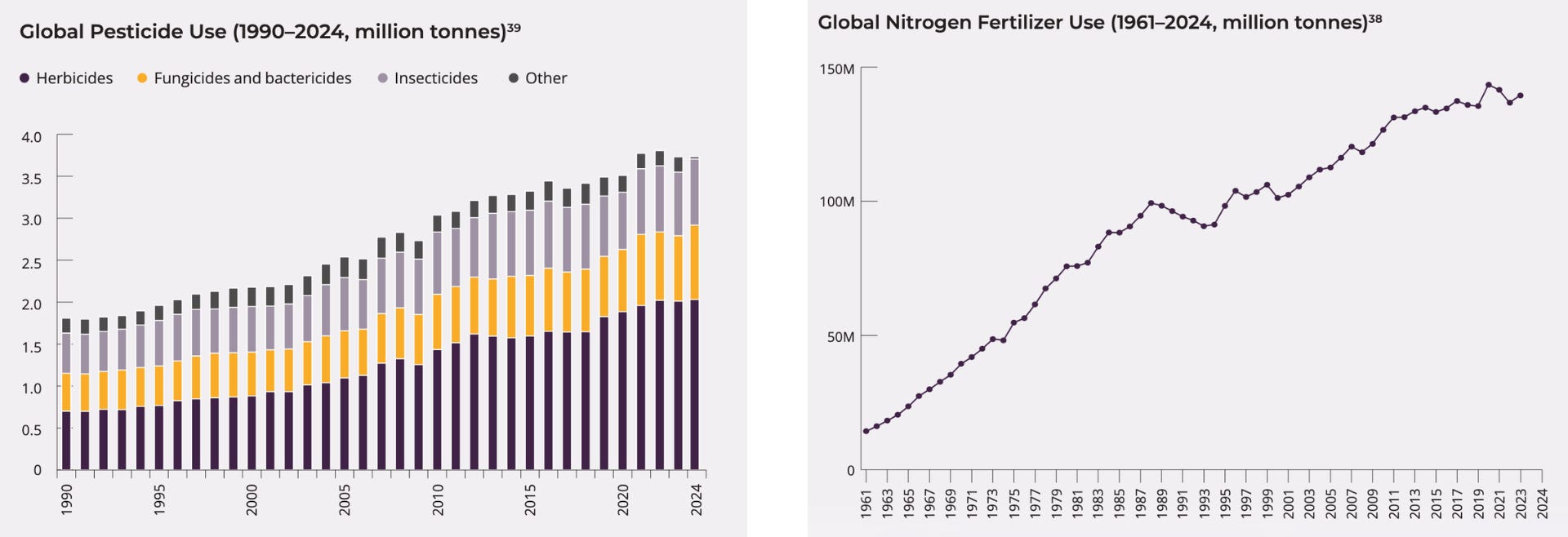
The report also exposes Europe’s hypocrisy: pesticides deemed too harmful to use in the EU are exported elsewhere. This is something we’ve documented extensively at Lighthouse Reports (here and here), but the latest data from the report still jolts me - almost 122,000 tonnes of pesticides banned in the EU were approved for export by member states in 2024.
Of course, our addiction did not come about accidentally.
It was maintained by trillions of dollars in fossil fuel and agricultural subsidies and the outsized power of agrochemical companies in shaping the policy environment, so the report is calling for systemic shifts across policy, funding, and narrative, including repurposing subsidies and phasing out synthetic fertilisers and pesticides.
“We publish this at a moment of acute urgency. A historic fertiliser crisis, driven by the US–Israel war in Iran and the disruption of the Strait of Hormuz, has placed fossil fuel dependence in food systems under an unprecedented spotlight. The vulnerabilities this compendium describes are not abstract or future risks; they are unfolding in real time, now.”
This report is best read alongside three related recent pieces:
A report by the Corporate Europe Observatory sounding the alarm that the EU’s Food & Feed Omnibus will dismantle EU pesticide regulations by, among other things, allowing unlimited approvals (meaning a perpetual, open-ended authorisation that does not expire). This was something both farm lobbies and agrochemical giant Bayer had called for.
A letter by five human rights experts warning that these proposed changes to the Food & Feed Omnibus could harm both human and planetary health, and that the legislative process itself went ahead without properly conducted impact assessments or the participation of affected communities.
A fairly technical but very interesting paper that uses social network analysis to map the ownership and leadership networks behind agrochemical conglomerates BASF, Bayer, Corteva, Dow, DuPont, FMC, COFCO, ChemChina and UPL.

The World’s Most Abusive Employer
Our reliance on toxic products, our lack of care for ecosystems, and our willingness to look away when things become inconvenient all show up in the people who are on the frontlines of our food systems: workers.
This is a large, broad group, encompassing farmworkers, fishers, slaughterhouse staff, as well as delivery drivers, restaurant and supermarket employees, and domestic workers.
“Food systems employ nearly 1.4 billion people – two out of every five workers – making food the largest employer and most abusive sector on the planet,” IPES-Food says in its latest report “Food Work”.
If you think “most abusive sector” is an exaggeration, think again. The exploitation runs the gamut: low pay, wage theft, forced and child labour, informal employment, discrimination, human trafficking, sexual violence, dangerous working conditions, and exclusion from basic labour protections.
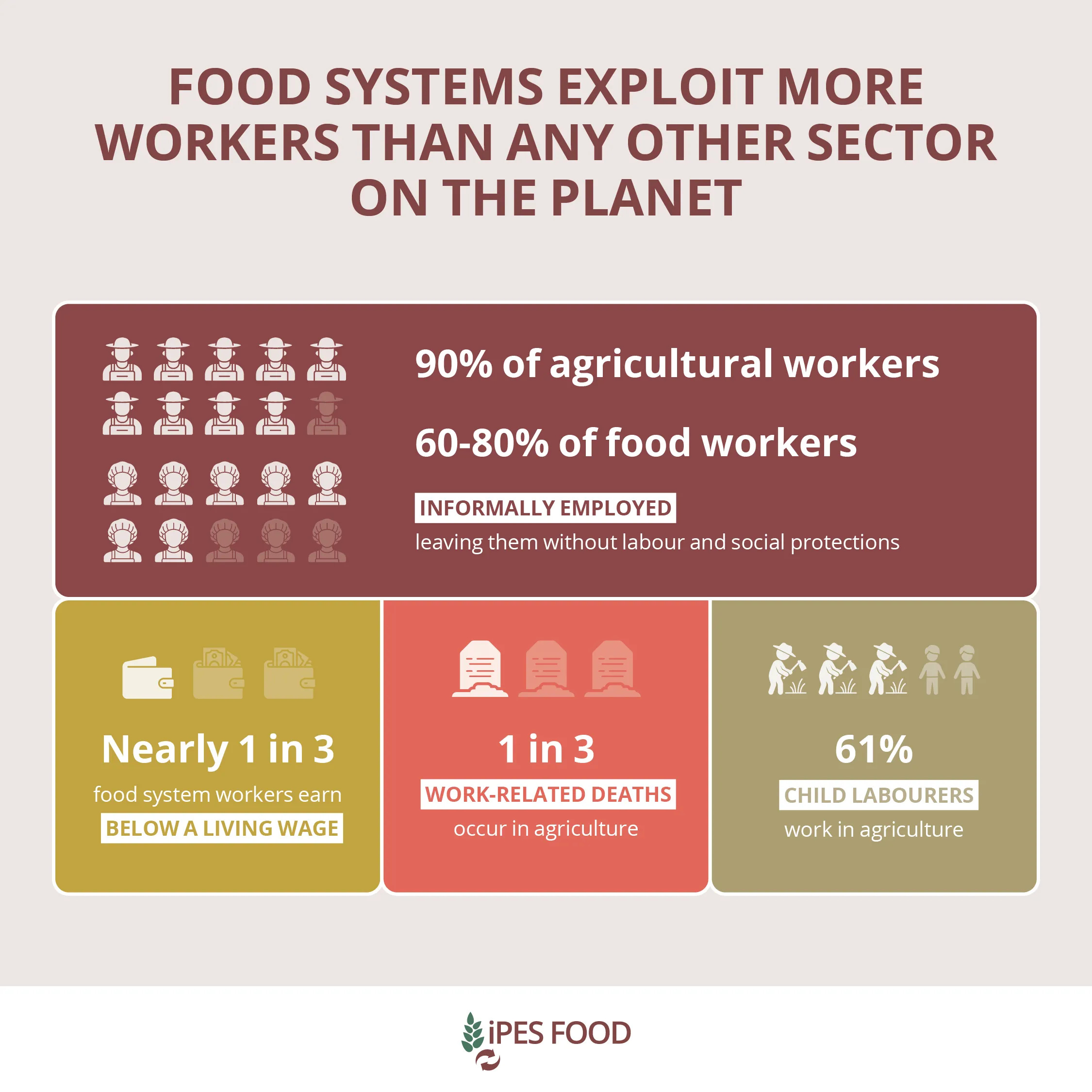
A few shocking global stats:
30% of food system workers – or 416 million people – earn below a living wage and women earn 50% less than men.
Of all workers, farm workers are the most likely to live in poverty and without social safety nets.
Farming and fishing consistently rank among the world’s most dangerous jobs, with agriculture accounting for one-third of all global workplace deaths.
Over one in four fishing workers globally has suffered serious harm on the job in the past two years.
Yet 80% of agricultural workers have never received any workplace safety training, the worst rate of any sector.
In app-based food delivery, riders suffer an estimated 1,000 accidents every day, with the vast majority denied basic workplace injury compensation.
Around 90% of farm employment and 60% to 80% of off-farm jobs worldwide are informal. They often earn less and work outside standard hours.
Migrants make up an estimated quarter of farm workers globally, with significantly higher shares in many countries: over 86% in the United States, 58% in Brunei, and 50% in Italy.
Food and agriculture are also among the sectors with the highest risk of modern slavery (an estimated 2.1 million forced labourers) and the most child labour (83 million).
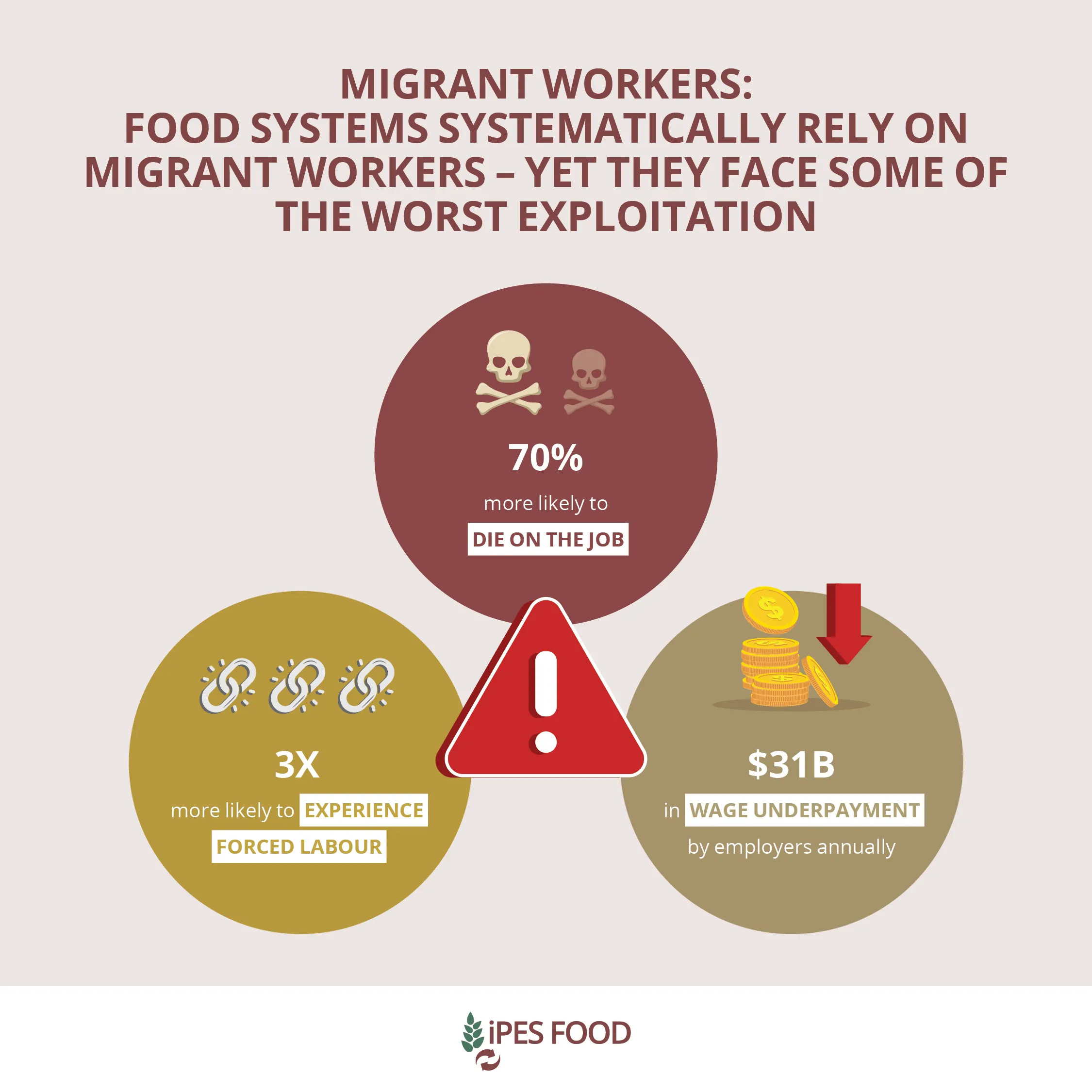
“Governments directly enable this abuse through legal carve-outs that explicitly exempt food and farm workers from basic protections on wages, workplace safety, and union rights,” adding that discrimination against migrant workers is institutionalised in many places despite the critical role they play, the report says.
We saw this happen in real time during COVID-19.
I live in a country where anti-immigrant rhetoric is mainstream politics, yet when pandemic lockdowns threatened to leave no one to harvest the great Mediterranean bounty, the political will for a solution appeared overnight.. Suddenly delivery drivers, slaughterhouse workers, and farm labourers became “essential” in countries all over the world.
The report also identifies three growing forces that are making things worse for the workers.
Climate breakdown: exposing workers to extreme heat, severe weather, toxic wildfire smoke, and growing pesticide use.
Corporate concentration: driving a race to the bottom by suppressing wages, undermining collective bargaining, and shifting risks onto workers.
Digital technologies: creating new frontiers of exploitation through gig-based platform work, automation, algorithmic management, and workplace surveillance.
They are compounding the structural problems of gender, class, and race-based discrimination, restrictive migration policies, and a failure to protect workers’ rights.
“The people who feed the world deserve safe, fairly paid, and dignified work.”
What’s Killing Us?
We know what’s going wrong with our food production and how it’s treating the people who feed us. What about on the consumer side?
Well, this isn’t a neat throughline but I do think some of the problems with our food systems are showing up in the statistics around the causes of our deaths.
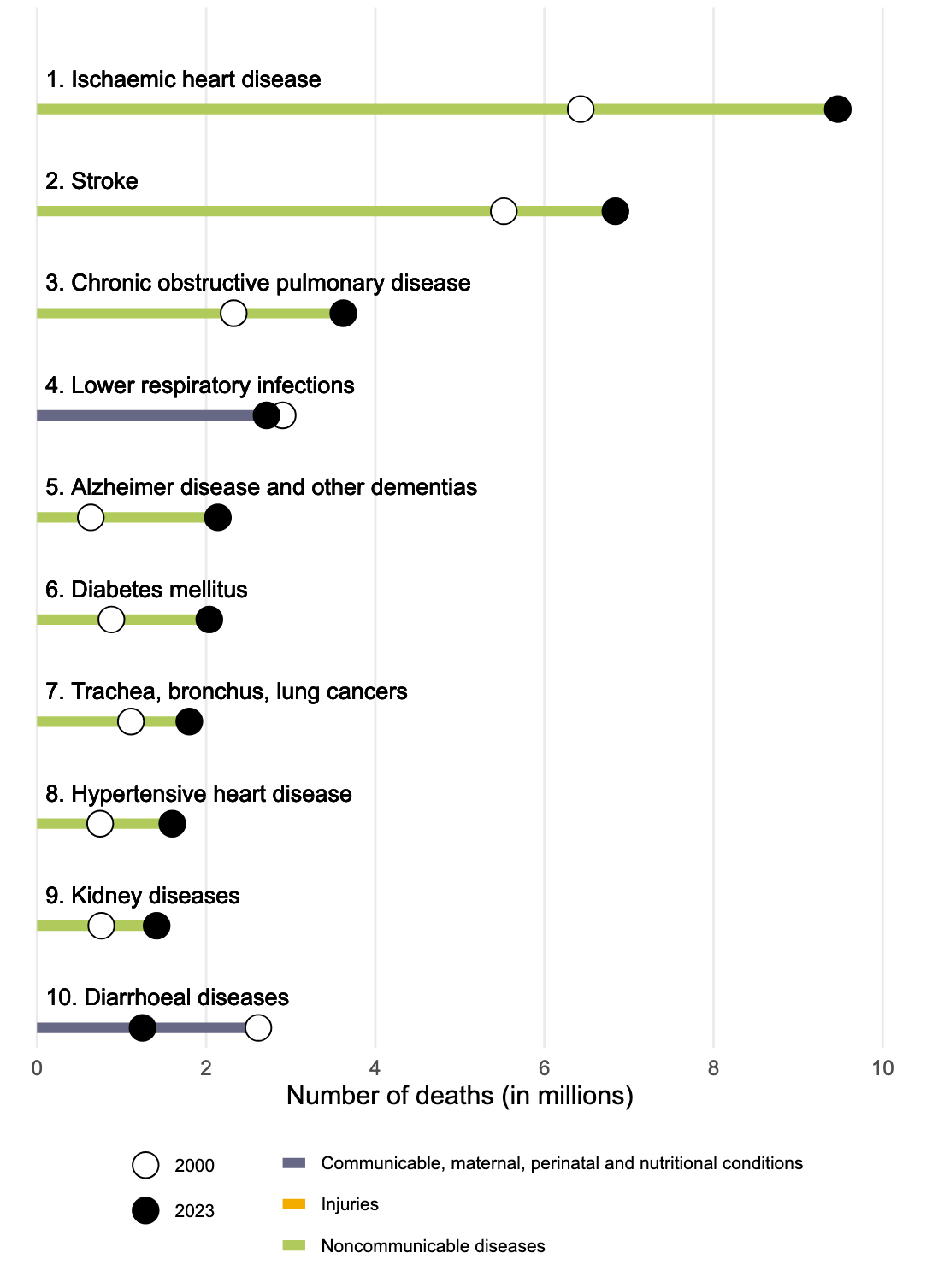
As per the WHO, the top 10 leading causes of death in 2023 accounted for 33 million deaths, or 54% of the total 61 million deaths worldwide.
What’s alarming to me is the breakdown.
Regardless of how you choose to slice and dice it, noncommunicable diseases like stroke, heart disease, diabetes, and cancers are the leading cause of death in all income groups except for the low-income countries.
Even in low-income countries, stroke and ischaemic (coronary) heart disease are the second and third leading causes of death and are rising, while communicable diseases like malaria, diarrhoeal diseases, HIV/AIDS, and tuberculosis have all been going down over the past two decades.
Globally, 8 of the 10 leading causes of death in 2023 were noncommunicable diseases, accounting for 47% of all deaths, or 88% of the top 10 causes.
I am a broken record, but this bears repeating. A lot of these noncommunicable diseases are linked to our diets as well as our built and food environments.
10 Issues Shaping Food Systems
The latest version of the “Critical, emerging and enduring issues for food security and nutrition”, updated every four years by the High Level Panel of Experts (HLPE) on Food Security and Nutrition, came out in August but works well as a last entry and a way to group and focus our attention.
HLPE is part of the Committee on World Food Security (CFS), the world’s most inclusive multistakeholder platform on food, hunger, and nutrition issues that is hosted in Rome at the FAO, the UN food and agriculture agency.
The report identified 10 interconnected issues based on “the scale and severity of their effects on food security and nutrition, their potential to intensify or generate systemic risks, their disproportionate impacts on vulnerable populations, and the scope for coordinated action through CFS”.
Here they are. They’re not in order of priority, and I’ve rewritten them slightly to make them easier to understand.
How to achieve the SDGs after their official deadline - the so-called “post-2030 development agenda” - through food systems transformation that can simultaneously address hunger, malnutrition, inequity, and environmental degradation
How to achieve food security and nutrition in climate crises
How to link food security and nutrition, and the three Rio Conventions: Biodiversity, Desertification and Climate Change
How to predict and prevent hunger and malnutrition at a time of geopolitical uncertainty and polycrises
How to ensure benefits and costs of international trade are distributed fairly, and that trade supports the right to adequate food, health, livelihoods, cultural practices, and environmental sustainability
How corporate concentration in food systems, which has become extreme in some markets, often undermines food security and nutrition
How to tackle concerns and opportunities arising from digital innovations and artificial intelligence
How to adopt a more integrated view of human, animal, plant and environmental health, known as “One Health”, across the UN system
How to ensure the affordability of healthy diets, which are currently out of reach for nearly 1 in 3 people
How to ensure people have true agency to make choices about what they eat, how that food is produced, processed and distributed, and to engage in policy processes that shape food systems
Thin’s Pickings
Informed Climate Journalism Network
This is a new free and online programme from Informed Earth, by the same team that previously ran the hugely successful Oxford Climate Journalism Network. They’re now calling for reporters and editors across the world who are interested in climate reporting to apply for its inaugural, six-month training course which starts in January 2027.
The deadline is November 1, 2026. More information and link to application here.
Fighting our toxic food environment: what can I do? - Food Fight Files
A cracking joint post by Stuart Gillespie, author of Food Fight who appeared in Thin Ink earlier this year, and Julia Belluz, co-author of Food Intelligence whom I’m hoping to have on Thin Ink soon.
“If junk food inundates people everywhere, even the best nutrition advice is going to be impossible to follow. If healthy food is the most expensive and laborious to prepare, eating well becomes a privilege few can afford.”
They provide six tangible and actionable steps people can take, and I’m grateful they mentioned our Big Food vs. The People investigation.
UN experts call on FAO to uphold human rights and protect staff
19 UN special rapporteurs and other rights experts - independent specialists appointed by the UN Human Rights Council - released a statement expressing “dismay” at recent remarks by the head of the FAO “that appear to downplay the role of human rights in the organisation’s work”.
The statement also said the experts are concerned “about the treatment of FAO staff who have engaged on violations of the right to food and of international humanitarian law in the Gaza strip”.
If you want the background to this, read my piece in The New Humanitarian or the Thin Ink issue from two weeks ago.

As always, please feel free to share this post and send tips and thoughts on bluesky @thinink.bsky.social, my LinkedIn page, or via e-mail thin@thin-ink.net.

Great post, as per usual, Thin....and thanks for the shout-out!