

A quote under “Side Effects” was updated on Mar 16, after CIEL alerted me it was from an academic paper. It’s now attributed to that paper.
There have been a lot of great writing about the food systems fallout caused by the U.S.-Israel attack on Iran. Much of it focuses on potential disruptions to fertiliser supplies and what that could mean for global food production.
Instead of retracing the same ground, I thought where I could add value was to step back and offer an explainer about fertilisers themselves, not just the current crisis.
We hear far more about pesticides and their impacts than fertilisers. Yet fertilisers have a fascinating - and often uncomfortable - history shaped by geopolitical exploitation, forced labour, and corporate concentration. Those forces continue to shape the industry today.
Thanks to the Lisa, Lena, and Rasmus, for responding to my queries despite their busy schedules, and to Jennifer, whose work on the history of fertilisers I relied on extensively.
In Myanmar, the agrarian country where I was born and raised, we call fertilisers မြေဩဇာ. We put ဓာတ် (pronounced “dhât” and meaning chemical) in front if it’s synthetic.
The name itself, a portmanteau of two Burmese words, is revealing.
မြေ (“myei”) stands for soil, while ဩဇာ (“aw-za”) refers to influence or power, but not the hard, institutional authority implied by အာဏာ (“are-nar”). Instead, ဩဇာ refers to a quieter kind of power accumulated through wisdom, virtue and respect.
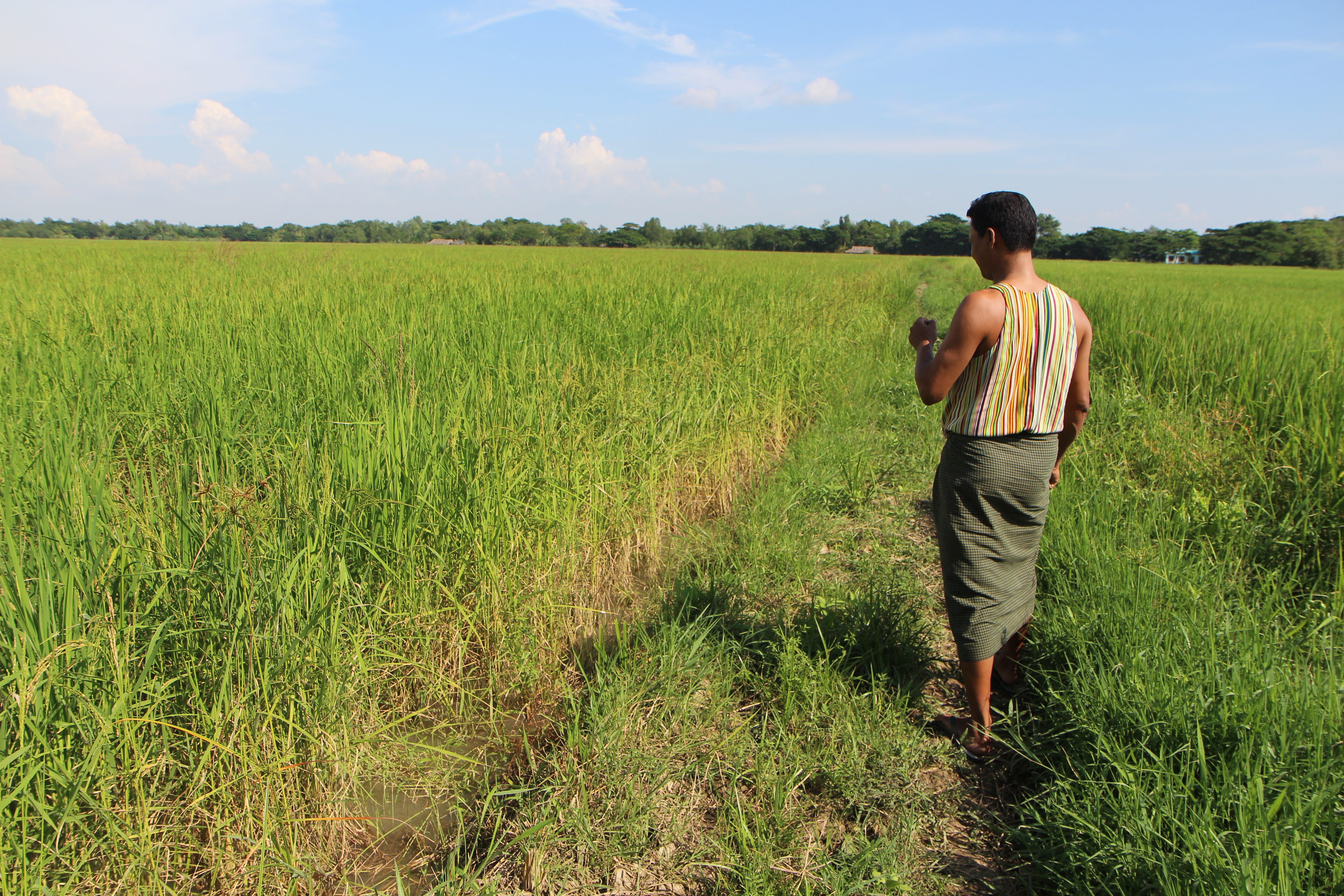
When headlines about fertilisers started filling my news feeds, I thought about that word, the underlying meaning it projects to farmers and ordinary people alike, and a trip I took to the Ayeyarwady delta, Myanmar’s rice bowl, seven years ago.
Lying directly south of former capital Yangon, the delta is where the mighty Ayeyarwady River fans out into a vast web of channels before meeting the sea. It’s criss-crossed by rivers, creeks and tidal waterways, and many villages are accessible only by boat. It’s also home to countless smallholder farmers whose rice feeds much of the nation.
I was there with a team from Proximity Designs that was offering low-cost soil testing services to farmers panicking about plunging yields.
Sitting on wooden floors, I listened to them recount the same story again and again: their once-thriving farms had become less productive and they don’t know why. Government extension services were largely absent, and most relied on advice from input dealers selling fertilisers and pesticides.
“We knew something was wrong, but didn’t know what to do,” rice farmer Win Zaw told me.
When the soil test results came back, the problem became clearer: all the farms had very low organic matter and farmers were applying far more fertilisers than their soils needed, which was costing them a lot of money but with little to no benefit.
Armed with soil analyses showing levels of nitrogen, phosphorus, potassium, acidity and organic matter, the team offered relatively simple advice: retain crop residues after harvest, grow cover crops, and reduce fertiliser use to appropriate levels.
The farmers were relieved to finally understand the problem, but also anxious. Using less fertiliser ran counter to everything they had been told.
That trip left me with two lasting impressions: fertiliser is critical for plant growth but we are often using it badly, and powerful economic forces make changing course difficult.
The History
Many of us have become so used to seeing abundant food we rarely take time to consider what is required for plant growth: light, water, plus three key nutrients (nitrogen (N), potassium (K), and phosphorus (P)). These are also the macronutrients you find in fertilisers.
Concerns about soil fertility date back to the mid-1800s - yes, you read that right! - in Europe and Norther America, helping to spur the rise of the commercial fertiliser industry, Jennifer Clapp wrote in her most recent book.
Early fertilisers included “night soil” - a euphemism for human waste - distributed from urbanised areas to rural ones; bones of animals - and probably humans - ground into powder or burned to ash; and guano, the nitrogen- and phosphorus-rich droppings of seabirds, specifically from the Chincha Islands of Peru.
In the 1840s, foreign companies started extracting guano using African slave labourer and indentured Chinese workers under dirty and smelly conditions, according to Jennifer.
In 1856, the U.S. government even passed the Guano Islands Act, which “legalised and encouraged the appropriation of any unoccupied guano islands by US citizens, so long as they were not already claimed by another government”.
Later in the nineteenth century, phosphate rock deposits were discovered in the U.S., North Africa, and islands in the South Pacific, shifting fertiliser production from bones to mining. The work was as treacherous and exploitative as in the guano mines.
Potassium followed a similar trajectory. Once produced by leaching ashes from burned biomass, the discovery of underground potash deposits in Germany in the 1850s transformed production into a large-scale mining industry.
The Breakthrough
The true revolution for N fertilisers, the most widely used variety, came in 1909, when German chemist Fritz Haber developed a process to convert atmospheric nitrogen into ammonia. The German conglomerate BASF financed Haber’s work, and Carl Bosch, an engineer at the company, found a way to scale it up.
The Haber–Bosch process, as it came to be known, solved a fundamental problem in agriculture: although nitrogen makes up about 78% of Earth’s atmosphere, plants cannot use it in its gaseous form (N₂), whereas ammonia (NH₃) is a form of nitrogen plants can absorb. See this TABLE primer, under “Nitrogen cycle in the Agri-Food System”.
By effectively turning the vast reservoir of atmospheric nitrogen into a usable nutrient for crops, the Haber–Bosch process removed a major limit on agricultural productivity, helped dramatically increase global food production, and became the foundation of modern synthetic fertiliser production.
The two scientists received Nobel prizes in chemistry: Haber in 1918 and Bosch in 1931. In a post last year and an earlier article, Our World in Data hailed them for topping the list of scientists whose innovations saved millions of lives. They estimated that Haber and Bosch saved more than 2 billion lives.
But as Jennifer pointed out in her book and Paul Martin in this 2021 piece, the story is not entirely heroic.
“Haber’s prize… was highly controversial because of his later work developing chemical weapons that Germany deployed during World War I resulting in thousands of deaths,” she wrote.
“Germany’s nitrogen production was so valuable that at the end of World War I, it shipped nitrogen-rich ammonia as part of its reparation payments to the Allies.”
Indeed, the first application of this process wasn’t to end hunger, but to go around the British embargo on guano and ensure Germany’s continued access to nitrate supplies. This allowed the country to continue World War I, according to Paul.
“Together with some other innovations, the Haber-Bosch process has enabled and locked in an agricultural system based on large-scale monocultures and industrial livestock operations (where animals are raised off the land and animal feed is grown elsewhere),” said Lisa Tostado, environmental policy analyst for the Center for International Environmental Law (CIEL).
“This model produces high yields, but also drives deforestation, accelerates methane and nitrous oxide emissions, pollutes waterways and deepens soil and biodiversity loss - making it fundamentally unsustainable.”
The Overuse
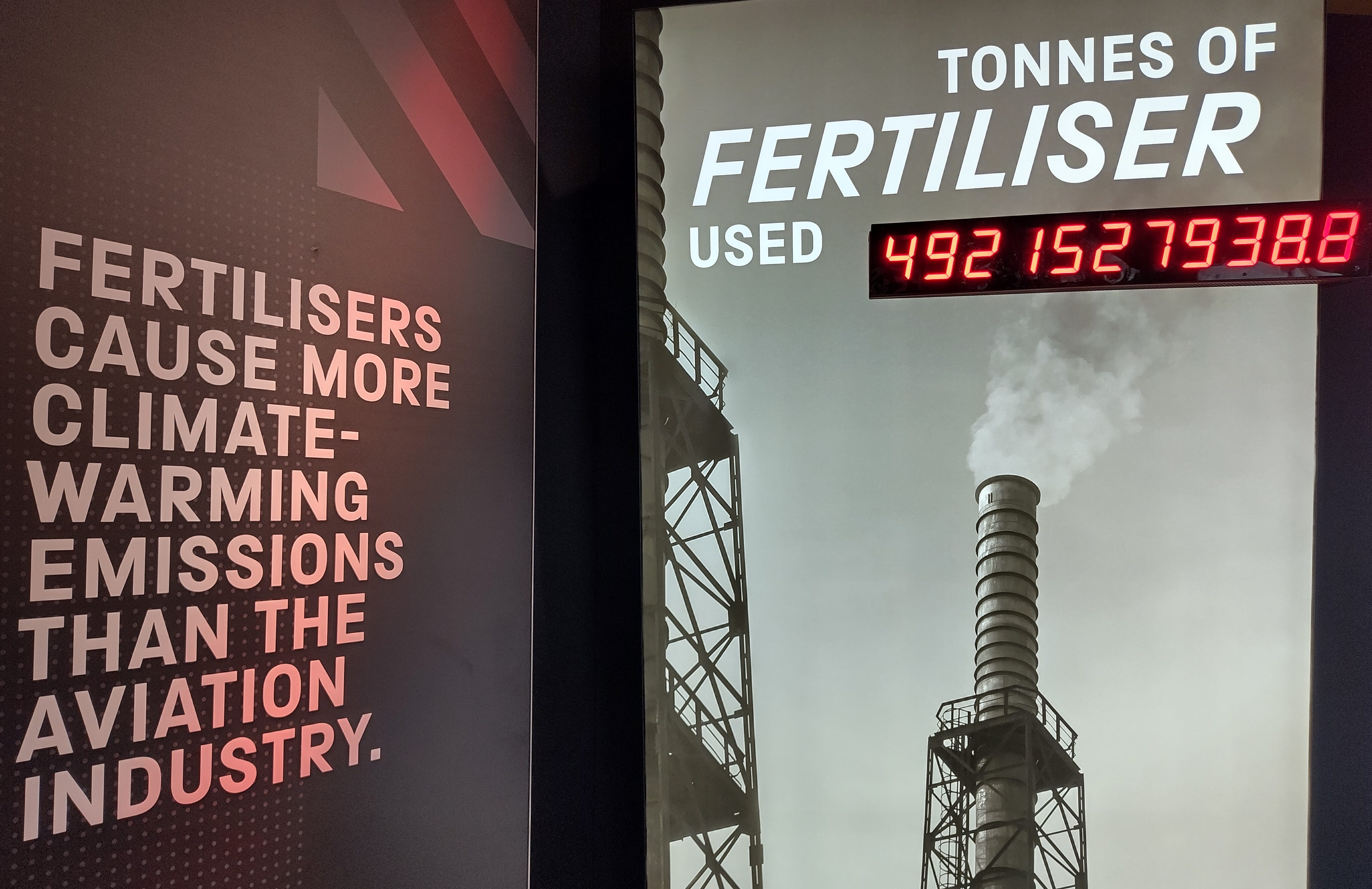
Since synthetic fertilisers became widely available, their use has skyrocketed.
In 1961, global nitrogen fertilisers use and production - usually in the form of ammonia-derived urea or nitrate - was about 13 million tonnes, according to CIEL.
By 1980, that number had jumped to 60 million tonnes and by 2020, had reached 107 million, according to a paper I covered two years ago.
Around half of the world’s crops are now grown with synthetic fertilisers.
Yet, fertiliser efficiency is surprisingly low.
Only 46% of nitrogen and 66% of phosphorous applied as fertiliser are actually taken up by the crops. Translation: more than half of nitrogen fertilisers and a third of phosphorous fertilisers escape instead of helping plants grow.
The Side Effects
Those unused nutrients cause widespread environmental damage.
The nitrogen and phosphorous that weren’t taken up by crops enter freshwater bodies and coastal areas with dire consequences for the environment: they can trigger eutrophication - explosive algae growth that depletes oxygen and creates dead zones..
Nitrogen fertilisers also release nitrous oxide (N₂O), also known as “laughing gas”. It’s the main man-made substance damaging the planet’s protective ozone layer. Also, as a greenhouse gas, N₂O is nearly 300 times more potent than carbon dioxide.
Globally, N₂O emissions have grown 40% between 1980 and 2020, largely due to the increased use of fertilisers.
The European Nitrogen Assessment estimated that nitrogen pollution costs EU Member states €70 - 320 billion per year in health and ecosystem damages.
“Such an amount of magnitude suggests that the social costs of nitrogen fertilisers in Europe now offset a large share of the gains. And that social benefits of reducing nitrogen use would exceed private losses,” according to this 2022 paper.
World Bank said nitrogen today “is a boon and a burden: critical for food production, yet its unbalanced use - worsened by misguided subsidies - is damaging soils, water, and air”.
“Nearly half of the global food supply comes from regions where nitrogen fertiliser does more harm than good to yields,” it added.
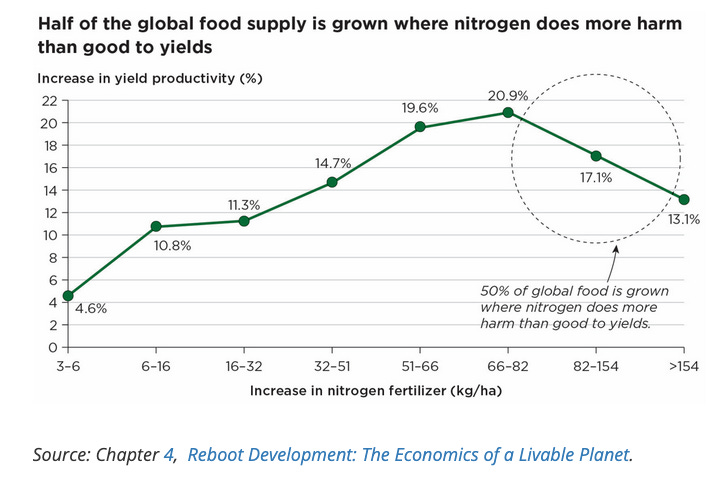
Government policies, particularly subsidies that encourage its overuse are partly responsible, as is a narrow focus on nitrogen at the expense of exploring other nutrient deficiencies and soil acidity that could also limit crop growth, the authors added.
Fertiliser production also carries a heavy climate footprint.
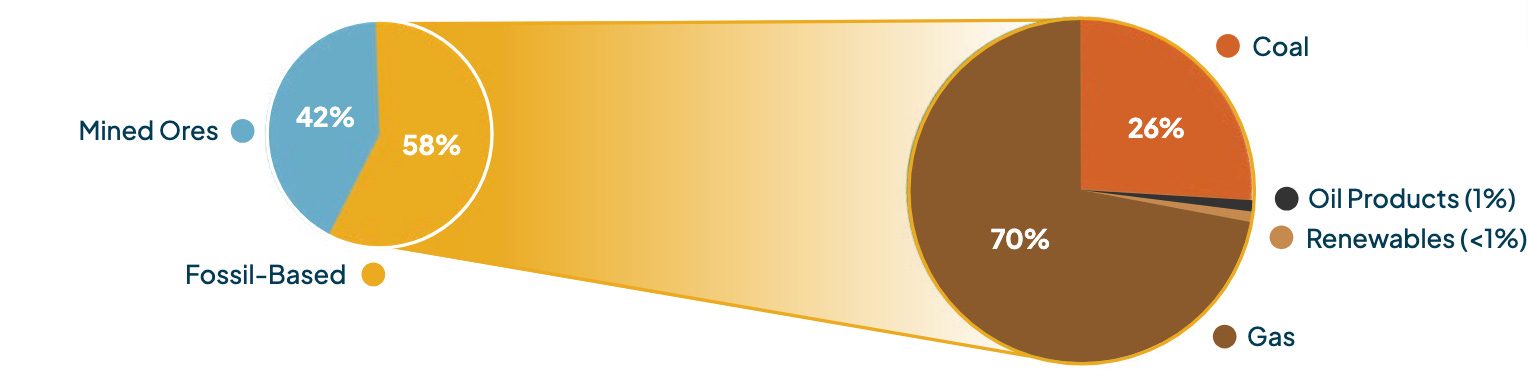
“Fossil fuels power around 58% of global fertiliser production, with mined ores providing feedstock for the rest. Of the fossil share, gas makes up approximately 70%, coal around 26%, and oil roughly 1%. Renewable energy accounts for less than 1%,” said CIEL.
“Synthesising ammonia is highly energy-intensive, requiring substantial heat and pressure, and it accounts for more carbon dioxide emissions than any other industrial chemical reaction. Nitrogen fertilisers alone account for 3-5% of global fossil gas use and more than 2 % of global emissions,” said Lisa.
This rivals commercial aviation, and while renewable ammonia is theoretically possible, current capacity is negligible, she added.
Potassium- and phosphorus-based fertilisers represent a smaller portion of global fertiliser use and do not rely on fossil gas as a raw material but they too have side effects: this beautiful essay traces how the ancient phosphorus cycle that underpins all life is being rapidly destabilised by modern agriculture, pollution, and extraction.
The Concentration
Like many agricultural sectors, fertiliser production is highly concentrated, both in terms of geographical regions and the number of companies involved.
According to GRAIN:
Over 55% of global urea production occurs in just four countries: China, India, Russia and the United States.
China, Russia, Saudi Arabia and Qatar account for 41% of nitrogen fertiliser exports.
70% of world phosphate fertiliser production and 61% of world exports are concentrated in China, Morocco, the U.S. and Russia.
75% of potash fertiliser production comes from Canada, Russia, Belarus and Chin. The first three alone are responsible for 77% of world exports.
The top fertiliser companies tend to be based in the producer countries, and they made a killing during the last food price crisis in 2022.
Globally, the top 10 fertiliser companies controls 39% of the market. Just four companies - Nutrien, Mosaic, ICL and K+S - control roughly half of the global market for potash fertiliser. Pages 24 and 25 of this CIEL report has profiles of some of these companies.
This concentration is not new. From Jennifer’s book: “By 1914, just six large firms dominated the US mixed fertiliser market”.
The Current Crisis
So why are analysis concerned about fertiliser disruptions from the U.S.-Israel attacks on Iran?
“About 27% of the world’s oil exports, 20% of global liquified natural gas (LNG) exports, and 20%-30% of global fertilizer exports, including urea, ammonia, phosphates, and sulfur, pass through the Strait (of Hormuz),” said IFPRI’s Joseph Glauber.
Escalating attacks on shipping have already sharply reduced maritime traffic and driven up insurance costs.
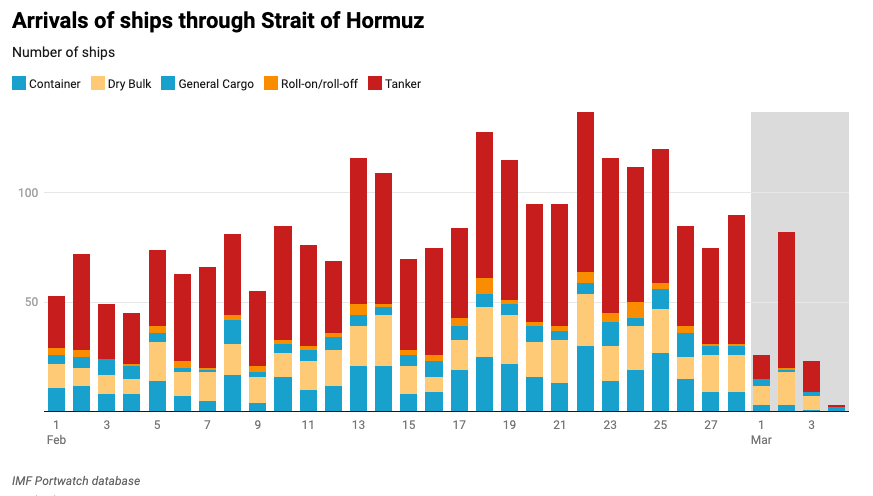
“A prolonged conflict would likely choke global sea trade with the Persian Gulf region, raising the costs of energy and fertiliser prices globally, directly threatening food security in Gulf countries (which depend on imports of grains, oilseeds, and vegetable oils through the Strait of Hormuz), and potentially affecting food production and prices in other regions as well.”
Countries where agriculture is heavily industrialised (North America, Brazil, Central Europe) to places were small-scale farms dominate, like South Asia or parts of Africa, could be in for a shock.
Lena Luig, Head of International Agricultural Policy Division at Germany’s Heinrich Böll Foundation, said subsidies caused small scale farmers on the African continent to become highly dependent on cheap fertilisers, making them as well as whole economies vulnerable to price shocks.
“Eventually low-income households in many countries will lose out when fertiliser prices spike again, as the prices of oil & gas, fertilisers, and food are closely linked and fertiliser prices play a crucial role - besides concentration in the food industry and the retail sector - in pushing food prices.”
Of course, the latest crisis could be exploited by groups already looking for excuses to derail environmental policies. See the third recommendation under Thin’s Pickings in this issue.
It could also lead to more projects banking on the controversial carbon capture and storage (CCS) and related technologies to produce ammonia. CIEL had already pointed out how oil, gas, and agrochemical companies are partnering on these projects (see Page 27 onwards).
“The fertiliser and fossil fuel industries are increasingly collaborating to launder fossil fuels - particularly gas - as an ever-expanding source of both “clean” energy and “clean” agrochemicals. It is neither.”
CIEL’s Lisa said that as long as agriculture continues to be so dependent on fossil inputs, “our food system remains hostage to gas and oil markets and geopolitics”. Slashing our dependence would not only make food production more resilient, but also lead to cleaner air and water, a safer climate and healthier diets.
“Rather than only asking ourselves “How to feed the world?”, we need to be asking “How do we get food to people who need it? In the right quantity and the right quality? How can we ensure fair livelihoods for farmers? How can we produce enough food in a way that protects the planet?”,” she added.
The Alternatives
I want to end on an inspirational note, because it’s important to point out that change is possible.
Successive government subsidies that favour chemical inputs - fertilisers, pesticides, et al - have tied food systems not only to fossil fuels but also to industrial agriculture that tends to prioritise monoculture and neglect smallholder farmers. It has also led to a narrative that equates industrialised food production with food security.
But there are alternatives, and Lena from Heinrich Böll pointed out many. They include:
Sabon Sake in Ghana, which turns sugarcane bagasse (dry, pulpy, fibrous material that remains after the stalks have been crushed) into a rich organic fertiliser using microbial agents and earthworms. The founder also trains smallscale farmers on how to produce their own biochar-based fertiliser.
Smaller scale, on-farm solutions, from black soldier fly compost to bokahsi.
New efforts to safely recycle “night soils”. While regulations still need to be sorted out, examples such as Switzerland’s Aurin already exists and a Europe-wide research project is underway.
Similar experiments are underway in Myanmar, where a combination of COVID-19 and a raging civil war forced farmers to turn to biological inputs such as the fungus Trichoderma as a substitute for chemical fertilisers and pesticides.
The Burmese word for fertiliser, မြေဩဇာ, is about a product that provides quiet power for the soil. For much of the past century, we treated that power as something we can manufacture endlessly in factories, pipe across oceans, and pour onto fields. The result has been astonishing harvests, but also a cascade of environmental costs and brittle supply chains.
These above approaches will not replace synthetic fertilisers overnight. Perhaps we may never eradicate them. But they highlight an important point: the current fertiliser system is not inevitable. We must explore other ways to restore soils’ power.
Further reading
How Trump’s war could ravage global food security, by Good Apocalypse
The nitrogen paradox: Every sweet hath its sour, by World Bank
Our phosphorescent world, by Aeon
Top 10 agribusiness giants: corporate concentration in food & farming in 2025, by GRAIN
Resilient Agriculture on the African Continent: The Proof will be in the Soil, by Heinrich Böll Foundation
Nitrogen in the Food System, by TABLE

Thin’s Pickings
USAID - Last Week Tonight with John Oliver
Given the amount of pieces I’m recommending this week, I toyed with the idea of not having a Thin’s Pickings for this issue.
But John Oliver, as usual, does a brilliant job of distilling the horror show that led to the dismantling of USAID and the aftermath, where he name checked Myanmar twice.
I’ve not always been a fan of USAID but I also recognise a lot of the good it has done, and I’m not going to quibble that this video focused most of it on the latter, not the former.

As always, please feel free to share this post and send tips and thoughts on bluesky @thinink.bsky.social, mastodon @ThinInk@journa.host, my LinkedIn page, twitter @thinink, or via e-mail thin@thin-ink.net.
nice overview.
Great post Thin. As for the alternatives, when engaged in organic agriculture, you certainly have to look into how to manage without nitrogen fertilizers. I refer to three research articles and my own experience in the linked article.
The changes needed include but are not limited to:
Recycling of organic waste from all parts of the food system, including human excrements.
Reducing food waste.
Integration of livestock and crop production.
Considerable use of permanent, non-fertilized grasslands. This doesn’t necessarily mean expansion of grasslands, but rather better use.
Expanded use of biological nitrogen fixation through, among others, the cultivation of leguminous plants. This is not limited to peas and beans for direct human consumption but also clover and alfaalfa for forage, the growing of leguminous plants as cover crops or living mulches and leguminous trees in forest gardens, permaculture, silvopastoral or agroforesty systems.
Adaptation of diets to what works well in an organic production system. Notably an appropriate organic diet is not the same in all parts of the world. The notion that there is one good global diet with largely the same composition is socially, culturally and ecologically inappropriate. On the contrary, they diet should be adapted to what can readily be produced locally.
https://gardenearth.substack.com/p/the-nitrogen-challenge-for-organic