

There has been a wonderful stream of food systems-related books published last year. I’m currently going through my fourth, with three in the pipeline.
After this week’s interview, I’m adding at least three more to this ever-growing pile. I probably should intersperse them with some good fiction, though, so if you have any recommendations, please drop me a line.
I first spoke to Stuart Gillespie some 18 months ago when I was researching the food environment and corporate tactics. He told me his book was coming out in a few months. I asked him to alert me when it did, and we stayed in touch via email and Substack, where Stuart has his own newsletter.
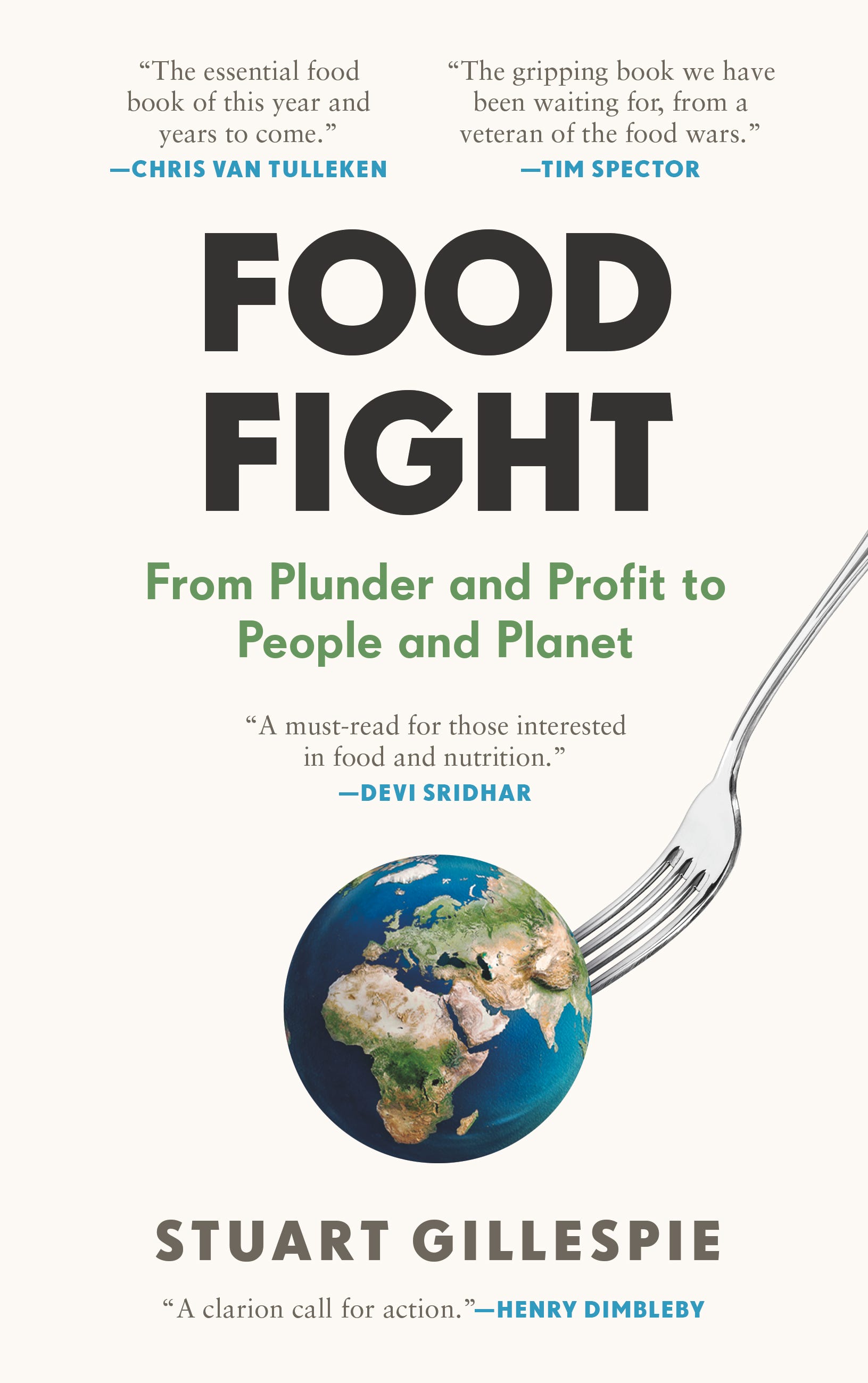
Food Fight was published last April. When I read it over the Christmas break, it felt less like a new intervention and more like the culmination of decades Stuart has spent tracing the political and commercial forces shaping what - and who - the global food system serves.
We spoke over Zoom about the books that shaped him, the misconceptions he had to unlearn, the growing sophistication of corporate influence, and why he still believes we may be approaching a moment of real change.
Note: The conversation has been edited lightly for length and clarity.
Q: You cite many interesting books and studies in Food Fight, some of them decades old. For someone trying to understand the political economy of food systems, what three books published before 2000 would you consider essential reading?
A: The first is How the Other Half Dies by Susan George (1976) - the first time I read anything that seriously interrogated the political economy and growing corporate capture of the food system. I came across it during a heatwave in Cambridge, in a second-hand bookshop, while on a school trip. It really galvanised my interest in food justice and understanding what was really going on.
It was a groundbreaking book and she was a great writer. That book was one of the main turning points for me. I heard the news that she had just passed away.
The second is A Quiet Violence by Betsy Hartmann and James Boyce (1983) - incisive storytelling that reflected the food injustice and silent violence of child hunger that I witnessed during my two years working in southern India (1984-1986).
I arrived at 23, completely out of my depth, and was working with indigenous tribal communities who were being systematically dispossessed. Incoming settlers were bribing government officials and farming land that had always been common land. When the tribal communities resisted, they were asked to show documents they’d never had. You see very quickly the deep political challenge and the injustice of the whole thing.
The third is Hunger and Public Action by Jean Drèze and Amartya Sen (1991) - an epic book from two brilliant minds, blending hard-nosed analysis with a powerful manifesto for change.
Other influential books but not so directly about food are Wretched of the Earth (Fanon), Putting the Last First (Chambers) and in early 2000s, Fast Food Nation (2001, Schlosser, just re-released) and Food Politics (Nestle, 2002).

Q: One of the most striking - and frankly unsettling - things about your book is how little of this is new. Power asymmetries, corporate capture, subsidy distortions, market concentration: these patterns have been documented for decades, as Jennifer Clapp also documented in her book. Why does the system seem so resistant to change?
A: That is the key question. If we’re serious about transformation, we have to ask it and answer it. To me, it’s the progressive entrenchment of power on the part of certain actors, with the facilitation of other powerful actors.
Transnational corporations are controlling ever-bigger shares of different stages in the food system. You’ve had a great conversation with Jennifer Clapp, whose book is fantastic - she talks about the CR4 ratios, where the top four companies holding more than 40% market share means you’re getting into trouble. That applies across the board in the food system, from farm to fork. On the downstream side alone, five companies - Nestlé, PepsiCo, Coca-Cola, General Mills, and Unilever - control at least 70% to 75%. It’s even worse upstream.
That corporate capture has gotten worse over time, helped by the fact that governments don’t use their power and authority to tackle it because there are too many ways in which corporate power is translated into political power through what I call “the dark arts.” And those tactics have become a lot more sophisticated, amplified by digitalisation and globalisation.
Much of this has been in play for decades, but we’re now seeing much more sophisticated approaches to infiltrating politics to block or delay regulation, and an amplification of the trends: heightened corporate concentration, ever more aggressive marketing especially to children, and throughout all of this, little in the way of a proactive large-scale response by governments. Too much has been piecemeal and ad hoc.
We just haven’t had anything like the push back - by the public, by media, by politicians - but we’re beginning to see those now.

Q: You’ve worked across academia, international institutions, and policy advisory roles for decades. What have you learned about how change actually happens in food systems, and what were your biggest misconceptions early in your career?
A: I wrote a blog on this in 2017, after starting an initiative called Stories of Change in Nutrition that, over a seven-year period, led to over 20 case studies of countries and Indian states. These shone a light on how change happens and more importantly, how we can change things, with individual, collective, political agency. Change happens when things come together at certain times. I think we are in one of those moments now.
One of the biggest misconceptions I had was in researching and writing a book on the double burden of malnutrition, a quarter century ago. My first misconception was that obesity was caused primarily by poor dietary choices by individuals. My second was that it didn’t really have much to do with deprivation, unlike hunger and undernutrition. I was wrong on both counts.
There’s a formula for change that I find useful. It’s simple: dissatisfaction with the status quo, plus a compelling collective vision of the future, plus the means of getting there. If those three things together are greater than the cost of changing, then you could be on the cusp of something.
And when you look at what we’ve tried - the kind of incremental, piecemeal stuff - you have to ask: is that sufficient vision? I don’t think it is. We need to go deeper into addressing structural drivers than we have in the past.
And I think, when a certain point is reached, you can get a cascade effect in a positive direction. Just as there’s been a cascade in the negative, you can turn vicious cycles into virtuous ones.
Q: In your chapter on “The Dark Arts,” you dissect how corporate actors shape narratives, research agendas and policy processes. How does conflict of interest most commonly manifest in food systems governance today and where are the most worrying blind spots?
A: Conflict of interest is a huge issue. I’ve spent 12 years digging into the research on it, including in this blog.
Big issues include industry “securing the science” by funding research, infiltrating dietary guideline committees and national food strategy advisory groups, sowing doubt, disputing evidence, denigrating other research and researchers. Industry also hides behind, or within, front groups who get to the policy table, including through policy conferences that were supposed to be run by the UN.
It’s a straw man, a false narrative. It’s like when Big Tobacco realised they were losing the battle on the science and said, right, we need to secure the science, we need to buy researchers. Now it’s not just researchers, it’s influencers online.
One of the “five deadly D’s” I write about in the Dark Arts chapter is disguise. The most powerful actors come into the big tent and they take over, as happened with the UN Food Systems Summit. The private sector didn’t come directly into that summit. They came in in disguise, through the World Business Council on Sustainable Development, as if they were normal partners in the policy discussion. They shouldn’t be.
One thing I’ve seen over the last few weeks is a new evolution: there are more and more influencers out there with quite significant social media followings who are not attacking the science directly but people like myself - people saying we need to transform food systems - accusing us of being anti-feminist and against the notion of convenience.
Q: Are we underestimating how sophisticated these influence strategies have become?
A: Yes!
Q: Some critics argue that structural critiques of corporate power or market-led governance risk being unrealistic or “purist.” How do you respond to that?
A: It’s a nonsense argument. Real history is made by addressing structural drivers of societal challenges, which is why slavery was abolished, why women can vote, why there’s a minimum wage.
I think it’s the incrementalists who are being unrealistic if they assume marginal tweaks will lead to significant and enduring change. We’ve been doing incremental for decades. It hasn’t worked.
Q: What genuinely feels different today compared to the 1990s? And what, depressingly, hasn’t changed at all?
A: There’s a higher level of discourse and engagement. The degree of naivety and ignorance around political and commercial drivers has changed - though not enough. People who would not previously have engaged with the political and commercial side are beginning to enter this sphere.
The level of discussion has become more differentiated, more detailed, less general. There are researchers, commentators, a few politicians who are realising there is an issue of imbalance of power and I don’t think that was really there before.
I should add a caveat: I may be biased. By the nature of what I’ve been doing the last few years, I’m looking for this and you find what you look for. But I do think it’s real.
The other thing I keep coming back to is purpose. What is it that we as citizens actually want from our food system?
Most people, I’d guess, want a system that nourishes us as humans and is good for the planet. What does the system we currently have do? It doesn’t do that. Its purpose is to maximise profit and the most profitable products are actually the least healthy, for both people and planet.
That is the crux of the entire challenge. Anyone who talks about incremental change without looking at purpose, power, and governance is not really going to get very far at this stage.
Q: After researching and writing this book, are you more optimistic or more pessimistic?
A: I believe in radical hope. Hope is more than optimism - it builds on agency. It’s a springboard to action. Rebecca Solnit and Byung-Chul Han have written brilliantly about this, as has Nick Cave, the musician. Why am I hopeful? Because I sense a coalescence of science, activism, and - belatedly - the stirrings of political will.
I also believe in radical realism. I think you have to be realistic: it’s not going to happen overnight. There’s a hell of a lot of work to do. You need to keep pushing, never be complacent when you think you’ve made a big step forward, consolidate it, and keep moving.
It’s a fight. It’s a food fight.
Q: If you could change one structural rule in the global food system tomorrow, what would it be?
A: That the “polluter pays” principle is grounded in principles of governance, law and regulation of harmful commodity industries, including the ultra-processed food industry.
The food system generates $15 trillion a year in net damage globally - 12% of GDP - significantly more than the net value it creates. It privatises the profits and socialises the costs, which fall on people and the planet. Industry doesn’t pay for that. And that has to change.
If we can start to tax the harms properly, and use that fiscal dividend to subsidise access and affordability for low-income families - balancing the see-saw towards healthier diets - that would be the goal.
But the bigger one-thing answer, if you’re asking me what to change in the system - it’s this: make those who cause the harm pay for it.
Thin’s Pickings
Agroecology has a PR problem. Here’s how we can solve it. - Arc2020
A provocatively titled but truly insightful piece from Robbie at IPES-Food about shaping narratives and how those of us who want a fairer, greener, and healthier food system can improve our messaging.
“Too many of us are more fluent in dense academic discourse than in the poetry of the dinner plate or the farm. And that leads to people tuning out. Especially in today’s fast-scrolling world.”
How public grocery stores could work in Canada - Canadian Centre for Policy Alternatives
A quartet of leading thinkers on food systems - Raj Patel, Aaron Vansintjan, Anna Paskal, and Errol Schweizer - give practical advice on how to operationalise in Canada an idea made popular by New York City Mayor Zohran Mamdani during his campaign.
They look at how and why the system has worked well in Mexico and the U.S. military, and point to Canada’s existing public retail options - provincial liquor stores and provincial-run cannabis shops - and the rapid rollout of the National School Food Program as evidence that the government can do this.
Holding the line on the EU carbon border adjustment mechanism - bruegel
For readers not steeped in EU policy wrangles, here is a useful and concise piece on the latest big fight between Big Ag and environmental policies, written by four experts and published by a European economic think tank.
It’s about CBAM, the European Union’s carbon border adjustment mechanism, which requires importers of carbon intensive products like fertilisers to pay for embedded emissions. With the support of farm lobby groups like Copa-Cogeca, a dozen countries have asked that fertilisers be exempted from CBAM, saying fertiliser prices have risen further and that imports have collapsed.
Others say the collapse in imports was due to stockpiling before CBAM came into force (subscription required), and that an exemption is the wrong approach. This op-ed also argues that exemption would be “unwise”.
‘Andor’ Creator Tony Gilroy Gives the Interview He Couldn’t During Its Release - The Hollywood Reporter
Given the state of the world, it can feel vacuous to talk about a Hollywood - and Disney (!!!) - show but to me, Andor is an example of art that is excellent, thought-provoking, and entertaining, while capturing the zeitgeist so acutely. I feel compelled to share this illuminating interview with its creator.
“You get out your Fascism for Dummies book for the 15 things you do, and we tried to include as many of them as we could in the most artful way possible. How were we supposed to know that this clown car in Washington was going to basically use the same book that we used? So I don’t think it’s prescience so much as the sad familiarity of fascism and the karaoke menu of things that you go through to do it.”

As always, please feel free to share this post and send tips and thoughts on bluesky @thinink.bsky.social, mastodon @ThinInk@journa.host, my LinkedIn page, twitter @thinink, or via e-mail thin@thin-ink.net.
When we consider our current global food system and its complexity, it is clear that food systems are integral to both people's health and the sustainability of our planet. As we have seen over the past 3 million years, our existence depends on both.
Indeed, an observer focused entirely on the challenges our current food systems create might say, “The future is bleak.” On the other hand, if one focuses on the opportunities and benefits that social and innovative change could bring, one might say, “The future looks bright.”
Perhaps a more realistic observation might be “the future is uncertain”.
Tackling the complex challenges of global food systems, ecosystems, and climate change will require transformative, systems-level changes rather than just minor adjustments.
Achieving these goals will depend on the collaboration of all key stakeholders, including leaders from diverse industries, politicians and policymakers, international agencies, research institutes, academia, farmers' associations, NGOs, and other relevant organisations.