

I’ve written a lot about food environments, their role in shaping our diets, and the need to move away from shaming and blaming consumers for their health problems.
This week’s issue is based on an investigation we worked on with Cuestión Pública, an award-winning Colombian investigative newsroom best known for its exposés on corporate and political power.
Published on May 27, the piece captures the enormous challenges faced by both consumers and governments trying to improve public health and the overall sustainability of food systems.
(P.S. I’m heading to Norway for the Oslo Freedom Forum. Please come say hello if you’re there too.)

Let’s begin by digesting - pun intended - these health statistics from Colombia.
Nearly 1 in 4 adults were obese in 2022, compared to fewer than 1 in 5 in 2012. (FAO, 2025)
The change is even more striking in terms of absolute numbers: 9.1 million adults were obese in 2022, compared to 5.7 million in 2012. (FAO, 2025)
More than half of adults were overweight in 2015. (ENSIN, most recent national survey)
Nearly 7% of children under 5 were overweight in 2024, up from 5.1% in 2012. (FAO, 2025)
More than 30% of Colombians consume sodas - sugar-sweetened beverages, in academic parlance - daily, among the highest consumption levels in Latin America. (BMJ Global Health, 2023)
Noncommunicable diseases (NCDs) account for 76% of premature deaths in Colombia, with cardiovascular diseases being the main cause. (WHO, 2022)
The costs of treating NCDs amounted to more than 6 trillion pesos (nearly US$1.5 billion) in 2021. Some estimates suggest that figure could reach 10.2 trillion pesos by 2030. (Ensayos Sobre Política Económica (ESPE), 2023)

I started with these numbers because they are the backdrop to a story that Cuestión Pública, our Colombian media partner, published this week.
“¿Qué hay detrás de la lonchera de tus hijos?Exceso de azúcar y un negociazo para los partidos” (roughly translated as “What’s in your children’s lunchboxes? Too much sugar and a lucrative business for political parties”) connects the dots between those statistics and the political and corporate forces making them so difficult to reverse.
It traces how, amid rising adult and childhood obesity, political parties in Colombia that are heavily financed by the ultra-processed food (UPF) industry have repeatedly blocked regulations and filed lawsuits seeking to overturn public health measures like “healthy taxes” and front-of-pack warning labels.
The “healthy taxes” refer to the tax reform signed by Colombia’s president in December 2022, after several years of delay. It introduced a 10% tax in 2023 on sugar-sweetened beverages and UPFs, increasing to 20% by 2025. The law was hailed as “groundbreaking” by public heath campaigners.
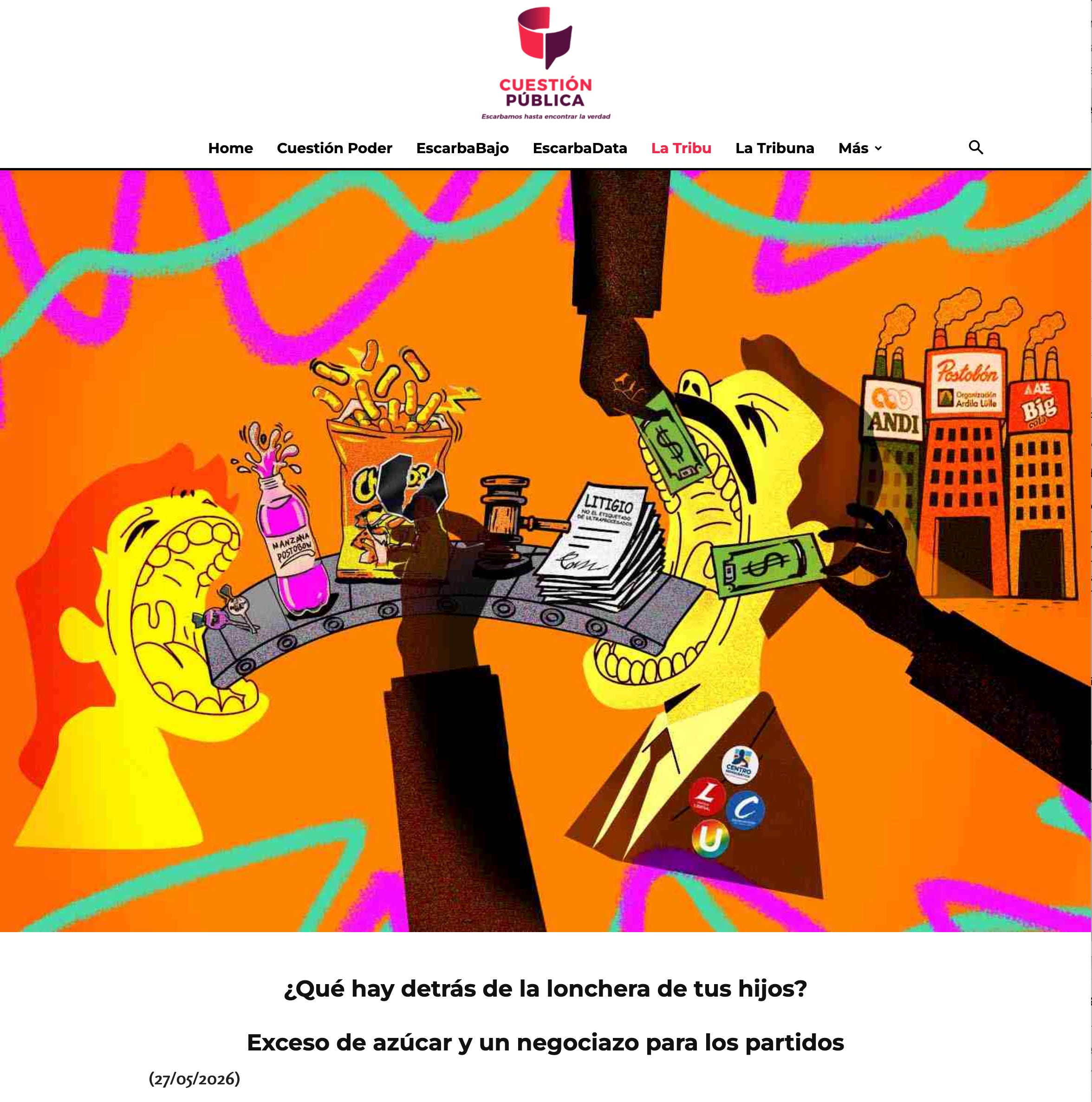
The story was published days before the high-stakes presidential elections on May 31 (Sunday), which currently has three main contenders and will determine the country’s future trajectory.
Much of the campaigning has focused on security and affordability issues, but Colombia’s pioneering approach to public health is at stake too, even if it is not being shouted from the stages.
Depending on who gets elected - or even who gets to the second round run-off - the country’s laws targeting foods that harm our health could be in jeopardy.
The outgoing, left-leaning President Gustavo Petro championed the measures, and Iván Cepeda, currently leading narrowly in the polls, has vowed to continue Petro’s social and environmental reforms.
But the other two candidates - establishment conservative Paloma Valencia and right-wing populist Abelardo de la Espriella - are pro-market and anti-tax.
In particular, Valencia, a political protégé of ex-President Álvaro Uribe, granddaughter of a former president, and a senator with Centro Democrático (Democratic Center), has explicitly said she will eliminate the taxes if elected, positioning her as a defender of shopkeepers, merchants, and the private sector.
Her campaign told Cuestión Pública in writing that removing the taxes would “help stabilise the basic family food basket without compromising the fiscal stability of the general budget.” She proposed replacing them with “technical working groups for industrial reformulation” with exemptions for companies that reduce sodium and sugar.
The Lobbying & The Law
There were nearly 20 legislative initiatives over the past decade that the government had put forward to regulate sugary drinks and ultra-processed foods, according to Cuestión Pública. These include regulating the advertising of UPFs to minors, restricting their marketing in school settings, taxing them, or making the less healthy ingredients more readily apparent.
Only two bills passed.
Law 2120 of 2021 established seals to warn about products that have high levels of added sugars, sodium, and trans fats. It required black, octagonal warning labels on the front of the packaging reading “High in Sugar,” “High in Sodium,” and so on. You can see similar labels in Mexico and Chile.
In April 2026, the Ministry of Health proposed a draft regulation that goes a step further, introducing a new, mandatory rectangular warning label explicitly reading “Advertencia Ultra Procesado” (Ultra-Processed Warning). This would make Colombia one of the first countries in the world to label food this way.
Law 2277 of 2022, created through Article 54 of the Tax Reform, placed a tiered tax on sugary drinks and a compounding tax on UPFs exceeding thresholds for sugars, sodium and trans fats.
Public health advocates, academics, and civil society groups view these laws with pride. The right-wing opposition, Big Food, and industrial business lobbies aggressively fought them.
Cuestión Pública detailed how lawmakers aligned with Big Food - including from Centro Democrático - tried to derail them: inviting lobbyists into Congress during the discussion of these laws, filing lawsuits, and introducing bills to overturn them.
The Funding & The Lawsuits
The newsroom also followed the money.
“In 2022, the year the health tax was discussed and passed, sugary drink and ultra-processed food companies donated 25 billion pesos (USD 6.8 million) across all their charities,” reported Cuestión Pública.
“This represented 40% of their total income that year. This is equivalent to the annual cost of care for more than 9,000 type 2 diabetes patients, according to 2019 figures.”
Between 2016 and 2024, such contributions by Big Food accounted for 30% of income reported by political groups, it added.
When the laws passed despite the lobbying and the funding, the lawsuits began: 17 challenges were filed, almost all by individuals, under a process that enables any Colombian citizen to challenge the constitutionality of laws or policies.
The plaintiffs include:
law firms such as Gómez-Pinzón, which has represented one of the most powerful banking families in Colombia to take control of Nutresa, a leading multinational processed food company in Colombia,
the constitutional lawyer Juan Manuel Charry, who has represented a producer of sweets and chocolates, and
Miguel Uribe Turbay, a Centro Democrático senator and former presidential candidate who was assassinated last year, and who had received campaign donations from the Nutresa Foundation.
After analysing more than 900 pages of lawsuits, such traces with the UPF industry were found in half of the them, including filings where industry talking points and data were used to criticise the laws, Cuestión Pública said.
So far, all the lawsuits have been unsuccessful. Colombia’s Constitutional Court has ruled the taxes to be valid and constitutional.
The strategy has since moved to overturning the taxes or asking for exemptions for certain products. Cuestión Pública has identified members of the Congress from Centro Democrático being part of these efforts.
The History & The Future
The latest article focused on the lobbying and pressure around these laws, but Colombia also has a documented history of threats and harassment against human rights and public health advocates.
Take the case of Dr. Esperanza Cerón, whose group Educar Consumidores was censored and legally threatened in 2016 after Colombia’s largest beverage company Postobón filed a complaint with the government’s consumer protection agency.
In an article, The New York Times documented menacing phone calls, strange malfunctions of the office computers, and men pounding on her car door telling her to “keep her mouth shut”. Although no direct links with the food industry were made at that time, public health advocates in Colombia later reported feeling unsafe on a daily basis during this same period.
A decade later, Colombia’s elections could determine whether the country cements its status as a pioneer in improving our food environments, or if an incoming conservative administration that has the ear and funding of the industry will attempt to dismantle those policies in the name of economic growth.
The Constitutional Court has provided some protection for the taxes, but Sunday’s vote could determine the trajectory of future policymaking.
Further Reading
Cuestión Pública’s story (in Spanish, get your browser translation extension ready!)
Instagram Reel about the findings (in Spanish)

Thin’s Pickings
Carlo Petrini Obituaries
There were plenty of fitting eulogies to mark the passing of the founder of the Slow Food Movement. But it was the pieces by Rachel Roddy (in The Guardian), by Pete Wells (former NYT restaurant critic) and Raj Patel that stayed with me: vivid, colourful, and enjoyable, just like Carlo’s life and vision.
”An environmentalist who isn’t a gastronome is sad; a gastronome who isn’t an environmentalist is foolish, he would say.” Aye! Aye!The Processing Gap: Why Ultra-Processed Foods Are the Real Driver of the US-Italy Obesity Divide - The Food Archive
A post from one of my favourite food systems experts - Jessica Fanzo - that combines personal musings with scientific evidence to unpack the differing levels of obesity between her current (Italy) and former (U.S.) homes.
As a fellow northern-Italy-dweller who has also lived in Rome, I couldn’t agree more with her observations, particularly on standards, food environments, and walking.What ‘ultraprocessed’ actually means (and why it matters) - Unjunked
A new substack from two scientists who study ultraprocessed foods for a living. Lindsey Smith Taillie has done numerous studies on food environments and UPFs and how to regulate them, and Ashley Gearhardt was an author on the UPF and tobacco study I cited in an earlier issue.
This post is great for those wanting to dip their toes into the UPF debate.

As always, please feel free to share this post and send tips and thoughts on bluesky @thinink.bsky.social, mastodon @ThinInk@journa.host, my LinkedIn page, twitter @thinink, or via e-mail thin@thin-ink.net.