

If you’re attending the World Health Assembly in Geneva next week and want to discuss the intersection of food systems and public health, or know of any side events worth attending, official or not, please shout.
It’s been a hectic week, so I’m keeping the preamble short and skipping Thin’s Pickings because the whole issue feels like an extended edition of Thin’s Pickings. Happy reading!
The four reports and papers I’m highlighting this week are an eclectic bunch, but together they give a taste of the fascinating and varied nature of our food systems.
One looks at the bigger, structural issues, another is at the intersection of food and climate, and two touch on the topic du jour - ultraprocessed foods (UPFs) - but through two distinct angles.
They are all worth reading in full, but if you don’t have time, well… that’s why I’m here.
How To Feed Your Citizens Amid Perpetual Shocks
I don’t know about you, but a strong sense of déjà vu seems to follow me almost everywhere these days. Perhaps it’s a sign of old age, but I rather think we’re living through a particularly painful learning phase in which the world needs to be hit on the head repeatedly before realising it’s time to change course.
There have been a lot of good analyses on why we’re bracing for yet another food price crisis. Here’s a new, pithy report from IPES-Food on what countries can do now to shore up resilience, drawing on real-world examples from India, West Africa, Canada, and Norway.
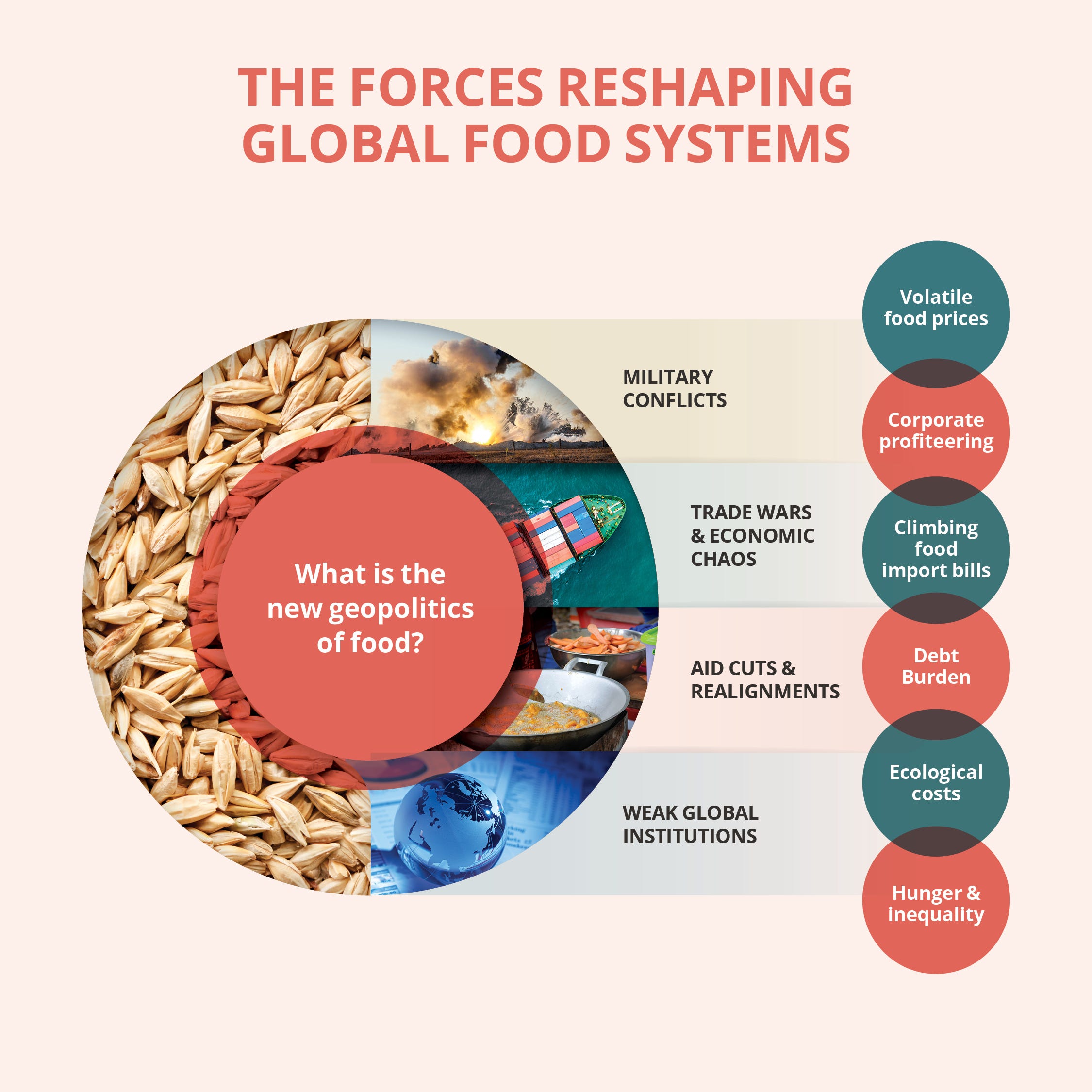
“The world is entering a new geopolitics of food. Conflicts, trade wars, climate shocks, aid cuts, and the breakdown of international institutions are destabilising global food markets,” it said.
“Governments must respond by building resilient self-reliance – strengthening domestic food systems, and reclaiming policy tools that can stabilise markets and protect food access in an increasingly unstable world. This means prioritising food systems that ensure fair livelihoods for farmers and stable access to food for consumers even in times of disruption.”
The concept of “resilient self-reliance” differs from isolationism, protectionism, anti-trade and even food sovereignty, according to Jennifer Clapp, food systems expert and lead author. She said this at the webinar launching the report, which I moderated.
It will “involve some trade”, but it will be trade that is cooperative, fair, and embeds norms like sustainability, agency, equity, and justice. The self reliant part will be built on sustainable agriculture, agroecological methods, and territorial markets that support local producers and ensure food access for consumers, she said.
“If states just want to suddenly be more self sufficient, and do so at all costs, this can have huge ecological consequences, but it can have enormous social consequences as well if it’s not built on the principles of equity and ensuring distribution for everyone.”
And while there are overlaps with food sovereignty principles, the report is responding to state involvement, she added.
There are a number of available interventions, but the report zeroes in on what’s called “market management measures” - specifically public stockholding and supply management - to reduce food price fluctuations that could really wreck people’s ability to feed themselves and farmers’ ability to enjoy a stable income.
These aren’t novel policies. They used to be widespread, until they were criticised as inefficient and countries were pressured to dismantle them as part of trade liberalisation and deregulation agendas.
In India, the public food stockholding and distribution system, which purchases wheat and rice from domestic farmers at minimum support prices set before harvest, serves two in three people and played an important buffer role in previous crises.
For example, as global rice prices soared by 230% between 2005 and 2006 and by 75% between October 2007 and March 2008, wholesale rice prices in India increased by just 16% and 14% over the same periods.
A similar programme exists in West Africa, albeit as regional reserves. It was set up in 2012 to deal with growing climatic threats, pest infestations, and ongoing regional food security challenges, and has since provided over 55,000 metric tonnes of cereals to six countries in the region.
The report also pointed to Canada where dairy, poultry, and egg industries have measures to negotiate minimum farm-gate prices and prevent cheaper imports from undercutting domestic production.
During both the 2007-2008 food price crisis and the COVID-19 pandemic in 2020-2023, unprocessed milk prices were highly volatile in both the US and Germany, but remained relatively stable in Canada’s supply-managed market.
Similarly, egg prices spiked in the U.S. when the 2024-2025 bird flu outbreak in North America paralysed large, centralised production systems. Canada, with a distributed and smaller-scale production model, was much less affected.
These programmes aren’t silver bullets - they can be costly, vulnerable to corruption, and contribute to higher prices for consumers - and cannot be developed in isolation.
Still, “when designed with equity, sustainability, and democratic participation in mind, market management tools can contribute to the stability and resilience of food systems – forming part of a broader shift towards building resilient self-reliance”, the report said.
These policies could particularly be helpful for countries in Sub-Saharan Africa, whose reliance on global markets make them particularly vulnerable to the latest geopolitical shifts. Already struggling with some of the world’s highest rates of hunger and undernutrition, it is now costing them more to feed their citizens.
For example, the food import bill for the Least Developed Countries (LDCs) was $59.4 billion in 2024, a sharp rise from $41 billion in 2020. Also, food price inflation exceeded 5% in approximately half of all low-income countries, compared to only one in five high-income countries.
“This is a historic moment to rethink how food systems are governed – and to strengthen local food systems against geopolitical shocks.”
If you don’t want to read the 40-page report, ARC2020 has a detailed article.

When Greenwashing Is The Norm
Remember when JBS and Tyson agreed to stop making claims about their meat being “net zero” and “climate-smart”?
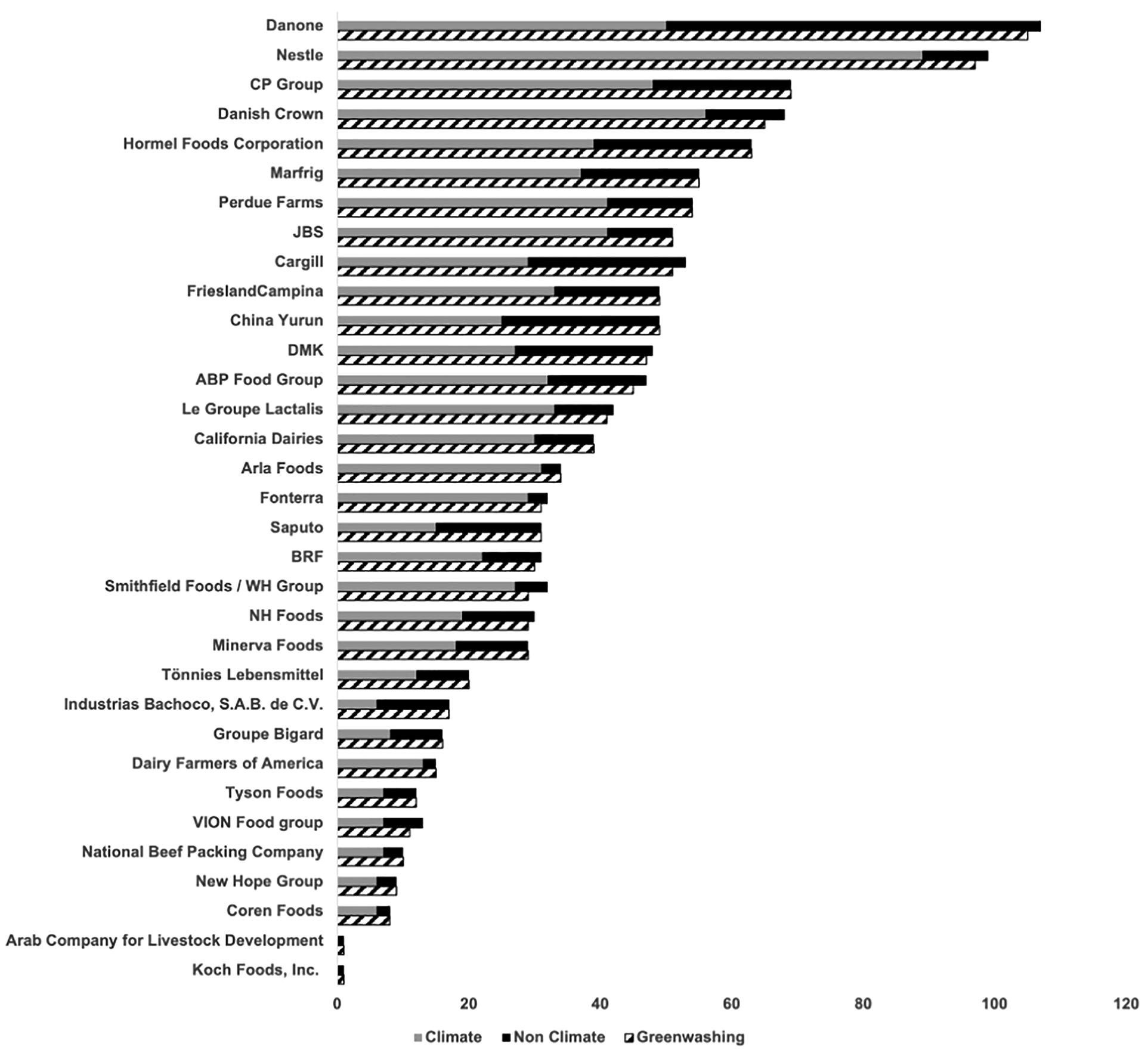
We know greenwashing is common in some industries, and livestock is one of them. But it is another thing entirely to have an academic paper that drills into the environmental claims of 33 of the world’s largest meat and dairy companies, and comes up with receipts.
The authors looked at publicly available materials from the companies that are related to sustainability - reports and websites - between 2021 and 2024.
A total of 1,233 environmental claims were identified, of which 98% could be considered greenwashing. Only 20 were verifiable and those tended to describe broad industry trends rather than specific initiatives.
Nearly 70% of claims directly or indirectly addressed greenhouse gas emissions or the impact of climate change.
More than two-thirds of the claims did not offer any supporting evidence.
More than a third of the claims (38%) were promises about the future, with dairy-based companies Nestlé and Danone leading the way. However, “the companies almost never laid out plans for implementation” of these future promises.
Of 33 companies, half (17) has made commitments to achieve net zero, including JBS and Tyson. Both have caveats, and both continue to expand their operations.
An interesting aside: BlackRock owns shares in nine of the 17 meat and dairy companies with net-zero commitments in the study’s sample.
Companies are often short on detail on how they intend to achieve these environmental claims and targets. When they do describe them, they were “generally small-scale, confined to local sites, or existed only in pilot form.”
For example, Arla Foods, the world’s fourth-largest dairy company and a cooperative of over 12,700 farmers, launched a “regenerative agriculture pilot” on 24 farms, representing just 0.0019% of its total global operations, and reported “installing solar panels on the roof of a cheese packaging site”.
Why is this a problem?
“Sustainability reporting strengthens public perception and can boost a company’s image, making it more attractive to investors. JBS, for example, raised $1 billion through sustainability-linked bonds linked to its net-zero pledge.”

How The Industry Engineered Addictions
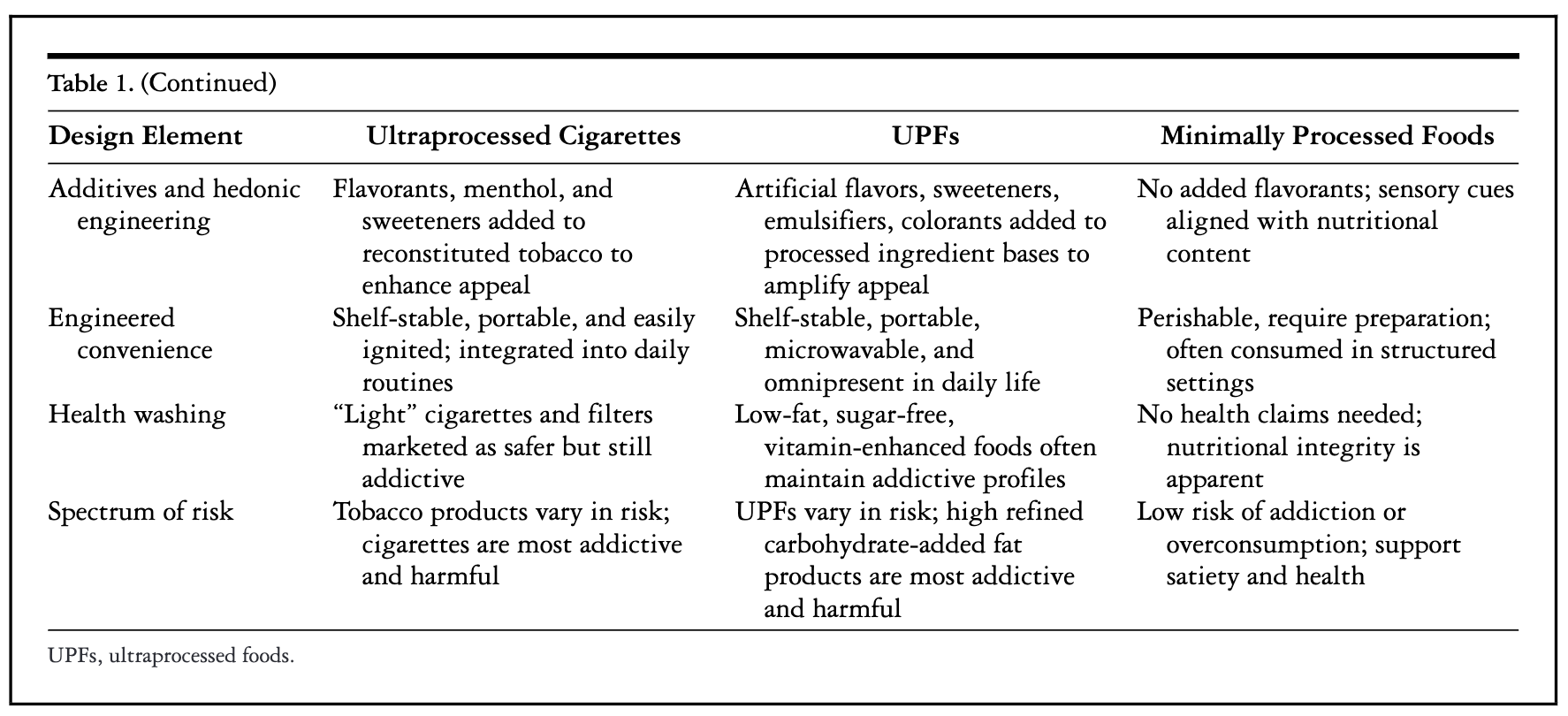
If you’ve ever wondered how accurate are the comparisons between Big Food and Big Tobacco, this fascinating analysis is for you. Even if you are already convinced, I’d urge you to read it anyway because it uses addiction science to understand UPFs.
“(UPFs) are not simply modified foods - they are carefully engineered to maximise hedonic impact, consumption, and profitability through industrial processing,” according to the authors from University of Michigan, Duke University, and Harvard University.
“Both industries have used similar strategies to increase product appeal, evade regulation, and shape public perception, including adding sensory additives, accelerating reward delivery, expanding contextual access, and deploying health-washing claims,” they write.
They also have a closely intertwined history, given that tobacco companies R.J. Reynolds and Philip Morris owned food companies such as Kraft, General Foods, and Nabisco and were top manufacturers and marketers of UPFs from the 1980s through the mid-2000s.
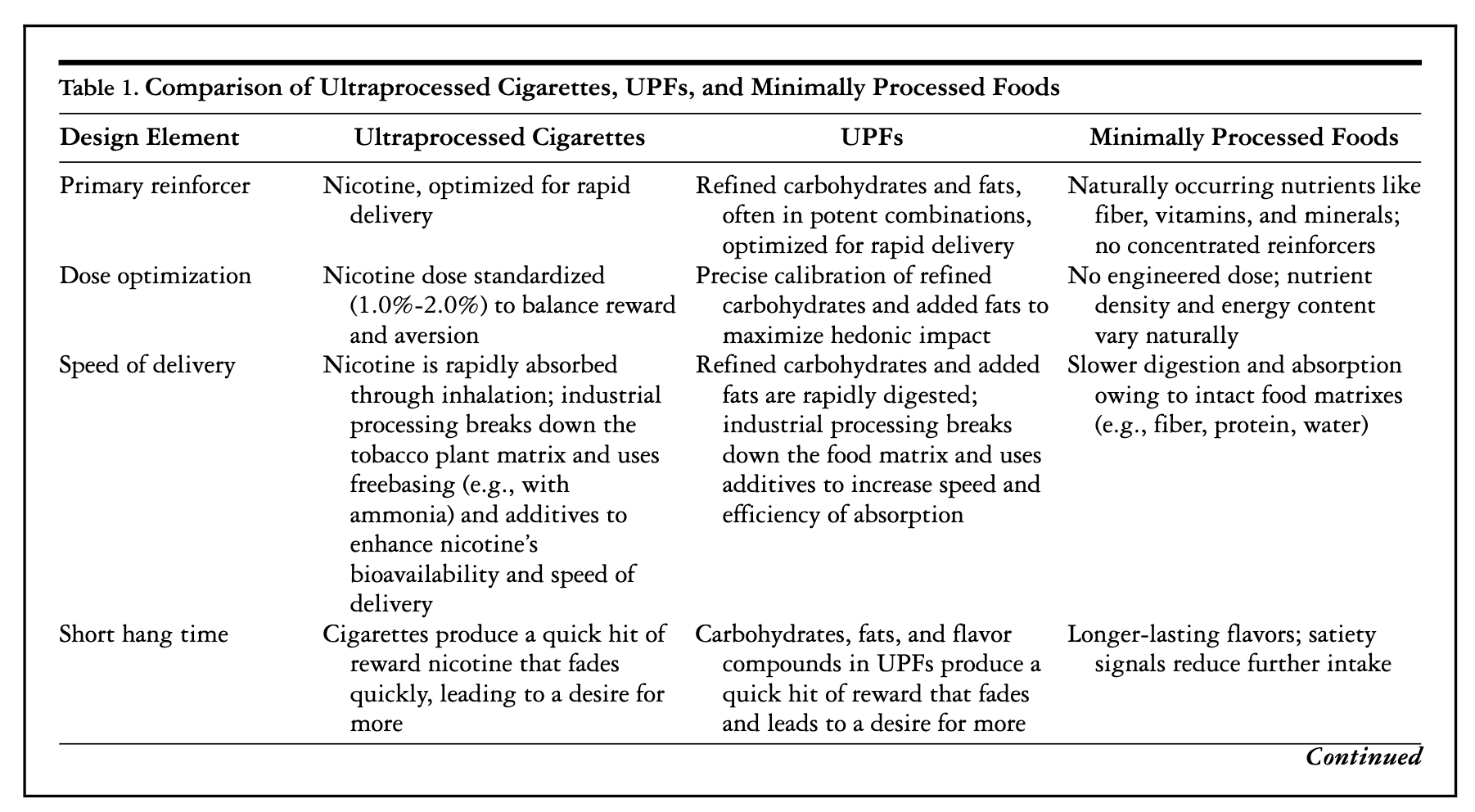
But the similarities extend far beyond historical ownership, and the authors say their analysis show many UPFs share more characteristics with cigarettes than with minimally processed fruits or vegetables.
The Origin Stories
Tobacco leaves, corn, sugarcane, grains, and oil seeds started out as natural, plant-based substances that have been consumed for centuries.
“What transformed these materials into major drivers of disease was not their inherent properties but the way they were industrially reengineered to enhance reinforcement, maximise both want and need, increase accessibility, and maximise profit.”
The Transformation
“Modern cigarettes are not simply dried tobacco rolled into paper. Rather, they are chemically engineered products, optimised for appeal, convenience, and profitability.”
This includes grinding tobacco leaf scraps into a pulp, combining them with additives and binders, and forming them into sheets that are rolled and cut like paper. These reconstituted tobacco sheets are known as “recon”.
Similarly, UPFs undergo extensive processing that strips away fibre, protein, and water - elements that normally slow digestion.
This goes way beyond traditional processing methods like stone grinding grains, fermenting milk, cold pressing oil, or boiling sugarcane juice to make crystals, which, in addition to being labour- and time-intensive, also retained much of the food’s original structure and nutrient complexity.
Dopamine Hit
We know that fats and carbohydrates are important calorie and energy sources and appear in whole foods, in the same way you can find trace nicotine in eggplants and tomatoes. All three also release dopamine, but eating whole foods that have them “do not typically lead to compulsive overconsumption”.
“Ultraprocessing transforms natural ingredients (e.g., tobacco leaves or corn) into products like cigarettes or UPFs, optimised for maximum palatability, reinforcement, and profitability. These products hijack ancient reward systems in ways that evolution could not have anticipated.”
Crucially, the carbohydrate-fat combination that drives this response is almost non-existent in nature, yet it produces dopamine responses up to 300% above baseline, compared to 120-150% for each alone.
More-ishness
Both cigarettes and UPFs are optimised to deliver “a rapid sensory peak followed by a swift decline, which, in turn, triggers renewed craving”.
“This cycle of craving, brief stimulation, subsequent crash, and repeated use is a hallmark of addictive intake patterns.”
Plain M&Ms illustrate this well: engineered to shatter quickly and melt immediately, releasing a brief burst of reward… then nothing, prompting you to reach for another.
Right Dose
“Both cigarettes and UPFs are engineered with remarkable precision to deliver a “just right” dose of reinforcing substances: nicotine in the case of cigarettes, and refined carbohydrates and fats in the case of UPFs.”
For example, most modern cigarettes contain between 1.0% and 2.0% nicotine by weight. Similar for UPFs, refined carbohydrates and fats are blended in a precise manner to elicit the maximally pleasurable response without sensory overload.
Brand Loyalty
“Both cigarettes and UPFs exploit the human brain’s sensitivity to sensory cues (e.g., taste, smell, mouthfeel, visual presentation) to create products that are not only pleasurable but also deeply reinforcing.”
This is also linked to consumers forming strong attachments to specific combinations of flavour, texture, and aroma, even when the core ingredients (e.g., sugar, fat) are chemically similar across brands.
UPFs also take advantage of humans’ tendency to be attracted to - and equate - colours with beneficial properties, which is why so many of them have bright, artificial colours, particularly for products targeted at youth.
Convenience
The infrastructure built around cigarettes and UPFs - for example, the use of chemical additives and packaging innovations that have increased their shelf lives and durability - has contributed to their widespread use.
“Convenience, in this context, is not incidental but engineered to minimise friction at every point from product formulation to environmental availability.”
“Smokers no longer must roll their own cigarettes or consume them before they go stale. They can carry packs in their pockets, keep them in desk drawers, and light up almost anywhere with minimal effort. Similarly, UPFs are easy to store, portion, and consume on demand, transforming them from occasional treats to daily fixtures in car consoles, office drawers, and kitchen cabinets.”
These similarities warrant regulation commensurate with the significant public-health risks they pose because tobacco’s history also showed the industry exporting addiction and disease worldwide, the authors warn.
In the U.S., taxation, litigation that exposed internal documents, and marketing restrictions contributed to a massive drop in smoking rates - 73% among adults and 86% among youth - but “required decades of scientific advance, advocacy, policy change, and litigation against a powerful industry determined to evade accountability and protect its profits”, they write.
“In the decades between known harm and meaningful action, millions more became addicted, and rates of preventable disease soared. These patterns are now echoed in the proliferation of UPFs.”
What To Consider When Regulating UPFs
This is an interesting and timely commentary from Madhura Rao et al, touching on an aspect that hasn’t received much attention in the UPF debate: that regulatory strategies to control consumption could inadvertently encumber women. They also cite a book - Milli Hill’s Ultra-Processed Women - that I now want to read.
“Domestic food preparation, procurement, and planning… are activities whose burden disproportionately falls on women and thus, reducing UPF consumption could inadvertently increase the time, energy, and resources women spend on food provisioning at home,” the authors warned.
These activities, referred to as “foodwork” in the commentary, range from meal planning and weighing nutritional and food safety risks, to interpreting conflicting dietary advice and managing family members’ preferences and health concerns.
“Although these tasks are often perceived as private, mundane acts, feminist scholars have shown that they are deeply social and political, reflecting and reinforcing existing gender, class, and racial hierarchies.”
I was raised in a household where meals were cooked from scratch, but it was also quite unconventional by Burmese standards: we had a male cook for many years, it was my widowed grandfather who did the weekly grocery runs instead of the single, married, and widowed women at home, my father was more adept in the kitchen than my mother, and my sister and I weren’t taught how to cook.
Despite this, I distinctly remember our great-aunts reinforcing strict gender hierarchy when it comes to preparing, serving, and consuming food. I witnessed the same in other homes. That formative experience left me with an eternal appreciation for men who can cook and are willing to do so, and for women who don’t pressure women into performing it.
In traditional households, the arrival of UPFs, together with technological advances and a sharp rise in women’s participation in the workforce, “profoundly transformed” domestic kitchens by minimising the time, effort, and skill required to prepare meals.
But the gendered nature of grocery shopping, prepping, and planning for meals continue to this day. In the US, women spend twice as much time on foodwork as men. In Brazil - home to the scientists who coined the term UPF - 95.6% of women perform daily meal preparation, versus 59.8% of men. The pattern holds across Europe, Africa, and Southeast Asia.
The utilisation and consumption of UPFs have also become an issue highlighting class and wealth disparities.
“Women from low income and racialised backgrounds in high incomes countries often contend with food deserts, precarious employment, and financial constraints that limit their ability to access fresh or minimally processed foods, leading to the inclusion of industrially prepared foods including UPF.”
“Women with class privilege, on the other hand, are able to outsource at least a part of the domestic foodwork that is societally expected from them to less privileged people (often women and other marginalised people), thereby being able provide their families with a healthier diet but also reproducing hierarchies of gender, race, and class within and beyond the household.”
The authors argue that UPF-reduction strategies that rely on increased home cooking or meal preparation effectively externalise labour costs onto women, without acknowledgement, compensation, or structural support.
They call for creating supportive food environments in schools, universities, workplaces, hospitals, and health and wellness centres so that reducing reliance on UPFs should not depend solely on individual household capacity or effort, which will end up shifting the burden onto women at home.
The suggest cooking classes at school, community kitchens and shared cooking spaces, and advertising and public campaigns that show fathers and sons cooking or meal prepping.
“Rather than positioning healthier eating as an additional responsibility to be absorbed within existing domestic structures, policies should actively engage with and seek to transform these structures to promote equity and shared responsibility.”

As always, please feel free to share this post and send tips and thoughts on bluesky @thinink.bsky.social, mastodon @ThinInk@journa.host, my LinkedIn page, twitter @thinink, or via e-mail thin@thin-ink.net.
Thank you for making your readers aware of the Milbank Quarterly UPF study. As a nurse and diabetes educator, this is extremely helpful. I also am looking forward to reading Ultra Processed Women, and sincerely appreciate you bringing up the point about food work. I was a line cook for years and am the meal planner and cook for my family at home and am well aware of the time/energy burden that comes with cooking from scratch. With me and my partner both working full time jobs this is exactly the issue that my family is struggling with in regards to keeping whole foods on the table.
Thin! I just sent you a direct message here on Substack in the “Chat” tab in the “requests” section -Chef Harrison :)