

I spent an inspiring day last week in Leuven, where a broad coalition of folks working on food systems gathered to discuss some knotty issues. The event reminded me how energising it can be to be in the same room, in person, with people who don’t agree on everything but share an overarching goal.
Then I came across this op-ed from a noted Bloomberg columnist which brought me back down with a thud, because, we’re still equating food security with productivity? Really?
News from COP31 on food and agriculture isn’t great either, because of course, we can afford to wait just as super El Niño reaches its peak. #sarcasm
Anyway, I’m not going to rant about either of those this week - admittedly, I already did on LinkedIn re: the former - because something big happened on Myanmar.
Food systems coverage resumes through Thin’s Pickings.
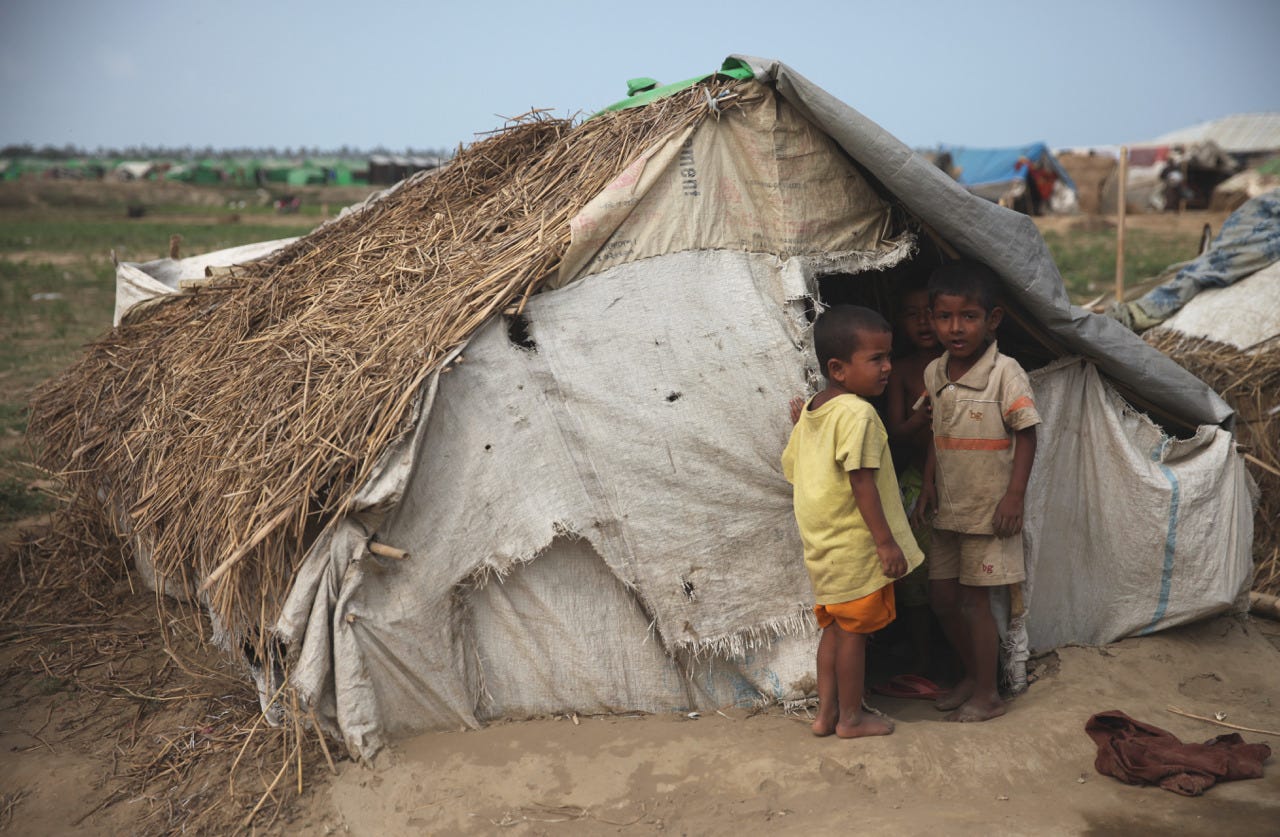
“The court… by nine votes to six, finds that the Republic of the Union of Myanmar has committed genocide against the Rohingya group in northern Rakhine State, in violation of its obligations under the Convention on the Prevention and Punishment of the Crime of Genocide.”
It was more than two hours into the LIVE broadcast that Judge Yuji Iwasawa, president of the International Court of Justice (ICJ) in The Hague, delivered this verdict on Nov. 19, on the conduct of my birth country during the notorious Aug 2017 “clearance operations”.
He was on page 182 of the 186-page judgement, and had recounted, in some detail, the historic discrimination suffered by the group and the restrictions imposed on them, as well as the more recent atrocities the security forces committed against the Rohingya.
The latter included indiscriminate killings even of children, widespread and brutal sexual violence, systemic destruction of homes and villages, and other inhumane abuses.
The Court accepted evidence that Myanmar’s forces killed an estimated 10,000 Rohingya, that security forces attacked those who were fleeing their homes, and that Myanmar’s behaviour was not just about counter-terrorism operations against violent attacks but “intentional” and did not distinguish between militants and civilians.
The judgement also detailed how Myanmar refused to cooperate with the two investigative bodies established by the United Nations Human Rights Council and provided documents that did not account for the large numbers of rounds of ammunition reported as used.
Facebook’s role was featured prominently in tracing the spread of hate speech against the Rohingya, including how Min Aung Hlaing (then commander-in-chief, later coup leader, now president) demonised the whole group, and how members of the military and police ran specific Facebook Pages. See Paragraphs 153 - 168.
“The manner in which the forcible displacement of the Rohingya was conducted, together with the selective targeting of the Rohingya population for violence and the burning of their homes, which sent a clear message that they had nothing to return to, supports the inference of an intention to destroy the group. The evidence of brutal acts of sexual violence and the targeting of children for violence in Rohingya communities also supports an inference that there was a desire to destroy the foundations of the group. The systematic nature of these actions further indicates a reasonable inference that Myanmar acted with genocidal intent.” (Para 436)
The Significance
This is the first time the ICJ has found a state to be responsible for genocide in its 80-year history. Its reasoning will be closely read for other pending genocide cases, including one brought by South Africa against Israel on the situation in Gaza.
A colleague said: “(The) bar has been really high (and still is) but not unreachable any more.”
Six out of 15 judges dissented on the central finding, after all.
The judgement also outlined reparations and legal consequences. I’m sure the inevitable - and important - questions around enforcement will follow.
For now, the verdict is a start, and shows some justice and accountability mechanisms remain intact and reinforces the need to protect them.
This means finding ways to stop bullies like the current U.S. administration from further sanctioning - and demonising - courts because they do not want themselves or their allies to be held to account.
U.S. Ambassador to the U.N. Mike Waltz had already publicly warned - and tried to undermine - the ICJ. There are fears ICJ judges will now face the same crippling and draconian sanctions imposed on nine judges at the International Criminal Court (ICC), which prosecutes individuals accused of war crimes and other international crimes.
A (Very Brief) Background
The court case was brought by The Gambia in 2019, backed by the OIC (Organisation of Islamic Cooperation), and 11 states intervened.
It centres on the events of August 2017 when the Myanmar military embarked on a weeks-long campaign of terror against the Rohingya in northern Rakhine State, a narrow coastal strip bordering Bangladesh to the north. The campaign was ostensibly in response to attacks on police posts by a militant group called the Arakan Rohingya Salvation Army (ARSA).
The roots of the abuse and hostility against the Rohingya go back much further, however. You can read more in a previous Thin Ink issue, paragraphs 70 to 76 and 134 to 152 of the judgement, or these pieces from Reuters (historic) and NYT (new).

What is Genocide?
In the verdict, Judge Iwasawa read out the definition as, “The specific intent to destroy the group in whole or in part”, where the term “destroy”, for the purposes of genocidal intent, refers to the physical or biological destruction of the group rather than destruction of the group’s culture in its various aspects
My Reflections
If you want a parsing of the legal language, you should check out some amazing legal scholars and historians who followed the live judgement, like Professor Melanie O’Brien or Judith Beyer. Or this explainer on how genocide is proven in court and this on-point analysis from the ICG.
My thoughts are coming from someone who was born and raised in Myanmar and who has covered the discrimination of the Rohingya - and the institutional racism in my country in general - fairly extensively. I was also part of the Reuters team that won the 2014 Pulitzer Prize for coverage of earlier bouts of violence against the Rohingya.
It’s about time.
The court case has been seven years in the making, but the suffering faced by the Rohingya has been going on for decades, and so has the ignorance of their plight.
I really hope this verdict brings some sense of being seen, although the price they paid has been tremendous.
Now, they need sustained support, whether they are in camps in Bangladesh or Myanmar, or being threatened with deportation in Malaysia.
I also hope the verdict draws back some much-needed attention on Myanmar, since neighbouring countries and those further afield (hello, U.S.?) are prioritising political expediency and their own profits instead of the suffering of millions of people.
I hope there is genuine reflection within our community.
For a long time, the outside world associated Myanmar with images of saffron-robed monks, glittering pagodas, and smiling, praying worshippers.
Meanwhile, within the country, the Bamar-Buddhist majority - of which I’m a part, because I was born into it - has always prided itself on how generous and magnanimous we are.
Yet, even before the 2012-2013 attacks against Muslims and the 2017 atrocities changed the world’s view of us, the country had suppressed the political rights of minority ethnic groups for as long as I can remember.
Sure, we can say it was the military, but many Bamars have turned a blind eye to this, and some, to this day, continue to deny this reality. That is also why many will likely see the verdict as an attack against the country - and themselves - instead of seeing it as accountability for one of the world’s most brutal militaries.
For example, one night just after dinner in 2012 or 2013, I was back home in Yangon for a reporting trip, one of many I took in those years.
I liked to linger long after the meal was over, because it gave me a chance to catch up with my loved ones as they gathered in the dining room to watch the nightly news from state TV. Often, this was the only time I got to see them at length, in between travels within the country and long working days.
That evening, there was a news item about the Rohingya. I do not remember the details, except for the conversation that followed, which started with someone commenting that the Rohingya set fire to their own houses to garner sympathy from the international community.
Up until that point, I’d studiously avoided getting into discussions with most of my fellow countrymen about this topic because I could not have one without getting upset and emotional, and them getting defensive and accusing me of becoming “too Western”. But I could not let this one go: this was someone I love dearly, someone who had watched me grow up.
So I asked: “Where did you hear that?”
Them: “Myanma A-Than” (literally meaning “Myanmar’s Voice”, short for the state-controlled TV and radio)
Me: “When did you ever believe anything you heard from Myanma A-Than?”
Them: “Never.”
Me: “Why do you believe them now?”
Them: “Hmmmm…”
Of course, they did not change their mind overnight. In fact, I’m not even sure if they fully changed their minds.
But they became more willing to question the official narrative, and listen and ask questions after I had returned from yet another reporting trip in Sittwe, the capital of Rakhine State in western Myanmar, where I had visited the ghettoised settlements the Rohingya had been forced to move to.
In 2017, in the aftermath of the atrocities, I turned some of those meetings and trips into a series of Facebook photos and posts, after an old friend said something along the lines of, “You’ve actually met the Rohingya. None of us have. What are they like?”
The hate I received was both shocking and revealing. My account was reported as breaking community rules.
But this was nothing compared to the threats faced by anyone who dared to point out that not all Rohingya are terrorists, or the more than 500 days my two former colleagues, Wa Lone and Kyaw Soe Oo, spent in prison on trumped-up charges. They were investigating the murders of 10 Rohingya men by the Myanmar army.
That was why the book, Nation of Strangers, resonated so much with me. When the writer Ece Temelkuran writes about her bewilderment at the Turkish voters’ continued support for Erdoğan despite his abuses, I felt the exact same witnessing the vitriolic responses from my own community against other groups.
And it isn’t only the Bamar majority… I have met many people belonging to minority ethnic groups who behave horribly towards the Rohingya. There are also those in the diaspora who support anti-immigrant policies with little sense of self-awareness.
Still, I take comfort in a new generation of Myanmar youngsters who have openly and unreservedly acknowledged these issues and are working to change things.
We need to listen to the survivors.
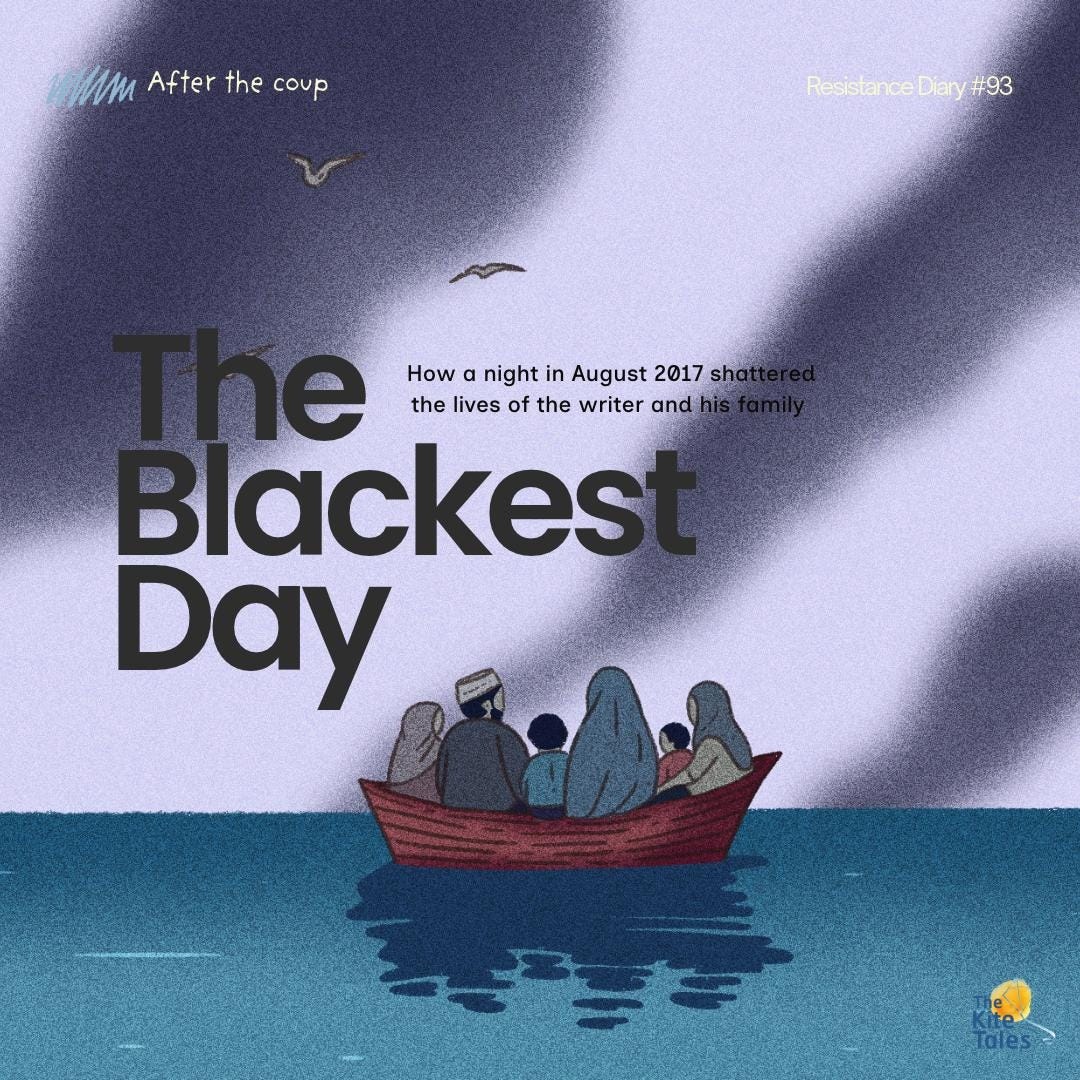
I want to end with a diary from The Kite Tales.
Some of you already know I co-founded a non-profit storytelling project a decade ago, at the height of Myanmar’s opening, called The Kite Tales. At that time, we had two main aims: to document the lives of ordinary people who were denied a voice for so long, and showcase the amazing diversity that makes up my country.
Since the 2021 coup, when journalism became more and more dangerous, we have been financially supporting journalists and illustrators both inside and outside the country.
This week, we published a story from a Rohingya writer who had to flee his home in Northern Rakhine State because of the events in 2017 and has been living in “an open-air prison” ever since. It is titled “The Blackest Day”.
“I imagined my death countless times. For fourteen days I felt as though I was in the jaws of a crocodile and my death was just one bite away. There was nothing in our hands to eat. We drank crap-stained water. We slept on the grass with insects,” he wrote.
This is just a single - albeit vivid - account of what it was like. Multiply it by some 700,000, the estimated number of Rohingya who were displaced in the aftermath.
Yesterday’s judgement cannot turn back the time, but I hope it will at least act as a salve to those who have endured so much, and encourage others in their pursuit of accountability.

Thin’s Pickings
COP31 stalls on agriculture, leaving food talks in limbo until 2027 - Devex
The headline says it all, but in case you need more on why this is so intractable, Elissa Miolene wrote: “Conversations on food security touch trade, tariffs, and production - all of which could impact agricultural policies - and that could make countries wary of adopting language that could constrain them.”
Ignoring how small farmers manage bird flu is a recipe for disaster - GRAIN
A warning to governments and experts on how neglecting smallholders and protecting industrial poultry interests could make bird flu an even bigger threat.The Right to Food vs. Food Security vs. Food Sovereignty - LinkedIn
This post from Juan Echanove Echanove, lead for the FAO’s Right to Food team, is a clear and concise explanation of the differences between the three and how they are related.
It is time the government treated hunger and obesity as two interlinked problems - The Guardian Letters
Letter from Professor Kent Buse of the World Obesity Federation is short, sweet, and does what it says in the headline.
Gates Foundation faces reckoning over AGRA - Mail & Guardian
Sheree Bega wrote about the criticism from faith leaders and UN experts on the philanthropic foundation’s continued support for an initiative that has failed to achieve its goals to reduce food insecurity.
Why is food so expensive? - Offshoot
A Growing Culture did a write-up about the webinar I moderated last month,

As always, please feel free to share this post and send tips and thoughts on bluesky @thinink.bsky.social, mastodon @ThinInk@journa.host, my LinkedIn page, or via e-mail thin@thin-ink.net.