

The big news in Europe this week is the European Parliament voting to deregulate new genomic techniques (NGTs) and rejecting amendments by farmers’ groups and organic sector representatives that would have placed limits on patents and full traceability for some plants.
How you take the news depends on which side of the debate you’re on. GM Watch warned of opening “the floodgates to a wave of patents”, small-scale farmers’ union ECVC said the EU has “betrayed farmers, consumers and seed SMEs”, but Syngenta’s Head of Europe hailed it as Europe “finally” choosing innovation.
My own position on GMOs and NGTs has shifted over the years - I used to be firmly against them, but now I see them as one of the tools in our toolbox - but my opposition to the weaponisation of Intellectual Property rights, the foot-dragging over traceability and transparency, and the corporate concentration of the seed sector remains firm.
It’s also telling when a vast majority of supporters for a policy happen to be some of the world’s biggest conglomerates who will financially benefit from it. Anyway, watch this space.
By the way, I’m in London next week for Climate Action Week and moderating the event, “Who keeps rainforests standing?”, on June 23. If you’re in London too and want to chat food and climate, drop me a line.
If you’re lost among the myriad of LCAW events, Oliver Camp has created an incredibly helpful list of food systems-related sessions. Find them here.

Time for another round-up of interesting reports and papers and there’s an obvious theme here.
It’s mostly to do with our current farming systems: their wastefulness, their contribution to climate change, and how, despite outwardly defending them, the industry is well aware of their problems and have found a convenient solution in the form of “regenerative agriculture”, a woolly term that can mean many things to many people.
But there’s also a small ray of hope: alternative systems already exist and are thriving. We don’t have to be held hostage by our lack of imagination or our fear of the unknown.
Stuck In A Fertiliser Trap We Can’t Get Out Of
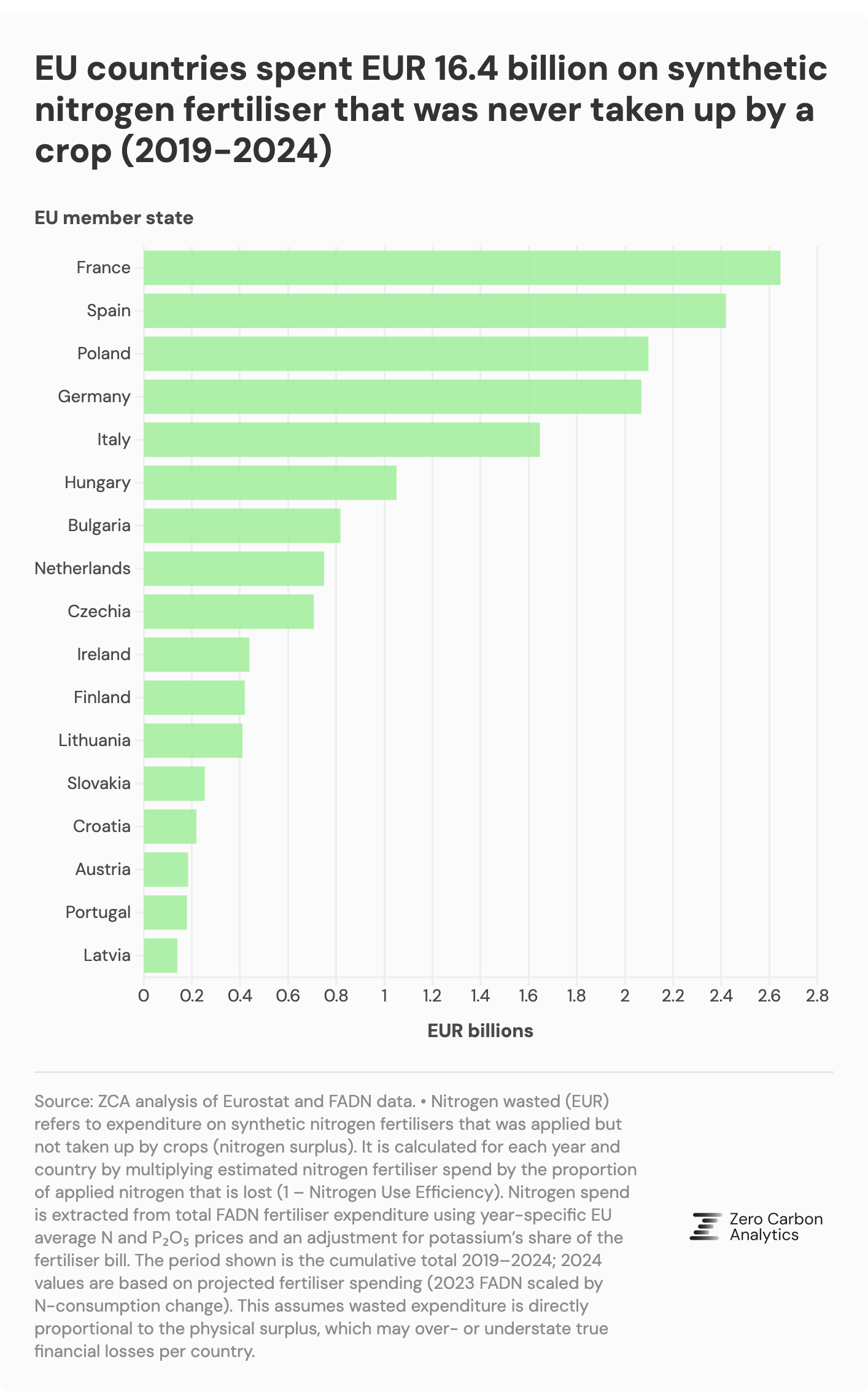
Between 2019 and 2024, European farms spent 16.4 billion Euros on synthetic nitrogen fertiliser that never reached crops, according to a new briefing on Europe’s structural vulnerability to energy markets from Zero Carbon Analytics (ZCA), an international research group on climate change.
The excess nitrogen fertiliser not taken up by the plants then leaked into rivers and streams, leading to nitrate contamination of groundwater and excessive water pollution. Instead of becoming food.
The analysis puts a number on the cost of Europe’s gas‑based fertiliser dependency, both in terms of wasted money and strategic vulnerability. It also shows how those costs could be reduced and make the food system here more resilient and sovereign.
“Total environmental damage costs from synthetic nitrogen losses were EUR 233.7 billion across the six-year period, with water pollution accounting for 79% of total estimated costs and air pollution accounting for the remainder,” the briefing said.
“If public support were redirected from sustaining the current input‑intensive model toward helping farmers transition to lower‑input, higher‑resilience systems, the economic and environmental gains could be substantial,” Dr Joanne Bentley-McKune, the author of the paper, told me via email.
Context 1: What do we mean by nitrogen fertilisers not reaching the crops? A 2024 special report on land said only 46% of nitrogen applied as fertiliser is taken up by the crops and the rest “runs off into freshwater bodies, and coastal areas with dire consequences for the environment”.
So the 17 countries Joanne and her team studied are above the global average, because based on Eurostat’s official Gross Nutrient Balance data, the nitrogen use efficiency ranged from about 65 % to 72 %.
It still begs the question: how are we happy with a scenario where the best case is losing a third of what you put in and the worst is losing more than half?
But EU’s efficiency is nullified by the scale of its use.
“Efficiency (NUE) is a ratio; it doesn’t tell you about scale. Because the EU applies so much nitrogen, even that ~30 % loss translates into billions of euros and large volumes of gas. Other regions might have lower efficiency but far lower total inputs, so their absolute waste is smaller. That’s an important nuance,” Joanne said.
Context 2: Fossil fuels are responsible for nearly 60% of global fertiliser production, with mined ores providing feedstock for the rest.
Context 3: Europe’s ammonia industry runs almost entirely on natural gas which means volatility in the energy markets affects fertiliser prices and production. Given the high level of fertiliser usage - estimated at 10 million tonnes a year - it is not only a chronic drain on resources but also translates into 14.1 billion cubic metres of natural gas wasted.
“This wastage represents a triple loss: farmers pay for inputs that never reach crops; natural gas – burned at great cost as a feedstock to synthesise fertiliser – is consumed for no productive purpose; and the synthetic nitrogen applied to croplands, whether it reaches a crop or not, causes environmental damage costing society billions of euros every year,” the paper said.
Some nitrogen loss is unavoidable, but the waste we’re seeing also “acts like a multiplier”, said Joanne. “When gas prices spike, farmers pay more for all the nitrogen they apply, including the share that never feeds a crop, making the system more sensitive to energy shocks than it needs to be.”
The top spenders - or losers, take your pick - during the period were France, Spain, Poland and Germany, together accounting for more than half the value of all the states included in the analysis. They represent some of Europe’s largest arable producers with large-scale intensive crop production.
“Even though their nitrogen‑use efficiency is relatively good (around 70%), the sheer volume of fertiliser applied means the absolute waste is large,” Joanne said.
“For example, Netherlands is one of the most intensive agricultural producers in Europe, but it doesn’t appear as high on our wasted‑spend chart as France or Germany. That’s not because it’s more efficient (in fact, its nitrogen‑use efficiency is lower, around 55 %) but because the Dutch system is dominated by livestock, so most of its nitrogen comes from manure, not from synthetic fertiliser.”
European farm unions have been incredibly vocal about keeping fertiliser prices low and availability high because farmers are facing enormous cost increases. But maybe we should rethink a system that has made them vulnerable in the first place,
“The problem isn’t just that fertiliser is expensive but that the whole system is built on a volatile gas‑based input. Every time there’s an energy shock (whether it’s the invasion of Ukraine or the Hormuz closure) fertiliser bills spike and farmers are hit.”
“If we keep subsidising that dependency, we’re essentially paying to preserve the vulnerability that causes the crises.”
Proven, cost effective tools and measures already exist to reduce synthetic fertiliser dependency and diversify nitrogen inputs, she said, citing precision nitrogen application, legume rotations, and crop varieties that need less nitrogen.
The briefing also gave two examples: South Africa, which applies only a third of the synthetic nitrogen fertiliser per hectare as France but achieves 78% of France’s cereal yields, and Paraguay, which applies a similarly quantity through nitrogen-fixing legumes, and produces 76% more grain per kilogram than France.
If you want to read more on fertilisers, here are my previous issues: The Fertiliser Trap, Path to a Livable Planet, Food Systems, We Have A Fertiliser-Induced Problem!

We’ve Got To Sort Our Rice Growing Together
Net greenhouse gas emissions from rice paddies have doubled over the past 70 years, including a 44% increase in methane emissions, primarily due to more land being used to grow rice, using more inputs (both chemical and organic), and cropping more often (up to three times a year in some countries), according to a new global assessment.
Over the past decade, that amounted to about 1.1 billion tons of carbon dioxide-equivalent emissions per year on average, roughly equivalent to the annual emissions of 239 million cars, said the study’s authors.
“This makes rice-growing the largest emissions source in agriculture outside of livestock, and rice demand is expected to keep rising,” they wrote.
This is an important paper, because while we have a plethora of studies and exposés into the close relationship between methane, which is 80 times more potent than CO₂ over a 20-year period, and livestock, there is much less discussion around rice cultivation.
In the grand scheme of things, livestock still emits much more methane than rice paddies - 30% versus 8%, excluding emissions from manure - but we’re in an “all hands on deck” moment and methane’s short-lived nature means the quicker we can reduce its emissions, the better for us.
Unfortunately, the paper is behind a paywall (urggghhhhhh) and I wasn’t organised enough to get a copy from the authors in time for this issue, so I’m basing this write-up on their op-ed in The Conversation and the LinkedIn post of Pep Canadell, executive director of the Global Carbon Project and one of the authors.
The expansion of rice growing areas is responsible for over half of the global increase in emissions. For example, Africa has roughly doubled its acreage since the 1960s. However, specific practices also play a role.
The authors identified how leaving rice stalks in the field after harvest and then ploughing them into the soil to improve soil fertility was responsible for about 18% of rice’s increase in overall net emissions since the 1960s.
Flooded rice fields remain a key contributor: the organic matter inside them breaks down without oxygen, produces methane, and escapes into the air as the plants grow.
This type of rice accounts for over 90% of the rice we consume and its production, particularly in Asia, “contributes approximately 80-90% of global rice methane emissions”, said Hayden Montgomery, Program Director for Agriculture at The Global Methane Hub, who was not involved in the study.
Rice not grown in flooded conditions have lower yields but there are efforts to change that through varieties that can still be productive in non-flooded conditions, Hayden told me in an e-mail.
Heavy reliance on synthetic nitrogen fertilisers - usage up 76% after 2000 - also led to rice paddies emitting more nitrous oxide (N₂O), 300 times more powerful than CO₂ and the main man-made substance damaging the planet’s protective ozone layer.
The authors of the paper wrote listed practices such as reducing fertiliser use and residue applications, managing irrigation to allow dry periods in between flooded ones, and reducing tillage, as ways to lower emissions.
However, the reduction is fairly small - only 10% - and switching from chemical to organic fertilisers does not necessarily improve the situation, at least from the emissions perspective. Also, the benefits from no-till farming is very much region-dependent, they said.
In his LinkedIn post, Pep made an important suggestion: “Rice cultivation, as is also the case for other GHG sources associated with food production, needs to be a prime target for Research & Development, as we don’t have enough abatement options at hand yet.”
As a voracious rice eater - have I mentioned I once had the nickname “Powered by Rice”? - I hope others take note.

Regen Ag: A Long Way Down To Nothing At All?
Two recent reports from two main corridors of power - Washington and Brussels - looked at the buzz around regenerative agriculture from different angles.
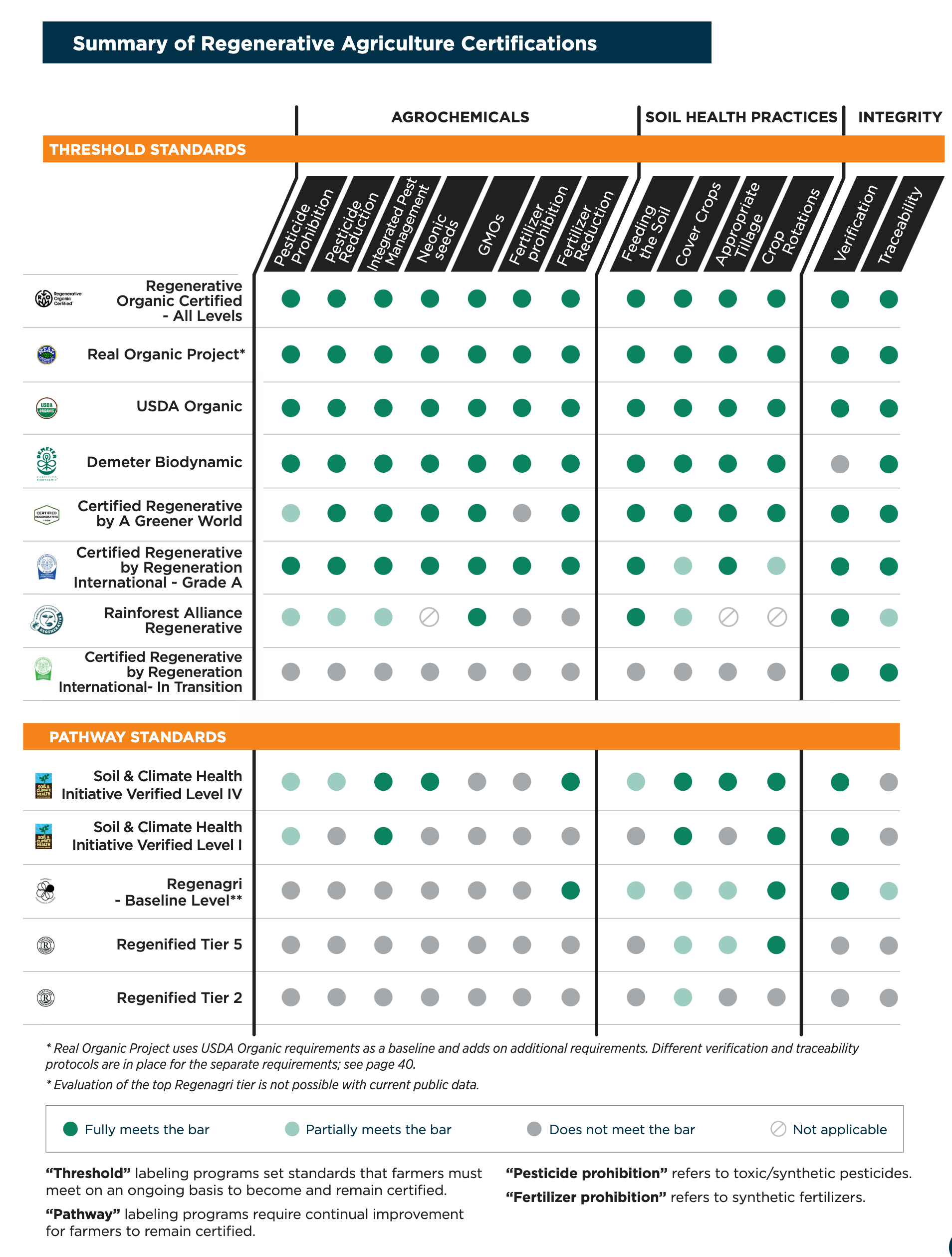
Friends of the Earth (FOE) United States evaluated 10 prominent regenerative food labelling programs to see how they stack up in terms of key parameters: reduction and/or phase out of harmful pesticides and fertilisers, building soil health, verifying farmer practice, and tracking product from farm to shelf. There’s a short summary.
Corporate Europe Observatory (CEO), meanwhile, traced how it became a buzzword in Brussels, exposing how agrochemical giants and global food and agribusinesses are pushing for a type of regenerative agriculture that will allow them to continue polluting, poisoning, and profiting. The PDF version is here.
The Labelling Report Card
“We found that regenerative labelling programs vary widely in their agrochemical restrictions, soil health requirements, and verification systems. Some programs are able to provide strong assurance to consumers and purchasers about the finished product, others provide strong assurance about practices on the ground, while others don’t have transparent or robust enough verification models to guarantee either.”
In other words: it’s a bit of a mess.
Some labels allow toxic pesticides, even though many consumers are likely to assume that the term “regenerative” means such products are not used.
The evaluation for agrochemicals is the most detailed part of the report, broken down into seven different aspects: prohibiting pesticides, reducing their use, integrated pest management, prohibiting synthetic fertilisers, reducing their use, and the use of GMOs, as well as seeds coated with neonicotinoids, a class of insecticides associated with extensive threats to soil organisms and pollinators.
More than a third of the labelling schemes failed to meet the bar on these standards.
Soil Health, broken down into feeding the soil, cover crops, appropriate tillage, and crop rotations, fared better, with almost all labelling schemes at least partially meeting the bar in one or more categories. The same is true for verification and traceability.
Overall, labels that build on organic standards and ethos are the most reliable, the analysis found.
FOE’s analysis also included three other pillars of regenerative agriculture - whether the label includes criteria related to 1) deforestation, 2) animal welfare, and 3) social fairness, including farmworker rights and protections.
“The growth of regenerative labels reflects shortcomings in current agricultural policies, which continue to favour industrial, chemical-intensive farming systems rather than supporting regenerative practices at scale,” said FOE.
Who’s Creating the buzz?
Since late 2024, the pesticide, dairy, and big food industries have lobbied the European Commission, using the concept of regenerative agriculture to promote practices such as the continued use of synthetic pesticides and chemical fertilisers that are linked to environmental harm, said CEO.
Leading the charge are some of the best-known food and farming conglomerates (Bayer, Syngenta, Yara, Cargill, Unilever), their associated financial institutions (Rabobank), and industry groups, it added.
It specifically identified groups such as the Forum for the Future of Agriculture (FFA) (co-founded in 2008 by Syngenta and the European Landowners Organisation), One Planet Business for Biodiversity (whose members include Nestlé, Unilever, Microsoft, and Google), and projects such as the Sustainable Agriculture Initiative (SAI) platform, which has 190 global food and farming companies including ADM, Danone, PepsiCo, McDonalds, etc.
These entities have repeatedly met with the European Commission to push for a particular type of regenerative agriculture: “outcome-based” which, instead of setting management practices for farmers to follow, “allows flexibility and context-specificity in the approach to achieve desired outcomes” as per the SAI platform.
But watchdogs like CEO and green groups point out that measuring outcomes is incredibly complex, costly, and time-consuming, and worry this is just a backdoor to the continued use of harmful - and wasteful - agrochemicals.
“Despite the existence of an organic community with governing stakeholders (farmers, consumers, conservationists, retailers, processors, inspectors, and scientists) that has evolved over at least seven decades and is codified in the Organic Foods Production Act (OFPA) of 1990, the term “regenerative” is now increasingly being advanced as a loosely defined alternative to the organic standard and label, which is transparent, defined, certified, enforced, and subject to public input,” the report said.
The private sector is also pushing for more support for regenerative agriculture under the EU’s Common Agricultural Policy (CAP), the bloc’s €380 billion farm subsidy programme, and some industry groups have suggested that their own frameworks could be used to determine which farming systems qualify for CAP support, according to CEO.
Groups like Agroecology Europe fear the prospect of private standards shaping the distribution of public funds, with research and investment flowing towards self-defined private initiatives.
“Regenerative agriculture is the new buzz word, and provides a smoke screen for agrobusiness to conceal destructive monoculture practices and input-intensive ways of doing agriculture. It’s a bit like fossil fuel companies such as Exxon saying “yeah but we are also investing in fuels from algae” while keeping 98% of their income from fossil fuels,” Yogi Hale Hendlin, Public Health Scientist at Erasmus University in Rotterdam, told CEO.
Andhra Pradesh Shows We Don’t Have To Be Stuck
For once, let’s end the newsletter on an upbeat note.
This year’s Food Planet Prize - the world’s largest environmental award, worth $1.5 million - went to Andhra Pradesh Community Managed Natural Farming (APCNF), “for its role in leading one of the most ambitious transitions to agroecology ever undertaken”.
Those who follow agroecology know APCNF well. For the uninitiated, the prize committee summed it up well.
“Over the past ten years, 1.8 million farmers in southern India have joined what is now one of the world’s largest transitions to natural agriculture - and the numbers keep growing.”
“Launched by the government of Andhra Pradesh, APCNF works through women’s collectives and a network of over 10,000 farmer trainers to help smallholders abandon synthetic inputs in favour of natural farming practices rooted in soil science and traditional knowledge. Year-round cover cropping and pre-monsoon dry sowing are among the methods being adopted across more than 8,000 villages.”
Since its launch in 2015-2016, this closely-watched and much-lauded agricultural programme said it increased farmer incomes by up to 66% over time and reduced greenhouse gas emission up to 46% per acre.
But don’t just take their word for it. A true-cost accounting study using the EU’s TEEBAgriFood framework found that adopting APCNF led to greater crop diversity, similar or higher yields, higher incomes, lower input costs, improved local economies, improved social networks, and reduced health costs.
APCNF said it “dedicate this recognition to the women farmers, self-help groups, community resource persons, farmer scientists, and community leaders whose commitment and leadership transformed a vision into a people’s movement.”
“This recognition is not the culmination of a journey. It is the beginning of a larger global movement. The Food Planet Prize will help us strengthen research, empower farmer scientists, share knowledge, and build pathways for countries seeking sustainable regenerative agricultural transformation.”
Thin’s Pickings - Health-Harming Foods Edition
How Big Tobacco helped design Lunchables - and gave birth to the ultra-processed food industry - Fast Company
This news article is perfect for those who don’t have the time to go through the recent blockbuster issue of American Journal of Public Health focusing on UPFs. This piece focuses on one of the articles that linked how R&D from the cigarette business was used to make ultra-processed foods that were designed to be hyper-palatable and encouraged overeating.
A single, mandatory warning label on unhealthy foods is key to a joined-up approach to obesity - BMJ
Christina Vogel, professor of food policy and director, Centre for Food Policy, argues that the UK public is confused over different nutritional information available in different settings: while buying prepackaged foods, visiting restaurants and takeaway chains, or eating in schools.
“This patchwork of policies… enables dishonest marketing that can cause confusion, as companies can add misleading claims such as “healthy,” “organic,” or “added vitamins,” even if a product is (high in fat, sugar, or salt) HFSS.”Harms of Framing Obesity as a Disease of Individuals - JAMA Health Forum
Three public health scholars on why current obesity framing “reinforces food, pharmaceutical, and wellness industry communication strategies emphasising obesity as a problem requiring medical treatment, rather than prevention” and ignores “food environments individuals find themselves in, which are shaped by government-set laws and financial incentives for the food industry”.

As always, please feel free to share this post and send tips and thoughts on bluesky @thinink.bsky.social, mastodon @ThinInk@journa.host, my LinkedIn page, twitter @thinink, or via e-mail thin@thin-ink.net.
If current food production and distribution models are to survive (esp in the US), they must adopt a balanced social contract. Consumers cannot be expected to have a PhD in chemistry in order to read labels and avoid toxins. The poison in US food is banned in most other countries. Not here. As a result we are sicker and spend more on sick-care than any other nation. It starts with clean natural food.
Big Agra/Food merely seeks profit and revenue growth above all. Once upon a time, representative governments placed responsible (dare I say “thoughtful”) curbs on these animal instincts. Today, they seek to patent seed, ration water and even air. Maybe corporatism and its inevitable consequences have been given enough rope. The 'useless eaters’ turn out to have real utility beyond profit maximization. And they are exhausted with global oligarchs and corporatist meddling.