
What I’ve Been Reading: Food, Power, and Policy Drift
A round-up of reports you may have missed

It’s been known for a while that past ambitions to make European food systems fairer, healthier, and greener are now firmly behind us. Still, it was both infuriating and deeply sad to see the Sustainable Food Systems initiative officially “abandoned” last week, despite over 2,600 public responses.
Professor Andreas Rasche at Copenhagen Business School called the decision “deeply flawed” and pointed out that 92% of respondents supported coordinated action.
It can feel like we’re regressing on many fronts, but instead of going into my shell and hibernating for the next three years (or however long), I am doubling down on strengthening my communities, celebrating the wins, and supporting people doing good work.
That includes the Earth Negotiation Bulletin, whose incredibly useful reporting on environmental negotiations has helped me on many occasions. If you find it equally useful, please consider donating to support their independent, neutral conference coverage.
I’m heartened too that the UN Human Rights Council has appointed Sofía Monsalve (on Thin Ink) as the new Special Rapporteur on the right to food. The current SR, Michael Fakhiri, has done a tremendous job and I look forward to Sofia’s tenure.
Also, I’ll be in Oxford later this month for the Skoll World Forum, moderating a panel of inspiring women farmers and innovators. If you’ll be there and want to talk food systems, please come say hello.

Head In The Clouds: Challenging the false promise of digital agriculture and cultivating innovation from the ground up
“Lock-in” is a concept in technology and business that we’re now familiar with: a situation where a particular product, service, tech, or platform becomes so widely adopted that it becomes progressively harder, more costly, and more complex to switch to alternatives. We are then stuck with adopting each subsequent product, service, or tech just to keep up.
This IPES-Food report takes the idea of technological “lock-ins” seriously and traces what it actually means for the people who grow our food, especially when technological solutions are being sold as a silver bullet to many wide-ranging and complex issues threatening our food systems.
This isn’t a gotcha document or a Luddite screed, but a careful, structurally rigorous examination of who controls agricultural innovation, whose knowledge counts, and what gets systematically left out, and how, in the process, we may be accelerating the deskilling and the loss of lived knowledge.
I find the report most compelling when it goes beyond the individual products to show how this new frontier - where Big Tech meets Big Ag - is as much about narratives that make certain technologies feel inevitable as it is about the technologies themselves.
“Innovation” has, as the report notes, become a cure-all buzzword, today synonymous almost exclusively with AI, precision agriculture, bioengineering, and automation. But innovation is deeply political, and it reproduces specific systems of power.
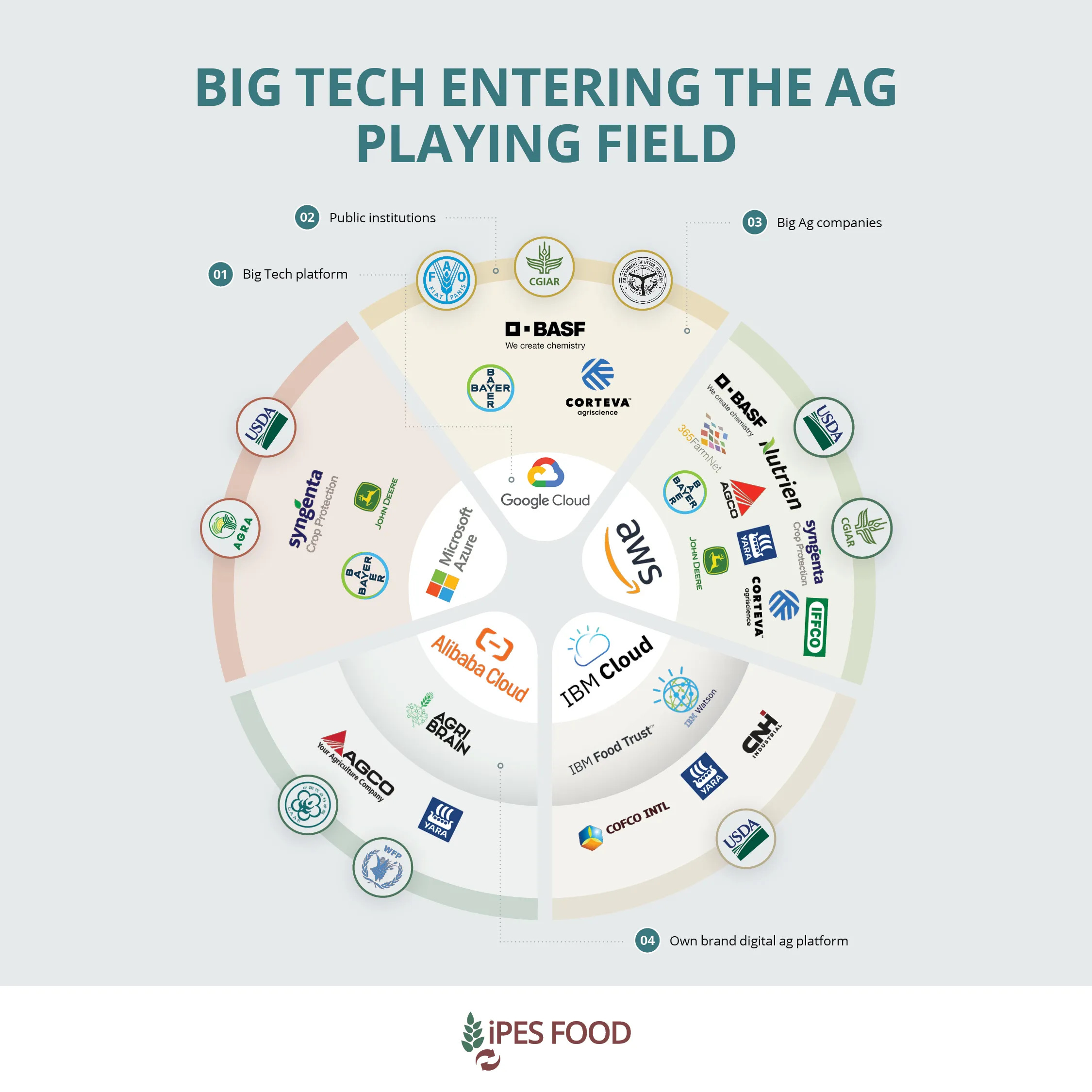
“A powerful new alliance between Big Tech corporations (including Google, Microsoft, Amazon, and Alibaba) and Big Ag firms is rapidly gaining control of farming under the guise of innovation,” it warned.
“Big Tech and Big Ag firms are turning farmers’ knowledge and work into profit, while farmers lose control over their own data. Digitalisation is outsourcing farmer decisions to distant algorithms, with little accountability. Control over data is thus becoming a new source of power and profit in agriculture.”
This op-ed in Civil Eats touches on similar themes, while Raj Patel, a member of IPES-Food, has published a piece on his own Substack covering the report.
The report breaks these dynamics down across three paired innovations - remote sensing versus manual tools for soil health; precision spraying versus ecological pest management for crop protection; gene-edited seeds versus peasant seed systems for climate adaptation.
In each pairing, the pattern is strikingly consistent: the corporate-led solution gets the billions in public and private R&D, the regulatory frameworks, the extension services, while the farmer-led alternative is systematically undervalued, underfunded, and in some cases actively criminalised.
Remote sensing tools, for instance, tend primarily to benefit large-scale monoculture farms and require the continuous capture of vast quantities of data, even though such data does not exist independently of the values and interests embedded in how it is gathered and interpreted.
Meanwhile, manual tools - time-consuming, difficult, and historically part of the exploitation of agricultural labour - are not straightforwardly solved by automation either, since mechanisation has a documented tendency to push women out of farming entirely.
But the report points to examples of farmer-led tools that allow them agency while improving working conditions. It also reminded me of one of my favourite TEDx talks from the heyday of Myanmar’s opening.
“The aim here is not to romanticise physical labour nor is it to reject high levels of mechanisation outright. Instead, it is about asking how to build farming systems where manual work is safe, valued, and supported.”
This is a theme that is repeated elsewhere in the report: it’s not a rejection of technology per se, but asking hard questions about ownership, agency, and dependence: who owns these tools, who designs them, and whose futures they are built to serve?
For example, every year, between 20% - 40% of global agricultural production is lost to pests and diseases. Clearly, we need to find ways to protect our plants. But are chemicals - the predominant response since WWII - the only answer? Is precision spraying with drones the necessary next step in a system where chemicals are now locked in?
Why aren’t we trying ecological pest management, by contrast, which works by preventing outbreaks in the first place through agrobiodiversity, crop rotation, and biocontrol, many of which also have the added benefit of improving soil quality? Maybe because it remains systematically underfunded? And is that because there isn’t a corporation that can profit from it so it doesn’t get intense lobbying?
On gene editing, the report points out how, despite the promotion of CRISPR and its cousins as climate solutions, the majority of gene-edited crops under development target traits for commercial appeal, shelf-life, or compatibility with chemical inputs, not climate resilience.
Meanwhile, “by positioning gene-editing as the benchmark of science-based innovation and painting resistance as ‘anti-science’ or ‘anti-innovation’, proponents of gene-editing reinforce knowledge hierarchies between biotechnology and its alternatives, including peasant and Indigenous seed systems.”
At the same time, the global minority countries that refuse to ratify or aren’t fulfilling their promises on international treaties designed to protect farmers and indigenous communities are pressuring Global South governments to adopt IP and seed laws that effectively lock smallholders into systems of patent payments and licensing fees.
Today, the six largest commercial seed and traits companies control close to two-thirds of the global market, and the top four also rank as the leading agrochemical companies. The concentration is a feature, not a bug. If you’re interested to learn more about seed sovereignty, see here and here.
The path the report sketches is not technophobia but something more demanding: a genuine reckoning with whose innovations get recognised, resourced, and protected, and whose remain hidden from view, whether it’s ecological pest management, or peasant seed systems that have been adapting to local conditions for centuries.
“Innovations tend to reinforce the system in which they are developed, whether extractive or inclusionary, corporate-driven or farmer-led, industrial or place-based.”

Capitalising (on) industrial epidemics: examining the influence of the ‘Big Three’ asset managers on corporate governance in key health-harming commodity industries
Australian researchers led by Benjamin Wood examined the influence of Big Three asset managers (BlackRock, Vanguard, State Street), which between them own shares in thousands of listed companies worldwide, on the governance of 40 major corporations in industries that harm human health. These include ultra-processed food manufacturing, intensive meat production, fast food retail, and agrochemicals.
The findings are, frankly, damning:
“In 2024, the Big Three overwhelmingly voted against proposals calling for the incorporation of social and environmental objectives into the policies and strategies of these corporations, and invariably voted in favour of proposals seeking to boost shareholder payouts and authorise political activities.”
Not only that, despite well-documented evidence of their fossil-fuel-based activities, Exxon Mobil and Coca-Cola (“one of the world’s largest users and polluters of fossil fuel-based plastics”) appear on funds marketed as climate-friendly.
The authors analysed the voting behaviour of the Big Three in 2024 with respect to shareholder and management proposals.
Apparently this emerging form of corporate governance is called ‘asset manager capitalism’ whose main aim is maximising the total monetary value of assets under their management.
We’re talking trillions of dollars: the Big Three currently manage close to US$25 trillion in assets, equivalent to “more than 20% of the global gross domestic growth generated in 2024”.
What this means is that they can influence corporate governance in a variety of ways and they’ve used it to “routinely vote against shareholder proposals aimed at incorporating social and environmental objectives into corporate decision-making”.
“Similarly, the Big Three have consistently opposed public health-related shareholder proposals aimed at major ultra-processed food and commercial milk formula corporations.”
However, they “voted in favour of all 20 of the identified management proposals relating to authorising shareholder payouts, as well as political donations and expenditure”.

Corporate Vectors of Chronic Disease — Using Internal Industry Documents to Craft Counterstrategies
A growing body of research is reframing how we understand public health, not as a matter of individual choice, but of corporate design.
According to the Consortium of the Center to End Corporate Harm at the University of California, San Francisco, five industries - fossil fuels, tobacco, ultraprocessed foods, chemicals, and alcohol - are linked to 31% of global deaths each year. These are not incidental harms but systemic outcomes, shaped by how products are produced, marketed, and regulated.
At the core is what the authors describe as the “commercial determinants of health,” closely tied to political systems that allow corporate influence to shape policy. Drawing on more than 24 million internal documents from six industries, the research identifies three recurring strategies: controlling scientific knowledge, influencing regulation, and shaping public narratives.
Knowledge Capture: Chemical giants DuPont and 3M suppressed evidence of PFAS toxicity for decades, despite early internal findings linking the substances to organ damage and birth defects. Employees were reassured there was “no known evidence” of harm, even as data suggested otherwise—allowing widespread exposure to continue.
In another case, the sugar industry funded research that redirected blame for heart disease onto saturated fats, obscuring sugar’s role. This helped shape decades of dietary guidance, even as sugar-sweetened beverages became a major driver of global obesity.
Regulatory Capture: Tobacco companies worked through front groups like the “Consumer Tax Alliance” to oppose cigarette taxes, recruiting other industries to give the impression of broad public resistance. They also partnered with alcohol industry actors to undermine clean air laws.
Shaping the public narrative: Tobacco firms such as R.J. Reynolds and Philip Morris, after acquiring major food brands, applied cigarette-marketing strategies to food—reformulating products, expanding flavour lines, and targeting children. Products like Hawaiian Punch were repositioned from cocktail mixers to brightly branded children’s drinks, while ultra-processed foods came to dominate supermarket shelves.
The paper doesn’t stop at diagnosis. It outlines five key counterstrategies:
Increase transparency on corporate funding of research through publicly accessible databases.
Require open science and mandatory registration of all industry-funded studies.
Prohibit financial ties between industry and researchers, with independent public funding models.
Protect policymaking from corporate influence, similar to tobacco control frameworks.
Ensure scientific advisory bodies are free from conflicts of interest.
Resilient Food Systems Index
This inaugural index by Economist Impact, supported by commodity giant Cargill, covers 60 countries and evaluates country performance across four pillars that go beyond the availability of food: affordability, availability, quality & safety, and climate risk responsiveness.
It includes a report and an interactive index you can play around with. It “provides a benchmark of countries’ capacity to produce and deliver sufficient, affordable and nutritious food amid increasingly frequent, severe and interconnected risks”, according to the publishers.
“No country in the index is insulated from shocks or long-term pressures. Climate risk responsiveness and food availability are areas of weakness across most countries in the index,” it said.
Key findings:
A handful of countries dominate food production: 15 countries produce 70% of the world’s food, and 11 of those are also key exporters, making the system highly exposed to disruptions in just a few places.
Climate preparedness is the weakest link, just as countries’ exposure to intensifying climate shocks grow.
Early warning systems are not strong enough: many countries lack reliable systems to predict and prepare for disasters, meaning shocks are often anticipated but not managed.
Pest and disease management is uneven: only about one-third of countries are well-prepared to deal with pests and crop diseases.
Brazil is a rare exception, and the report credits the country for “the adoption of agritech solutions”, pointing to application of nature-based solutions with “digital precision” and how “large swathes of Brazil’s crop belt rely on AI-enabled platforms, which fuse satellite imagery, weather data and field-level scouting to flag pest pressure early and guide precisely timed interventions”. (Interesting to see this in light of the IPES-Food report above.)
Food may be “affordable,” but not necessarily nutritious. Healthy diets are still out of reach for many, often costing two-thirds of income for poorer households.
Cheap food is often unhealthy: ultra-processed, low-nutrient foods are more accessible and heavily marketed than fresh, nutritious options.
Even high-income countries struggle with diet quality: the U.S. ranks 51st out of 60 countries on dietary diversity, due to its high consumption of low-nutrient foods.
Farmers lack basic services: access to credit, banking, infrastructure, and markets remains limited in many countries, holding back resilience.
Food waste solutions exist but lack investment: most countries have strategies, but underinvest in basics like cold storage, leading to continued losses across supply chains.
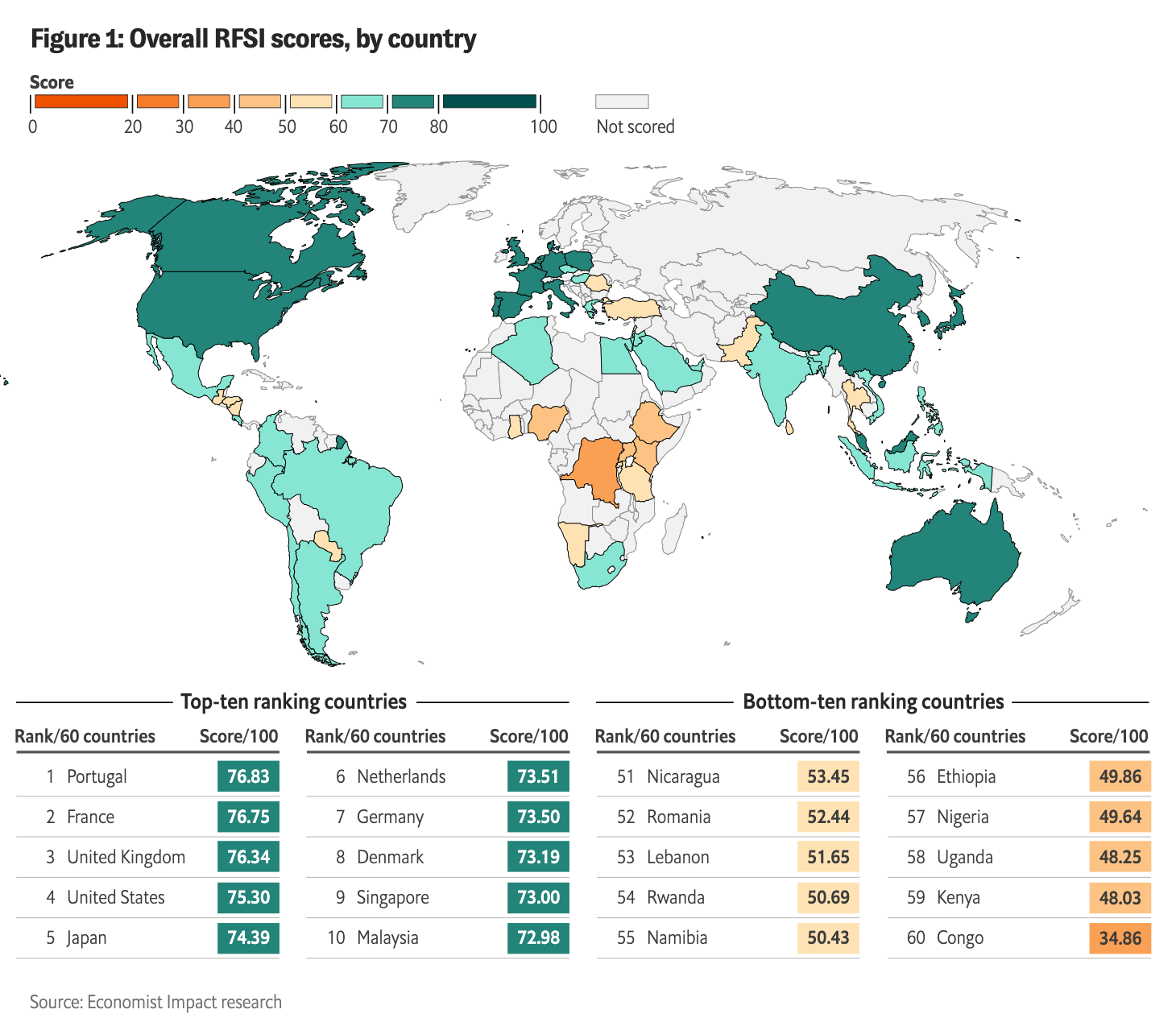
The Index also listed an overall ranking of all 60 countries, with Portugal coming out top. I was surprised to see the UK at number three, however, because it seems to go against recent news and reports that point out major challenges and gaps in UK food systems. These include DEFRA’s unpublished report covered in The Times, the ECIU’s 2025 analysis, and a recently published paper in Sustainability that called the UK food systems “a tinderbox”.
I reached out to Economist Impact for comment, but due to the long Easter break in many countries, I didn’t receive a response before publishing. I hope to come back to it.
‘Climate adaptation and mitigation in the agri-food system – Recommendations for coherent EU policies’,
At nearly 360 pages, the European Scientific Advisory Board on Climate Change report is not designed for casual reading. Given limited time and attention, I focused on the recommendations, summary, and Chapters 1, 2, 6, and 10.
That was sufficient to understand its central argument: Europe’s agri-food system is nowhere near on track.
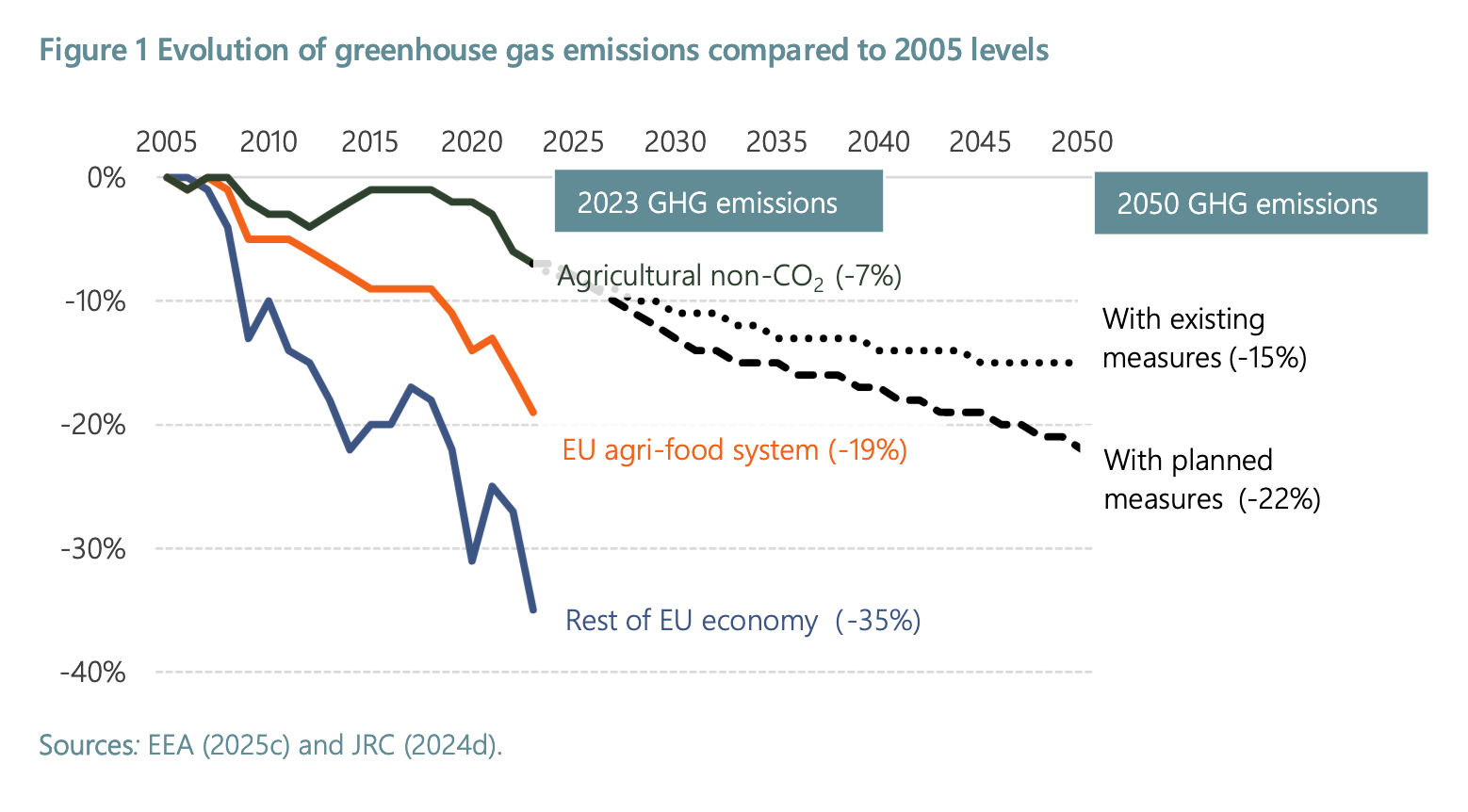
Agriculture sits at the heart of the climate challenge, responsible for roughly a third of EU greenhouse gas emissions. Farming itself accounts for the majority of this, driven largely by livestock, fertilisers, and land use. Despite this, progress has been slow, particularly for non-CO₂ emissions, which have barely declined since 2005.
Policy, the report suggests, is part of the problem. The Common Agricultural Policy (CAP), with its €50 billion annual budget, remains the EU’s central agricultural tool. But its climate impact is limited. Much of the system still incentivises production in ways that are misaligned with long-term climate goals.
“Taken together, the current EU policy framework lacks the coherence, strength of incentives and governance mechanisms needed to steer a systemic transition of the agri-food system.”
“Only a systemic transition, featuring both structural and technical change, can climate-proof the European agri-food system.”
The key word here is “systemic”. Incremental reform - tweaking subsidies, adding new schemes - is not enough.
The risks are not abstract. Climate impacts on European agriculture are already visible and are projected to intensify. Southern Europe, in particular, faces severe water scarcity, with availability potentially dropping by up to 40% under higher warming scenarios. In some cases, current farming systems may simply become unviable.
What stands out is the report’s insistence on both structural and technical change. It gives six key recommendations.
Phasing out CAP payments that incentivise the most greenhouse gas-intensive practices, while exploring alternative income-support mechanisms consistent with climate objectives.
Introducing a dedicated greenhouse gas pricing mechanism for the agri-food system, applying the polluter pays principle gradually and adaptively, while recycling revenues to support farmers and reward carbon removals.
Providing targeted transition support to help farmers overcome financial and knowledge barriers.
Strengthening tools that help farmers cope with unavoidable climate impacts.
Promoting healthy, climate-friendly diets and reducing food waste.
Ensuring adequate and timely public funding to finance the transition.
Diet is a particularly striking inclusion. The report links current consumption patterns - high in red meat and ultra-processed foods - not only to emissions but to public health costs, estimated at €530 billion annually.
Reading it, it’s hard not to think about what’s missing: the now-abandoned Sustainable Food Systems initiative (see preamble), and the Farm to Fork Strategy, many of whose policies remain unimplemented.
The EU policy landscape is fragmented, still struggling to connect agriculture, health, and climate into a coherent whole. The decision-makers continue to insist on loosening regulations in the name of cutting red tape and increasing competitiveness, while seemingly unaware of - or uninterested in - how these moves may be undermining the bloc’s resilience.
Without deeper structural change, the EU risks locking itself into a system that is both environmentally unsustainable and increasingly fragile and eventually forced to adapt under pressure rather than by design. By then, it may be too late.
Thin’s Pickings
Pitchfork politics and sausage-making: how the farmers ‘crisis’ rewrote EU green rules behind closed doors - EU Observer
I’ve written ad nauseam about how the farmers’ protests got hijacked so it’s great to see Natasha Foote’s investigation into how the EU’s once-ambitious environmental policies were undone in a way that was quite unprecedented.
Seeds of doubt: The dark side of an Italian energy giant’s green jet fuel promise - Politico
How Kenyan farmers who were enticed by the idea of higher income from planting caster seeds instead of something they can eat - like maize - were left holding the bag when harvests failed and buyers who recruited them on behalf of Eni, Italy’s biggest oil company, disappeared.
What (Who) is Driving Up Food Prices? - IPES-Food & Lighthouse Reports
Thought it might be timely to reshare this webinar from last year, where Jennifer Clapp, my colleague Margot Gibbs, and yours truly talked about how to investigate food prices in a time of polycrisis.

As always, please feel free to share this post and send tips and thoughts on bluesky @thinink.bsky.social, mastodon @ThinInk@journa.host, my LinkedIn page, twitter @thinink, or via e-mail thin@thin-ink.net.