

There are two big events happening next week, so I’m in a bit of a headless-chicken mode at the moment.
I’ll be in New York early next week for Climate Week, participating in A People’s Forum on Food, Land, Forests & Finance on Sep 22 and Tilt Collective’s Food Day on Sep 23.
I’ll then rush back to Torino for Slow Food’s Terra Madre Salone del Gusto, where I’ll be moderating the session on Food Justice And The Taste For Power on Sep 25.
If you’re in any of these places, drop me a line!
I realise I’m overdue for another round-up of big reports, but this week I want to focus on two new papers whose findings reinforce each other.
A Conscious Decoupling: Shock & Resilience
Whether weather-related events, natural disasters, pandemics, wars, or economic troubles, conventional wisdom has it that the bigger the shock, the higher the chances of disruption to our lives, jobs, assets, and food supplies.
For example, recent food-system troubles, from rising food and fertiliser prices to stubbornly high levels of hunger and malnutrition notwithstanding gains in the last two global reports, have often been linked to shocks: COVID-19, Russia’s invasion of Ukraine, the U.S.-Israeli war on Iran, and El Niño.
But a new study that came out this week - one of the first global empirical assessments of what underpins food system resilience - challenges this assumption. In fact, it shows that a large-scale shock does not need to lead to worsening hunger.
“Decoupling food insecurity from shocks: a global analysis of food system resilience” (thankfully not behind a paywall) is authored by a coalition of food systems experts spanning five continents and multiple disciplines.
Published in PNAS, it uses a large dataset from the Food Systems Countdown Initiative (FSCI) to conduct a multi-country, multi-year analysis - from 2011 to 2019 - across 87 countries.
Here are my four key takeaways from this paper.
A bigger shock doesn’t mean more hunger
The image below is based on a different analysis using a larger sample of countries (105 rather than the 87 countries in the main analysis) and plots the severity of shocks (increasing from left to right) against the average deviation from the mean food insecurity level between 2011 and 2019.
Countries that are exposed to more severe shocks (on the right-hand side of the graph) do not necessarily display higher levels of food insecurity than other countries.
Countries that are wealthier (indicated by darker bubbles) are not always more resilient. More on that in the next point.
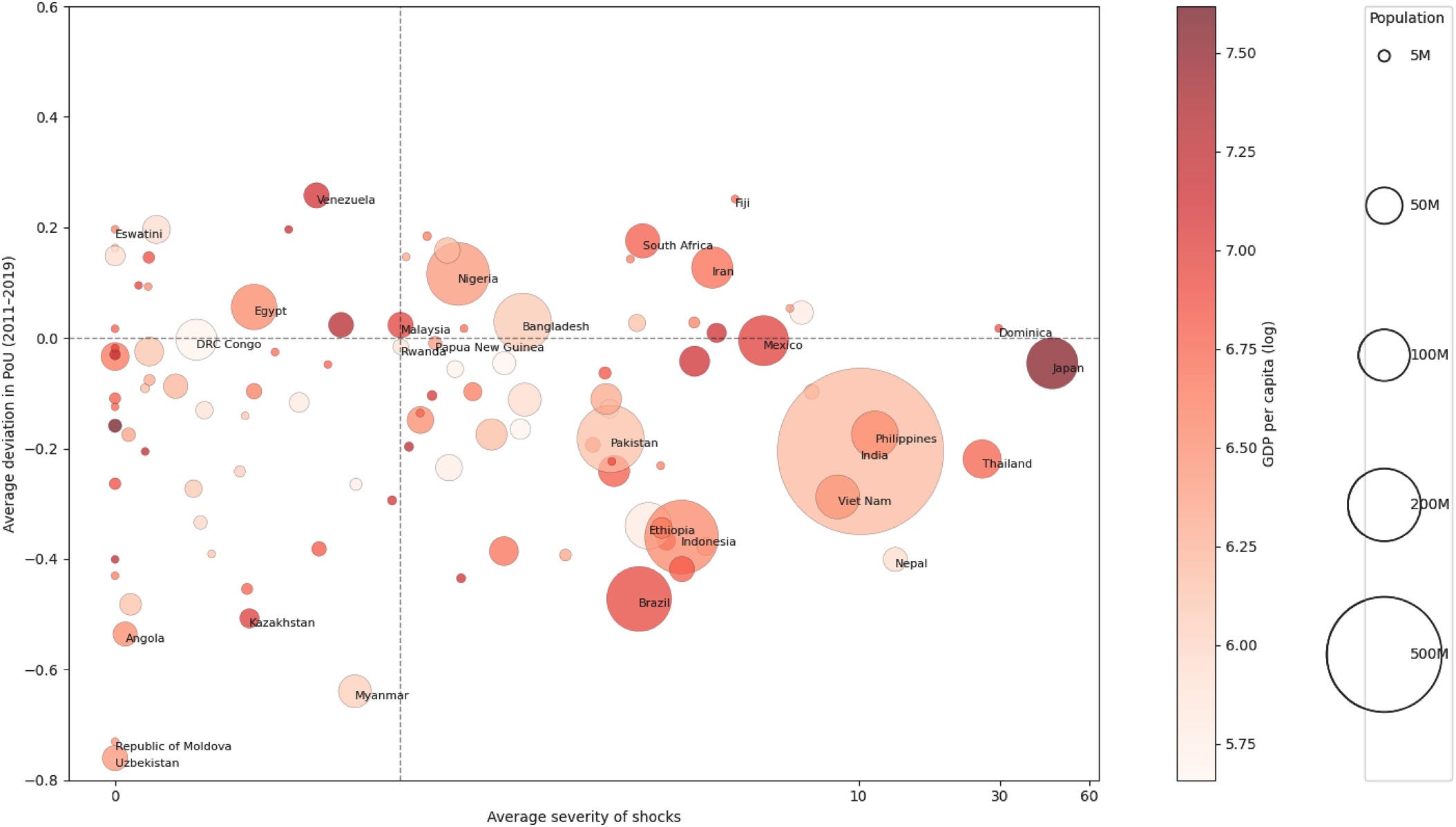
“There’s a tendency for all of us to assume that a bigger disaster means a bigger food security impact. What the figure shows is that the reality is more complicated,” said Chris Béné, lead author and Senior Policy Advisor with the International Center for Tropical Agriculture (CIAT) and Wageningen University & Research.
The authors were surprised by the findings, which showed that “shocks are only part of the story”, he told me in an interview.
“Shocks matter, but the consequence is not predetermined…. There’s no systematic relation between the severity of the shock and how the countries are doing in terms of food security,” he told me in an interview.
It’s resilience, stupid
“Instead, what is important, what matters, is how capable the country’s food system is in absorbing that shock, which is basically resilience,” Chris added.
“Resilience is what breaks or at least weakens the link between the shock and the consequence in terms of food insecurity.”
The paper defines resilience as “the ability of the actors of the food system to maintain, protect, or recover the system’s long-term outcomes (food security) in the face of adversity, through their capacities to cope, adapt or transform. As such, resilience builds on actors’ agency and system’s emergent properties.”
But measuring resilience is hard, because governments usually monitor the upstream part - the production - and the downstream part - the nutrition and food security - and almost nothing about how the system functions “in the middle”, said Chris.
“That’s why it’s been quite a challenge to identify indicators that could help us understand how it works. And very few of (the existing) indicators are really what you would dream of if you were to try to better understand resilience. They’re more of what we call proxy indicators. That’s why not many papers had managed to look at that issue because it’s a huge endeavour to put those data together.”
Wealth doesn’t necessarily determine resilience
In the image, GDP per capita is denoted by the colour of the dots: the higher the figure, the darker the dots.
Again, there isn’t a clear pattern on who is more resilient from shocks.
Sure, Japan is a rich country in a high-shock environment and also appears to be fairly resilient. But Pakistan and Indonesia are in the same quadrant. Meanwhile, Malaysia and South Africa, which have higher GDP per capita, are not.
“Being a rich country does not automatically make their food system resilient. What seems to matter is whether countries are strengthening the capacities that allow them to respond to shocks.”
While there does not seem to be a straightforward relationship between a country’s economic development and its ability to withstand shocks, richer countries tend to have more capacity to deal with disruptions at both individual and institutional levels.
We already know what to do
“Strengthening institutional effectiveness, enhancing redundancy, and investing in social capital emerge as critical pathways for building resilient food systems in an increasingly shock prone world,” the authors said.
This sounds eminently sensible. It is also not new. This is something both academics and civil society have been banging on about for many, many years.
What is new is the weight this empirical data, done at scale, brings to the argument, which elevates it from a ‘of course, it sounds like this is what we should do,’ to ‘the data shows that doing it will actually make a big difference’.
Still, the authors didn’t go in with pre-conceived notions about what they were going to find, according to Chris.
“We were not trying to demonstrate anything. We were really letting the data tell us whether there’s something to say.”
And the data showed the role these three factors play in buffering the impact of shocks.
Government effectiveness can translate into whether governments are active, transparent, and effective in what they’re doing, while redundancy refers to diversification in the food supply, whether countries have various ways to get food: national/local production, import, trade, etc.
“The good thing is that those two key factors (government effectiveness, food supply diversity) are something that government or donors or the international community can control,” said Chris.
“You cannot control the severity of the shock, but you can certainly help government get more effective. You can help with infrastructure to make sure there is not one single route for the food - some from importing, some from domestic supply. These can be influenced by government policy.”
Social capital is far subtler but serves as a long-term foundation for resilience, which governments should continue to invest in even if the results are not immediately visible.
“One of the key lessons from Hurricane Katrina was that the neighbourhoods that were characterised by a higher level of social capital were usually faster in bouncing back... It’s been empirically and even theoretically identified as a key factors for building resilience.”
Caveat: The analysis only runs to 2019, because some of the indicators were available only up to then, so the impact of some of the biggest shocks in our recent memory - the pandemic, the invasion of Ukraine, the attack on Iran, et al - are not reflected.
For example, in the image above, Myanmar, my home country, doesn’t look bad at all. But we know that since the Feb 2021 coup, hunger levels have worsened significantly. So would more updated data provide a different picture?
Maybe. But Chris believes the latest data is likely to confirm rather than contradict these findings.
“For example, during COVID-19, African countries were heavily depending on the rice imported from India. So when India decided to cut their export, that had huge effect on a lot of African countries because they were depending on only one route for their rice.”
“So this illustrates in a negative way what I was talking about earlier, which is the importance of diversification. Same thing for the Russian invasion of Ukraine, where countries that were heavily depending on the cereal imported from the region were affected more than the countries that could turn to other supply.”
I think the same logic can be applied to Myanmar, too, where worsened food insecurity is a result of conflict, economic disruption, and the military’s attacks on civilian populations.

The Power In The Middle
“Power, value capture and redistribution by multinational traders in agri-food value chains in East and Southern Africa” was published earlier - July 30 - in the journal Competition & Change, but I wanted to put these two studies side-by-side because the second reinforces the first, particularly on government effectiveness.
Written by experts at The Centre for Competition, Regulation and Economic Development (CCRED) at the University of Johannesburg, it touches on one of my obsession topics: antitrust or competition issues.
It focuses on the mid-stream value chains for maize and soybeans - two crops that are integral for human food and animal feed - and uses data on prices, production, consumption, and trade, alongside interviews in Kenya, Malawi, Tanzania, Uganda and Zambia.
It also takes into consideration how things like government regulations, ad hoc trade restrictions, and efforts by governments and donors to address what they see as market failures end up reinforcing the unequal power dynamics.
The findings in a nutshell: large traders enjoy excessive margins while poor households and smaller players face volatile food prices.
Here are my five key takeaways.
Concentration means power, and power captures value
The paper explains how these dominant firms not only capture power but also value, using their collective market and bargaining power to shape prices to the detriment of consumers and other market participants.
Example 1: In 2020/2021, a combination of Brazil’s mega-drought and bad weather in Mexico and the U.S. pushed up international maize and soybean prices, and the situation worsened after Russia’s invasion of Ukraine.
“The movements in prices in (East and Southern Africa) countries in absolute terms were, however, much greater than changes in international prices pointing to other factors at work in addition to global shocks,” the paper said.
In fact, “the price changes and the differentials between countries within ESA are orders of magnitude greater than shocks to prices in international markets” and “the price differentials within the region are far in excess of transport and related costs”.
Example 2: When international soybean prices increased to around US$600/Mt in 2021, prices in Kenya, Tanzania and Malawi increased to over US$1200/t towards the end of that year.
“Even more perplexing was that these prices occurred alongside bumper harvests in Malawi and Zambia meaning abundant supply, and sizeable net exports including to India and UAE.”
Example 3: The authors found large price swings between harvest time - when farmers, often needing quick cash, sell their produce - and later in the year, in both Zambia and Malawi. Traders who can afford to store grain capture the difference, meaning farmers get far less than the price consumers eventually pay.
Think “Regional”, not “National”
Tackling this requires a regional rather than a national response, especially because many countries are now reliant on each other to feed their population, Arthur Mahuma and Grace Nsomba, two of the paper’s authors, said in an interview.
For instance, Kenya grows high-value products like avocados but relies on Zambia or Tanzania for staples such as maize and soybeans.
“So they have to trade with each other. But because markets are so concentrated and controlled by very few players, it means they’re also at the mercy of whatever these incumbents decide to do and how they decide to price, and Kenya has seen prices far higher than its neighbours,” according to Grace.
Market liberalisation has also produced concentrated industries, with large players expanding across borders beyond the reach of national competition authorities.
“We are saying regional competition enforcement, like from the COMESA Competition Commission, is important because they’re in a position to address why it is that Kenya is facing such high food prices when countries such as Zambia and Tanzania have surplus production?”
Arthur agrees.
Traditional competition enforcement is very much focused on national jurisdiction, but “that’s not how supply chains work”, he said. “They go beyond national geographies, beyond competitive regulation boundaries.”
It’s not just about market failures. It’s about Market Power
Governments, donors, and regional bodies tend to focus on addressing what’s considered market failures - things like incomplete and asymmetric information and high transaction costs - by launching initiatives like commodities exchanges, digital tools for farmers, and market information networks.
Yet, they fail to address the market power of dominant companies, which means these initiatives have not only failed to address the underlying problem, but in some cases, reinforced the status quo.
“Rather than market failures, it is market and bargaining power which has underpinned differential access to market information and which has enabled control over trade flows, margins and value redistribution. This power includes the ways in which information is collected and controlled through various institutional arrangements,” the paper said.
Take exchanges such as ZAMACE in Zambia, ACE in Malawi, the Tanzania Mercantile Exchange and the Kenya Agriculture Commodity Exchange, for example.
They failed to gain traction, at least partly because “multinational traders have no incentive to support the exchanges given the margins they can earn from their insider status”.
At one point, multinational maize traders supplying Nairobi and Dar es Salaam were making estimated excess margins of around 40% to 80%, while excess margins for soybeans averaged 44%, according to the paper.
What about digital tools for farmers, touted as a key solution?
“If you look at Kenya… they’ve got an abundance of apps in terms of digitalisation. But I think the key question for farmers is always: when they produce these goods, who do they then sell to?” said Arthur.
“There’s bargaining power imbalances because the traders are large and in the contexts we’re looking at, most of the farmers are smallholder farmers, where the key issue is how much can we get for a particular point in time? They don’t have storage facilities. They’re not able to export to different markets.”
“All of these initiatives are trying to create more information for the farmers, but that’s not the key problem. The key problem is when they need to negotiate for the pricing, that bargaining power level is distorted, and this is where competition policy comes to play.”
The paper singled out one initiative in particular: the Regional Agricultural Trade Intelligence Network (RATIN), set up by the East African Grains Council (EAGC) with donor support.
It published price data from 2006, but around 2021, access was restricted to a narrow subset of EAGC members.
“(EAGC) is basically an association of the large traders. So if you’re going to give resources to the large traders in terms of trying to alleviate problems in the market, it’s kind of like counterintuitive and actually reinforcing the power that they already hold,” said Grace.
Super El Niño is adding urgency to tackle this issue
While the paper doesn’t discuss the weather phenomenon, I couldn’t help but think about its implications for the region while reading it.
“What we have seen from the previous research is that when there is a drought in the southern part of the continent, there will be abundant rain in the eastern part of the continent. So if trade was working well in terms of price, then the [region] wouldn’t suffer because on balance, it will be food secure,” said Arthur.
But given the dysfunctional market dynamics, there is a risk of traders exploiting supply shocks, he added.
“(Super El Nino is) definitely a very big concern,” said Grace. “I think that actually reinforces, 1, the need for regional market surveillance, and 2, the need for transparency in markets.”
She said they are calling for an expansion of the African Market Observatory, an initiative providing data on prices, trade and production that could help producers, consumers and competition authorities across the region make better decisions and curb possible “opportunistic behaviour by some large incumbents… using the super [El Niño as an excuse to price gouge or raise prices and costs across the region”
We already know what to do
Remember the three key factors for resilience I mentioned above? One of them is government effectiveness, and to me, the consequences of its absence are glaring in this paper.
Africa now has the largest number of hungry people in the world. If we don’t want this situation to deteriorate, we need to make sure both farmers and consumers are not shortchanged. And that requires governments - including competition authorities - to be active, transparent, and effective.
“Our findings on maize and soybean markets indicate issues of market and bargaining power are central, not peripheral, to sustainability concerns in food value chains. Interventions to address skewed power imbalances are essential to complement other initiatives such as improved water management and sustainable farming practices.”
“The concentration and power relations point to a research agenda including regional market surveillance by competition authorities as part of a broader policy push to analyse the ways in which large companies shape food systems. If governments step-aside then this risks the further expansion of private regulation by lead firms, as we have found here, to control food systems transformation, continue to capture the majority of value created and undermine the ability of smaller market participants to adapt to extreme weather.”

Thin’s Pickings
Food & Farming Storytelling Fund for journalists - Sentient
Sentient, whose reporting focuses on exposing the problems with factory farming, has announced a $360,000-fund to provide direct grants to storytellers covering food and agriculture over the next two years.The Critical Minerals Linking Myanmar’s Civil War to the World - International Crisis Group
A visually arresting, satellite-imagery-driven investigation into how jade, tin, gold, and heavy rare earths tie Myanmar's civil war to global supply chains for EVs, electronics, defence and luxury goods.
There’s also this FT article (paywalled) about how Norwegian telecoms giant Telenor have been “charged with aiding crimes against humanity in Myanmar”, over allegations it handed customer data to Myanmar's military junta and later transferred sanctioned surveillance equipment when it sold its Myanmar business.
It echoes our own investigation in 2022 on how Western technology ended up in the junta's hands.What will Luke Lindberg mean for WFP and humanitarians? — The New Humanitarian
An unflinching look on how a Trump-aligned, “America First” USDA official will lead the world’s largest humanitarian agency.Devex broke the story of Lindberg’s nomination back in April and its latest newsletter provides good context and background.

As always, please feel free to share this post and send tips and thoughts on bluesky @thinink.bsky.social, mastodon @ThinInk@journa.host, my LinkedIn page, twitter @thinink, or via e-mail thin@thin-ink.net.
Thanks for posting, Thin. It strikes me that Chris is really naive if he believes: "'The good thing is that those two key factors (government effectiveness, food supply diversity) are something that government or donors or the international community can control,' said Chris. 'The good thing is that those two key factors (government effectiveness, food supply diversity) are something that government or donors or the international community can control,' said Chris." It seems like magical thinking to believe that donors can control government effectiveness and food supply diversity, as if there are no politics involved at all.