

News broke earlier this month that the EU has “agreed to ban 31 meat-like names from being used on plant-based product labels” to avoid confusion. The “veggie burger”, however, survives.
As a carnivore - albeit one who is trying to reduce her meat intake - I’ve always been perplexed by this debate. In all my years of grocery shopping, I have never accidentally bought a plant-based alternative thinking it was meat. It sounds like - dare I say it? - a narrative pushed forward by the meat lobby.
What’s even more perplexing - and aggravating - is the amount of time and political energy spent on this issue when there are so many more pressing food challenges policymakers in Brussels could be tackling.
Like the fact that 42 million people in Europe cannot afford a proper meal every two days, and that the right to food is still not enshrined in the constitutions of most EU countries.
This week’s guest post tackles that disconnect head-on. Drawing on research from community kitchens across Spain, it explores what hunger actually looks like in wealthy European societies and what it might take to guarantee access to good food with dignity.
Paola’s writing also resonated with me on a personal level because I’ve spent time in all the cities she writes about, and many of my memories of them are tied to food.
I hope you give it a read. And if you’re persuaded, consider signing the GoodFoodForAll European Citizens’ Initiative, which aims to force European leaders to finally confront the issue.
Paola Hernández Oliván is a project coordinator at Mensa Civica, working across Spain and Europe to connect environment, health, and social justice through strategic advocacy and local and European initiatives.
The queue starts forming before nine in the morning. By midday, when the doors open, it stretches down the street. This is Zaragoza - one of Spain’s wealthiest mid-sized cities, with good hospitals, a functioning metro, a proud culinary tradition - and what you are looking at, if you let yourself see it, is a food queue.
But it’s not the kind of food queue that nostalgic food writers romanticise about, outside a beloved bakery or a famous hole-in-the-wall.
Rather, this is the kind of food queue that Western governments promised they had made obsolete. People waiting, some of them for hours, in a city with a functioning social security system, in a country that helped write the Universal Declaration of Human Rights, for a single meal.
This is the Olla Comunitaria del Gancho (the Gancho Community Pot). Every Saturday, in the neighbourhood of San Pablo, one of Zaragoza’s most deprived, it serves between 150 and 200 portions for free.
The meal is always vegetarian, always built around legumes, served in reusable containers each person brings from home. There are no forms to fill in, no proof of poverty required, no means-testing at the door. In four years, they have not missed a single Saturday.
Standing in that queue, you begin to understand something that European food policy rarely confronts directly: hunger in wealthy countries does not look the way we imagine it. It is not acute famine. It is the slow, grinding arithmetic of a pension that no longer covers both rent and groceries. The single mother working two jobs yet still cannot afford a hot meal every day. The undocumented migrant who falls outside every system of state support. In Spain, a country that has signed every international treaty recognising food as a fundamental human right, yet has never enshrined it in its own Constitution, more than 6 million people are food insecure.
Europe has a well-worn response to this: Food banks, social canteens, emergency parcels. These systems do important work, but they carry a baked-in logic of charity that quietly shapes how people experience hunger and how institutions feel entitled to respond to it. To access most food aid in Spain, you must prove you are sufficiently poor, which means many others fall through the cracks: those who hover just above eligibility thresholds, those whose pride cannot absorb the bureaucratic humiliation, those whose immigration status makes them invisible to public services, those who simply don’t know the system exists.
In this gap, community kitchens have emerged over the past five years, and the COVID-19 pandemic accelerated their spread across Spanish cities.
We spent six months studying four of them. What we found disrupts comfortable assumptions about who goes hungry in wealthy Europe, and what it might actually look like to guarantee the right to food.

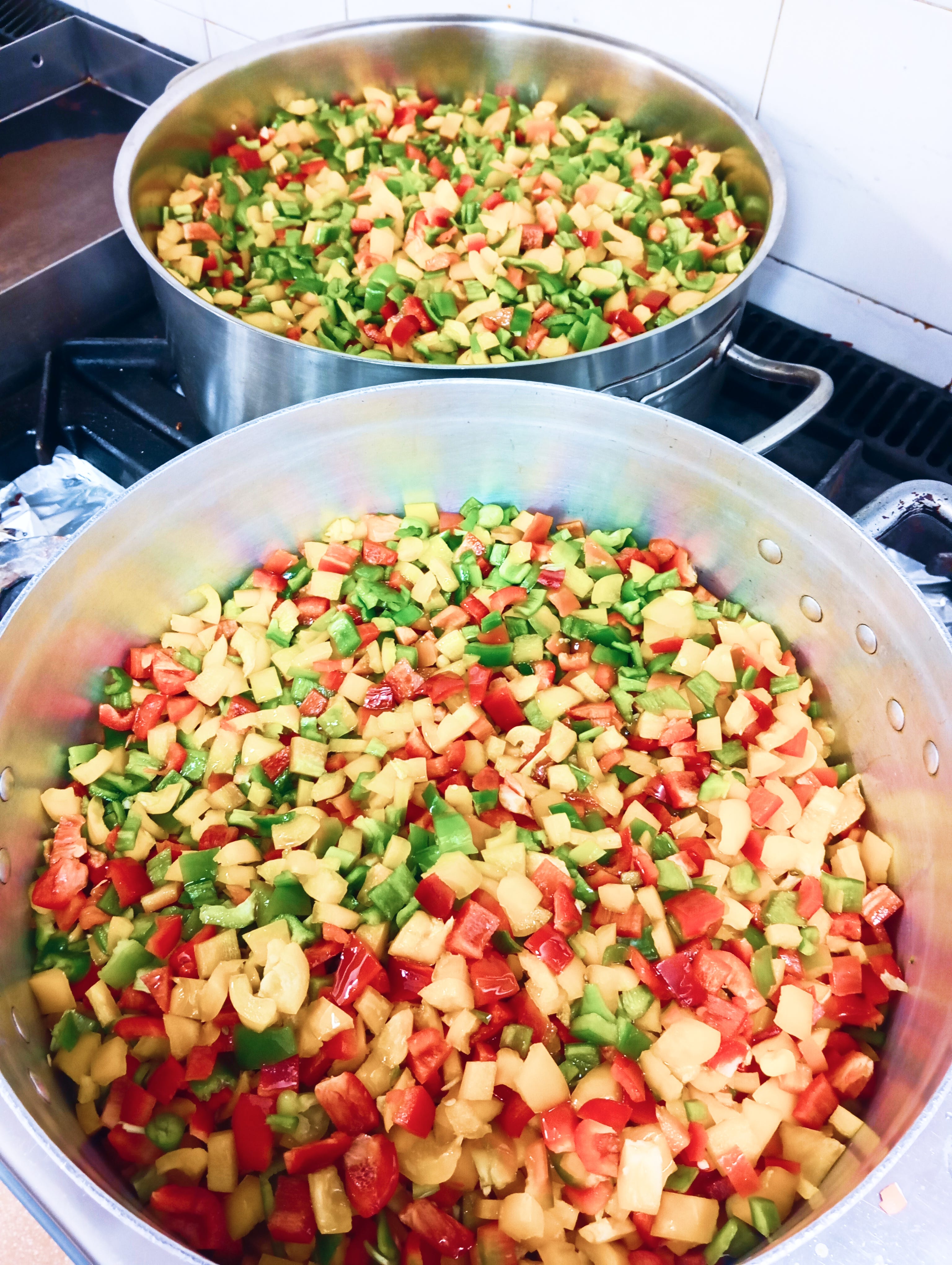
The thermopol pot at Cuina de Barri, in Valencia’s Cabanyal neighbourhood, does not look revolutionary. It is a large steel vessel, insulated so effectively that once brought to temperature it loses only one degree per hour without being connected to power. Four workers take turns to cook 220 portions a day, five days a week, but never more than four hours at a stretch. The meal costs €1.25. That price has not changed since 2020.
The Cabanyal is a neighbourhood whose existence has been repeatedly threatened. It was nearly demolished in the 1990s to extend an avenue to the sea; residents fought for decades to save it. Now gentrification is doing what the bulldozers couldn’t - pricing out families who have lived there for generations, and replacing neighbourhood shops with tourist accommodation. The community kitchen emerged as a strand in a web of responses built by a community that has learned, through hard experience, that it must organise for itself.
Cuina de Barri grew from Cabanyal Horta, an agroecological project with edible gardens growing on the ruins of houses demolished before the neighbourhood won its battle. Its founders spent five years building relationships with local producers and learning to cook seasonally before the pandemic gave them both the urgency and the pause to launch the kitchen. Their menus follow whatever the land around Valencia produces each quarter: wheat and fennel stew in autumn, and broad bean dishes in spring. More than 200 members sustain the project through monthly subscriptions.
In the cinemathic San Sebastian, Basajaun Elkartea occupies a different kind of space: a retirees’ social club that sat largely unused, in a district that lost its rural character within living memory. The Basque Country has a long tradition of communal cooking: the all-male gastronomic societies, the txokos, emerged in the 19th century as places for men to cook together away from the taverns, and which now number over 1,500 across the region.
Basajaun both inhabits and updates this tradition: members order meals a week in advance, by Thursday at noon. They choose from three seasonal dishes (vegetable, fish, or meat) plus 16 permanent plates built around pulses, pasta and rice.
The advanced order is not a minor administrative detail: it encourages diners to think about where food comes from, how it is produced, who prepares it, and what it costs. The kitchen uses software its founders built themselves to prevent any food waste: if it hasn’t been ordered, it isn’t bought. The 400 to 500 weekly portions are distributed across two neighbourhoods.
Membership costs €30 per month, plus €5 for each meal.
Each year, in a general assembly, members vote on which social cause receives the kitchen’s economic surplus — the funds left over after wages and running costs are covered — which this year means 200 free meals a week donated to another solidarity project across the city.
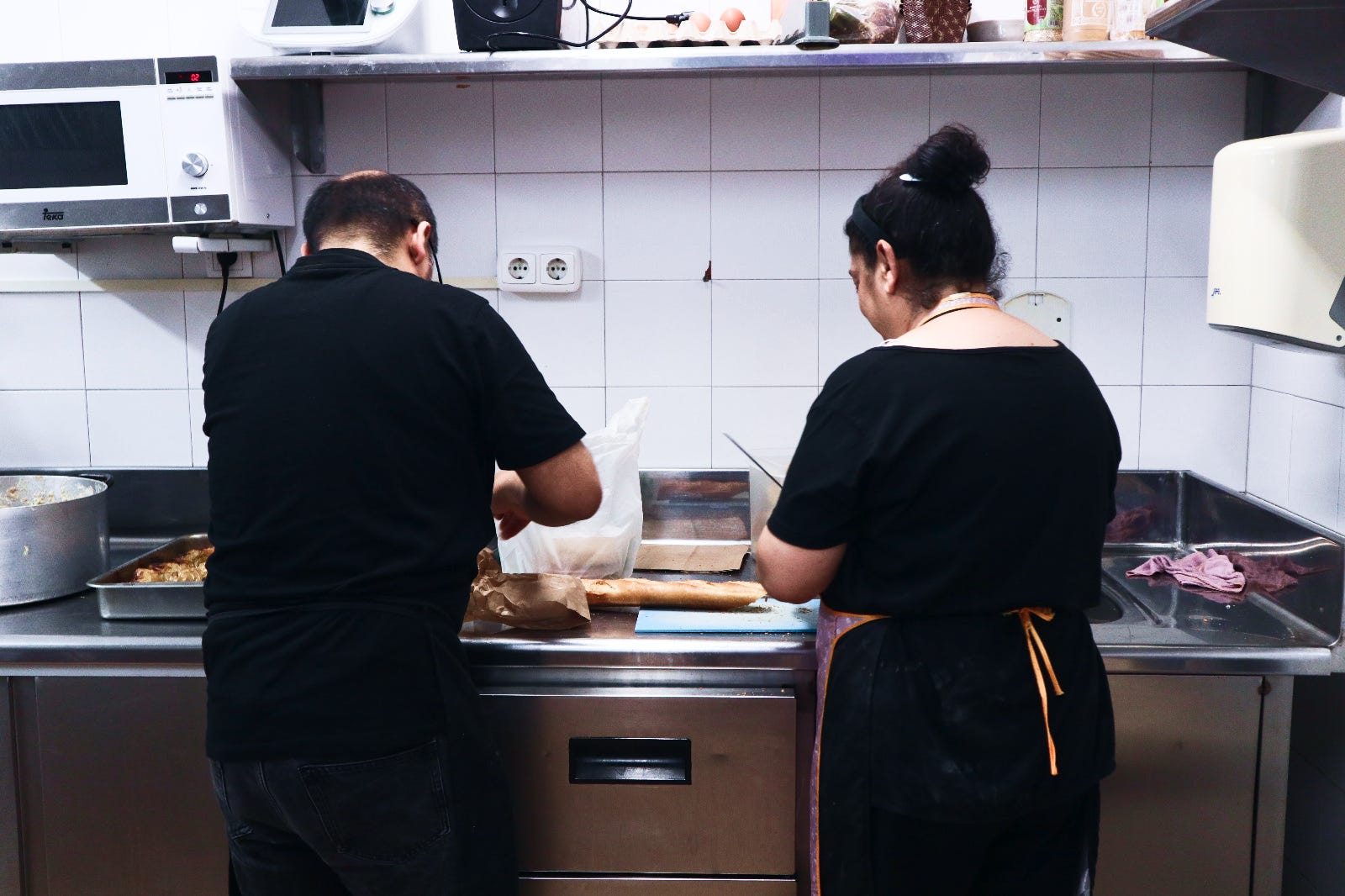
In L’Hospitalet de Llobregat, a dense, diverse, but historically overlooked municipality on Barcelona’s western edge, are three interconnected kitchens with a rich history. La Suculenta, the oldest, is a worker cooperative that employs four people on hospitality-sector wages, serving around 250 meals a week. Since its funding, it has also helped workers to navigate the administrative maze, building trust over hot meals.
A second initiative, La Xarxa de Suport (Support Network), where a vast majority of attendees are women, meets every Friday. They come bearing recipes from home, wherever that may be: Extremadura, Andalucía, Ecuador, Senegal, or Morocco. They cook together, and chat about their lives and experiences while doing so. The food becomes a medium for memory and connection across cultural distances.
The kitchens in these four cities share something beyond the cooking. They prioritise local, seasonal, organic ingredients and maintain direct relationships with farmers. They use reusable containers and are organised around the logic of food sovereignty rather than food charity. They are not simply responding to food insecurity but are challenging the agro-industrial system they believe creates it.
In doing so, they quietly prove something that European food policy debates too often treat as a dilemma: that feeding people well and sustaining the planet are not competing goals.
They are the same goal.

Across these kitchens, we surveyed 69 participants. Many were there for various reasons: economic need, support for the local economy, concern for sustainability, community, health, friendship. What surprised us more was the trajectory. Their perception of the kitchen had become more positive over time. Without exception.
One participant in L’Hospitalet told us: “We don’t just feed bodies. We feed souls and the hope that we can live differently.”
That is not the language of a social service. There are no requirements beyond being part of the community. Dignity is non-negotiable, said one organiser.
But here’s the disconnect with policymakers, who have been talking about “food security” constantly in Brussels declarations, farm-to-fork strategies, and agricultural summits. In these discussions, the term has become so elastic it risks meaning nothing at all.
More often than not, they are talking about trade dependencies, climate resilience, agricultural productivity, or geopolitical supply chains. Rarely does it mean what it means to the person in line on a Saturday morning in Zaragoza: whether you will eat today.
Food security, in European policy language, is a problem located somewhere else: in volatile markets, in droughts in the Global South, in the instability of shipping routes.
Across the EU, roughly 42 million people cannot afford a quality meal every two days, according to Eurostat (2023).
This numbers coexist with a different set of numbers: the EU’s Common Agricultural Policy budget of €387 billion for 2021–2027. The continent’s collective GDP of roughly €17 trillion. Spain’s GDP per capita of around €30,000.
The gap between these two sets of figures - between what Europe produces and what its people can access - is not a scarcity problem. It is a distribution problem. And distribution, unlike drought or conflict, is a choice.
Real food security is multidimensional: availability, access, nutrition, stability. The policy debate desperately needs to identify genuine risks to each of these dimensions and articulate strategies to address them, while also enhancing the food system’s contribution to climate mitigation, health, and biodiversity. Too often, we are told these goals conflict. Community kitchens prove, one pot at a time, that they don’t.
It is not just Spain where the right to food is absent from the Constitution, most EU member states do not have that either. In fact, the European Union, for all its sophistication in regulating food production, safety, and trade, has no legally binding framework to guarantee that its own citizens can actually access adequate food.
The pandemic made this brutally clear. As institutional support crumbled, community kitchens began sprouting in cities across Spain. Yet every kitchen we visited is in a precarious position: inadequate spaces, unstable funding, overwork and burnout, lack of institutional recognition, and in some cases, active hostility from local governments. They are doing work that institutions have abandoned, with none of the resources institutions command.
This is where the GoodFoodForAll European Citizens’ Initiative comes in. It is demanding that the European Union establish a legally binding framework for the right to adequate food, not as charity, not as conditional welfare, but as a fundamental right. The initiative calls for constitutional recognition of the right to food across EU member states, mandatory impact assessments for all EU policies that affect food access, and accountability mechanisms when governments fail. It needs 1 million signatures by the end of this year, 2026, to force the European Commission to respond.
This may sound legalese, but in real terms, it means the availability of locally, agroecologically-produced food that is nutritious, seasonal, and culturally meaningful, and the ability to access it without stigma or conditionality.
We called our study A Fuego Lento - Slow Fire - because community kitchens transform territories and lives gradually, without flashiness or headlines. But their slow burn is their strength. They are contemporary manifestations of something ancient: gathering around fire to cook, share, and build community. Spaces where heat isn’t just about preparing food, but to provide warmth to a social fabric that market forces have left cold.
Four community kitchens in Spain. Hundreds more across Europe doing similar work. One question running beneath all of it: whether we are ready to recognise them as what they are - essential infrastructure for just, sustainable, democratic food systems - and build the frameworks that allow them to thrive, rather than survive.
The fire is already lit. The pots are simmering. The question is who shows up to tend them.
This article draws from a six-month participatory study of community kitchens across Spain, conducted with support from the Daniel and Nina Carasso Foundation. The full report in Spanish is available at the website of Mensa Cívica.
Thin’s Pickings
What counts as a food story? - From the Desk of Alicia Kennedy
Sharp questions from Alicia Kennedy amid all the noise about Noma and Rene Redzepi.
”When farmworkers are facing ongoing crises and meatpacking workers are targeted by Tyson and teenagers working on hog farms die, these stories aren’t considered “food” stories. They go into sections marked “U.S.” and “Politics.” So who counts in food? Do there need to be tweezers involved? Are more people likely to have Tyson chicken in their freezer or eat at Noma (the most rhetorical question of them all)?”Why the Kids Won’t Farm - NYT Opinion
A nuanced take by Brooks Lamb on why farming in the U.S. (and much of the world) is an ageing profession, and what needs to change.
”Many people claim that millennials and Gen Z-ers don’t want to farm, that the work is too hard and dirty and that rural lifestyles aren’t appealing. While it’s true that some young people feel this way, the bigger reasons the next generation isn’t flocking to the farm are much more complicated.”

As always, please feel free to share this post and send tips and thoughts on bluesky @thinink.bsky.social, mastodon @ThinInk@journa.host, my LinkedIn page, twitter @thinink, or via e-mail thin@thin-ink.net.